
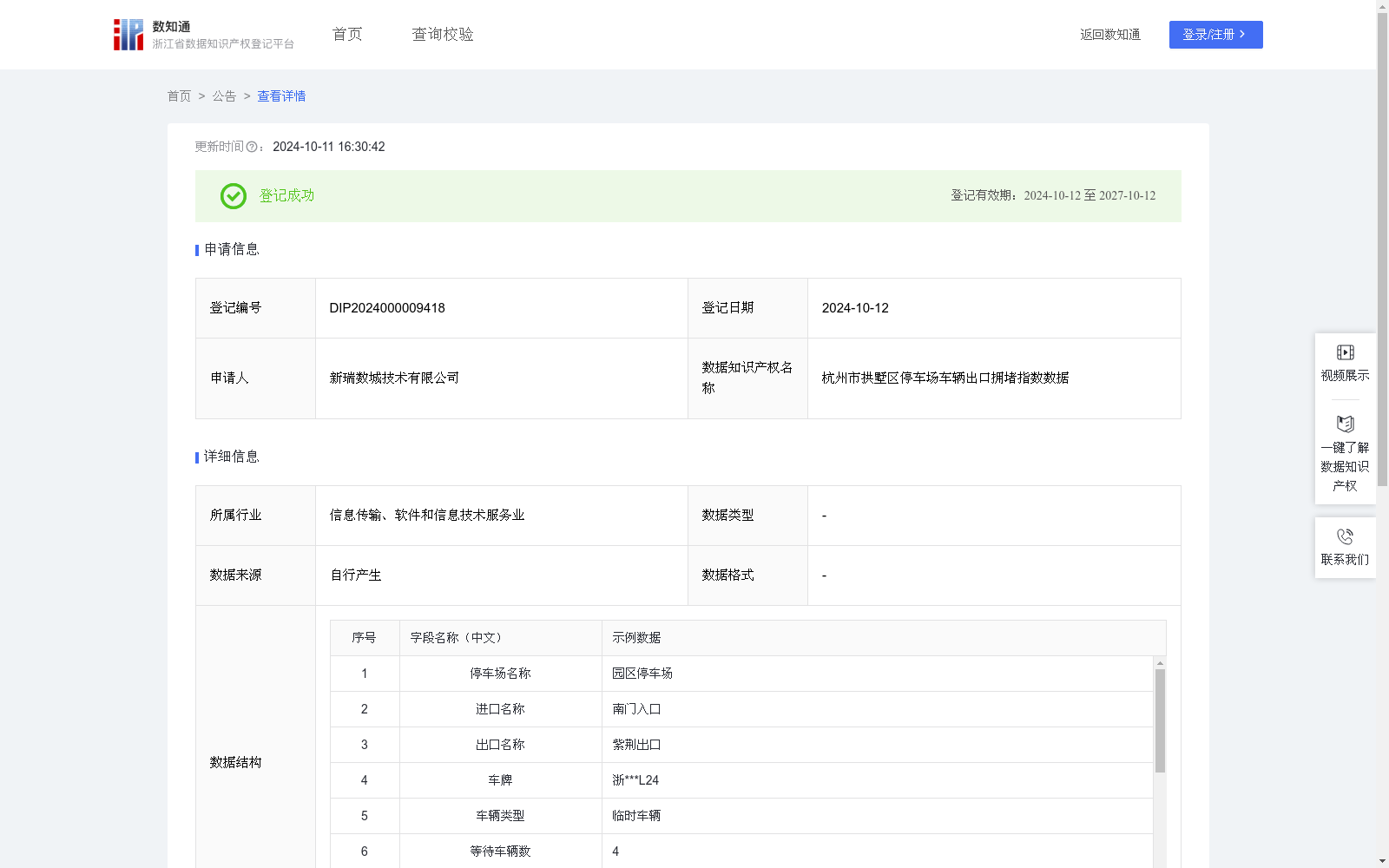
杭州市拱墅区停车场车辆出口拥堵指数数据
收藏浙江省数据知识产权登记平台2024-10-11 更新2024-10-12 收录
下载链接:
https://www.zjip.org.cn/home/announce/trends/69817
下载链接
链接失效反馈官方服务:
资源简介:
停车场车辆出口拥堵指数的应用场景非常广泛,可以帮助管理者和用户更好地理解和应对停车场的拥堵问题。下面列举了一些具体的场景:
1、实时监测与预警:
实时监测停车场出口的拥堵情况,当拥堵指数达到一定阈值时,自动触发预警系统,提醒管理人员采取相应措施。
可以通过移动应用或信息发布系统向驾驶员发送拥堵警告,帮助他们提前规划路线或选择其他停车场。一、停车场车辆出口的拥堵情况可以通过多种方式进行量化和评估。一个常见的做法是建立一个拥堵指数模型来反映拥堵程度。这个指数可以基于多个因素进行计算,包括以下几点:
1、车流量(F):记录单位时间内通过出口的车辆数量。
2、排队长度(Q):测量出口处排队等待离开的车辆队列长度。通常用车辆数量或者距离表示。
3、等待时间(T):车辆从进入排队到完成缴费并离开的时间。
4、拥堵系数(CI):一种综合评价指标,可以将上述各项指标加权求和得到。0-50通畅、50-70轻度拥堵,70-90中度拥堵、90>严重拥堵。
5、权重值(W):W1、W2、W3分别是给定的权重,可以根据实际情况调整。
二、我们使用一个简单的线性模型来计算拥堵指数(CI),该模型计算公式为:
CI=w1*F+w2*Q+w3*T
说明:F是单位时间内的车流量。Q是出口处的排队长度。T是车辆的平均等待时间。w1,w2,w3分别是给定的权重,可以根据实际情况调整。如果认为排队长度对拥堵影响最大,则可以给w2一个较高的值。
The congestion index for vehicle exits of parking lots has a wide range of application scenarios, which can assist parking lot managers and users in better understanding and addressing congestion-related issues. Specific scenarios are listed below:
1. Real-time Monitoring and Early Warning
Real-time monitor the congestion status of parking lot exits. When the congestion index reaches a specified threshold, the early warning system will be automatically triggered to remind managers to take corresponding measures. Warnings about congestion can be sent to drivers via mobile applications or information release systems, helping them plan their routes in advance or choose alternative parking lots.
1. Quantification and Evaluation of Parking Lot Exit Congestion
The congestion status of parking lot vehicle exits can be quantified and evaluated through multiple approaches. A common practice is to develop a congestion index model to reflect the level of congestion. This index can be calculated based on multiple factors, including the following:
1. Traffic Flow (F): The number of vehicles passing through the exit per unit time.
2. Queue Length (Q): The length of the vehicle queue waiting to exit the parking lot at the exit, which is typically expressed in terms of either the number of vehicles or physical distance.
3. Waiting Time (T): The time taken for a vehicle from joining the queue to completing payment and exiting the parking facility.
4. Congestion Index (CI): A comprehensive evaluation indicator obtained by weighted summation of the above indicators. The grading standards are: 0–50: Unobstructed; 50–70: Mild Congestion; 70–90: Moderate Congestion; >90: Severe Congestion.
5. Weight Coefficients (W): W1, W2, and W3 are preset weights that can be adjusted based on actual operational conditions.
2. Congestion Index Calculation via Linear Model
We utilize a straightforward linear model to compute the congestion index (CI), with the following calculation formula:
CI = w1*F + w2*Q + w3*T
Explanation: F denotes the traffic flow per unit time; Q denotes the queue length at the exit; T denotes the average waiting time of vehicles; w1, w2, and w3 are preset weights that can be adjusted per actual scenarios. If queue length is deemed to have the most substantial impact on congestion, a higher value can be assigned to w2.
提供机构:
新瑞数城技术有限公司
创建时间:
2024-09-19
搜集汇总
数据集介绍
以上内容由遇见数据集搜集并总结生成



