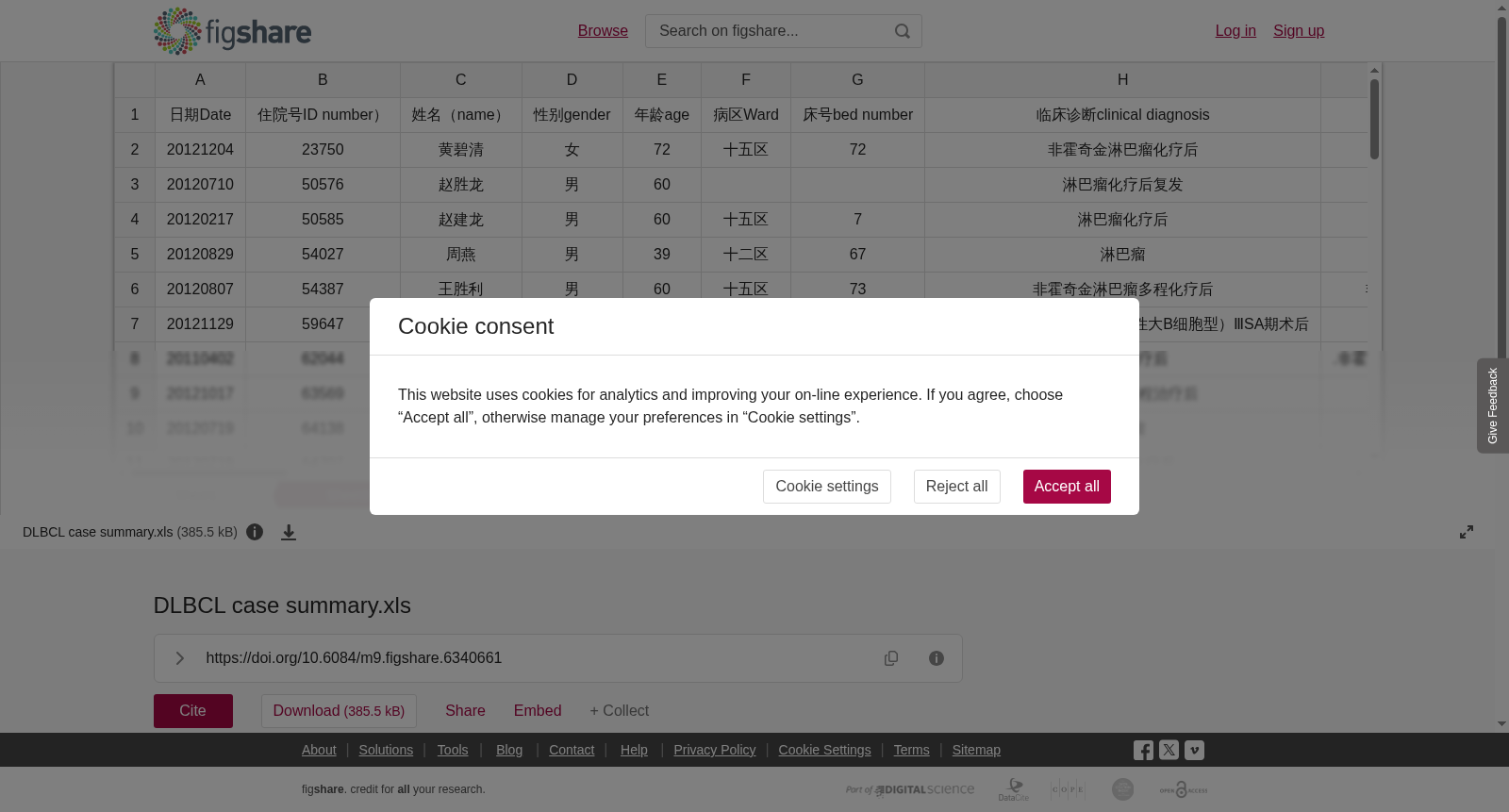
DLBCL case summary.xls
收藏资源简介:
Currently risk factors associated with chemotherapy-induced thrombocytopenia(CIT) in patients with Diffuse Large B Cell Lymphoma (DLBCL) is still undefined. Our research aims to analyse the effects of risk factors on thrombocytopenia. Moreover, it also aims to analyse the optimal threshold for infusion platelets of CIT patients who have received platelet transfusions.We conducted a retrospective analysis of 523 patients with DLBCL from 2011 to 2013 . Clinical and demographic parameters were extracted and analyse the risk factors associated with CIT. The threshold for platelet transfusions in DLBCL patients with central venous catheter (CVC) was evaluated.227 (43.4%) DLBCL patients had thrombocytopenia and 63 (12%) had thrombocytopenia without concomitant cytopenias. We identified that the choice of chemotherapy regimen was positively correlated with thrombocytopenia (p <0.001). The chemotherapy regimens that are most likely to result in thrombocytopenia were DHAP (92.3%), ICE (89.7%), GDP (89.7%) and Gemox (69%) respectively. Aside from this, high LDH (P = 0.006) and Ann Arbor Stage III / IV (P = 0.025) were determined to be risk factors leading to thrombocytopenia. 40 patients (17.6%) had transfused platelets, and all of them were placed in the central venous. The high-threshold group (Platelet count PC≤20×10<sup>9</sup>/L) has a significant lower amount of platelet transfusions than the low-threshold group (PC≤10×10<sup>9</sup>/L). The platelet transfusion amount was1.44 ± 0.77 vs 2.05 ± 1.13(p = 0.047).In conclusion,The chemotherapy regimens that were DHAP, ICE, GDP and Gemox can easily lead to thrombocytopenia. A high level of LDH in peripheral blood and Ann Arbor Stage III / IV are also risk factors accountable for thrombocytopenia. A 20×10<sup>9</sup>/L prophylactic platelet transfusion threshold value is safe and effective and a better choice for the DLBCL patients with CVC.
目前,弥漫大B细胞淋巴瘤(Diffuse Large B Cell Lymphoma, DLBCL)患者中,与化疗相关性血小板减少症(chemotherapy-induced thrombocytopenia, CIT)相关的危险因素仍未明确。本研究旨在分析危险因素对血小板减少症的影响,同时探讨接受血小板输注的CIT患者的最佳血小板输注阈值。我们对2011至2013年收治的523例DLBCL患者进行了回顾性分析,提取临床及人口学参数,分析与CIT相关的危险因素,并评估了留置中心静脉导管(central venous catheter, CVC)的DLBCL患者的血小板输注阈值。227例(43.4%)DLBCL患者合并血小板减少症,其中63例(12%)仅存在血小板减少而无合并其他血细胞减少症。本研究发现,化疗方案的选择与血小板减少症呈正相关(p<0.001)。最易引发血小板减少症的化疗方案依次为DHAP(92.3%)、ICE(89.7%)、GDP(89.7%)及Gemox(69%)。此外,血清乳酸脱氢酶(lactate dehydrogenase, LDH)水平升高(P=0.006)及Ann Arbor分期Ⅲ/Ⅳ期(P=0.025)被确定为血小板减少症的危险因素。40例患者(17.6%)接受了血小板输注,所有患者均留置中心静脉导管。高阈值组(血小板计数PC≤20×10^9/L)的血小板输注量显著低于低阈值组(PC≤10×10^9/L),两组输注量分别为1.44±0.77与2.05±1.13(p=0.047)。综上,DHAP、ICE、GDP及Gemox化疗方案易引发血小板减少症;外周血乳酸脱氢酶水平升高及Ann Arbor分期Ⅲ/Ⅳ期同样为血小板减少症的危险因素。对于留置中心静脉导管的DLBCL患者,采用20×10^9/L的预防性血小板输注阈值安全有效,是更优的选择。