
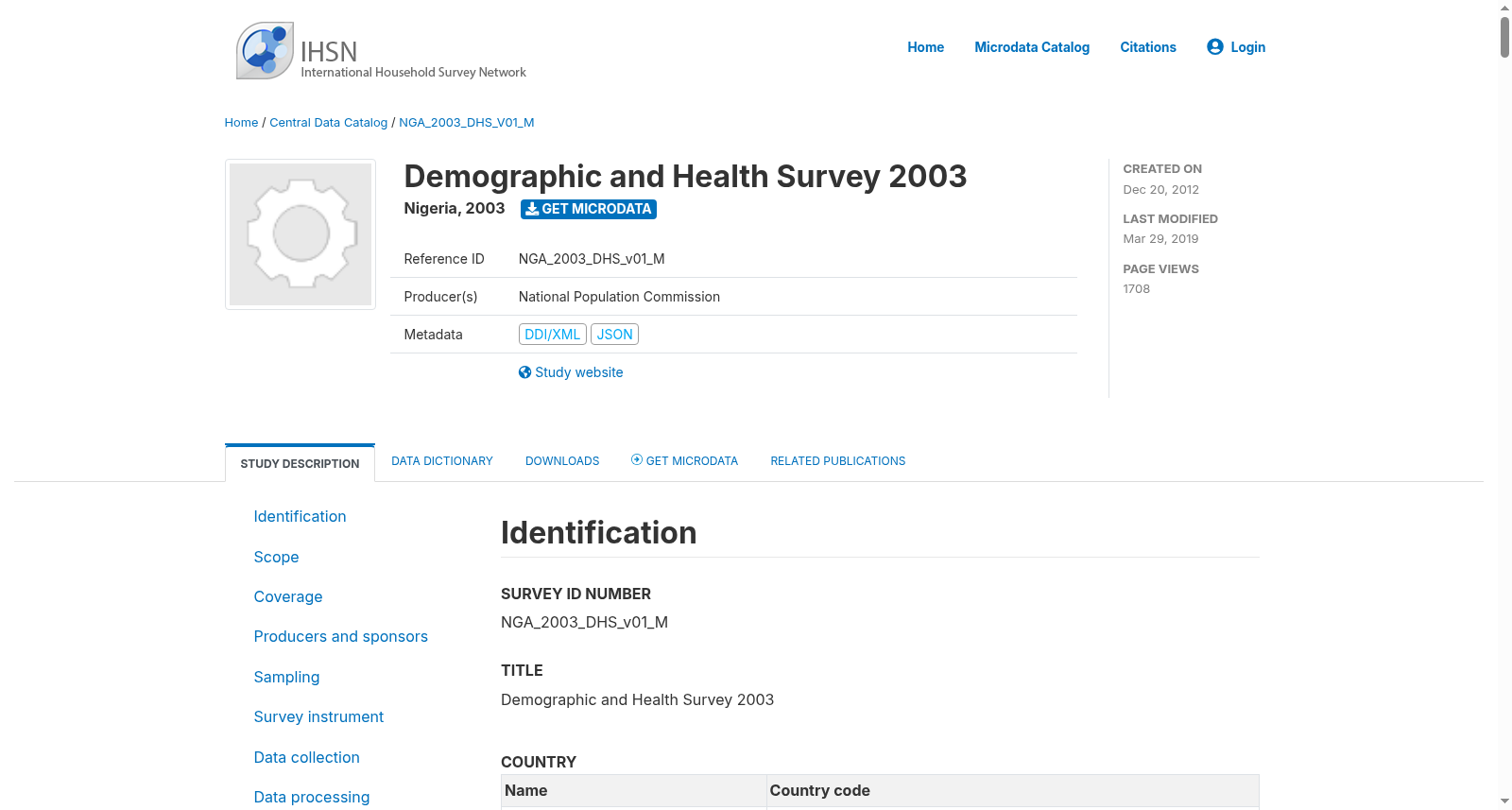
Demographic and Health Survey 2003 - Nigeria
收藏catalog.ihsn.org2019-03-29 更新2025-03-24 收录
下载链接:
http://catalog.ihsn.org/catalog/2558
下载链接
链接失效反馈官方服务:
资源简介:
Abstract
---------------------------
The 2003 Nigeria Demographic and Health Survey (2003 NDHS) is the third national Demographic and Health Survey conducted in Nigeria. The 2003 NDHS is based on a nationally representative sample of over 7,000 households. All women age 15-49 in these households and all men age 15-59 in a subsample of one-third of the households were individually interviewed. The survey provides up-to-date information on the population and health situation in Nigeria.
The 2003 NDHS was designed to provide estimates for key indicators such as fertility, contraceptive use, infant and child mortality, immunization levels, use of family planning, maternal and child health, breastfeeding practices, nutritional status of mothers and young children, use of mosquito nets, female genital cutting, marriage, sexual activity, and awareness and behaviour regarding AIDS and other sexually transmitted infections in Nigeria.
MAIN RESULTS
- FERTILITY
Fertility Levels, Trends, and Preferences. The total fertility rate (TFR) in Nigeria is 5.7. This means that at current fertility levels, the average Nigerian woman who is at the beginning of her childbearing years will give birth to 5.7 children by the end of her lifetime. Compared with previous national surveys, the 2003 survey shows a modest decline in fertility over the last two decades: from a TFR of 6.3 in the 1981-82 National Fertility Survey (NFS) to 6.0 in the 1990 NDHS to 5.7 in the 2003 NDHS. However, the 2003 NDHS rate of 5.7 is significantly higher than the 1999 NDHS rate of 5.2. Analysis has shown that the 1999 survey underestimated the true levels of fertility in Nigeria.
On average, rural women will have one more child than urban women (6.1 and 4.9, respectively). Fertility varies considerably by region of residence, with lower rates in the south and higher rates in the north. Fertility also has a strong negative correlation with a woman's educational attainment.
Most Nigerians, irrespective of their number of living children, want large families. The ideal number of children is 6.7 for all women and 7.3 for currently married women. Nigerian men want even more children than women. The ideal number of children for all men is 8.6 and for currently married men is 10.6. Clearly, one reason for the slow decline in Nigerian fertility is the desire for large families.
- FAMILY PLANNING
Knowledge of Family Planning Methods. About eight in ten women and nine in ten men know at least one modern method of family planning. The pill, injectables, and the male condom are the most widely known modern methods among both women and men. Mass media is an important source of information on family planning. Radio is the most frequent source of family planning messages: 40 percent of women and 56 percent of men say they heard a radio message about family planning during the months preceding the survey. However, more than half of women (56 percent) and 41 percent men were not exposed to family planning messages from a mass media source.
Current Use. A total of 13 percent of currently married women are using a method of family planning, including 8 percent who are using a modern method. The most common modern methods are the pill, injectables, and the male condom (2 percent each). Urban women are more than twice as likely as rural women to use a method of contraception (20 percent versus 9 percent). Contraceptive use varies significantly by region. For example, one-third of married women in the South West use a method of contraception compared with just 4 percent of women in the North East and 5 percent of women in the North West.
- CHILD HEALTH
Mortality. The 2003 NDHS survey estimates infant mortality to be 100 per 1,000 live births for the 1999-2003 period. This infant mortality rate is significantly higher than the estimates from both the 1990 and 1999 NDHS surveys; the earlier surveys underestimated mortality levels in certain regions of the country, which in turn biased downward the national estimates. Thus, the higher rate from the 2003 NDHS is more likely due to better data quality than an actual increase in mortality risk overall.
The rural infant mortality rate (121 per 1,000) is considerably higher than the urban rate (81 per 1,000), due in large part to the difference in neonatal mortality rates. As in other countries, low maternal education, a low position on the household wealth index, and shorter birth intervals are strongly associated with increased mortality risk. The under-five mortality rate for the 1999-2003 period was 201 per 1,000.
Vaccinations. Only 13 percent of Nigerian children age 12-23 months can be considered fully vaccinated, that is, have received BCG, measles, and three doses each of DPT and polio vaccine (excluding the polio vaccine given at birth). This is the lowest vaccination rate among African countries in which DHS surveys have been conducted since 1998. Less than half of children have received each of the recommended vaccinations, with the exception of polio 1 (67 percent) and polio 2 (52 percent). More than three times as many urban children as rural children are fully vaccinated (25 percent and 7 percent, respectively). WHO guidelines are that children should complete the schedule of recommended vaccinations by 12 months of age. In Nigeria, however, only 11 percent of children age 12-23 months received all of the recommended vaccinations before their first birthday.
- WOMEN'S HEALTH
Breastfeeding. Breastfeeding is almost universal in Nigeria, with 97 percent of children born in the five years preceding the survey having been breastfed. However, just one-third of children were given breast milk within one hour of birth (32 percent), and less than two-thirds were given breast milk within 24 hours of birth (63 percent). Overall, the median duration of any breastfeeding is 18.6 months, while the median duration of exclusive breastfeeding is only half a month.
Complementary Feeding. At age 6-9 months, the recommended age for introducing complementary foods, three-quarters of breast-feeding infants received solid or semisolid foods during the day or night preceding the interview; 56 percent received food made from grains, 25 percent received meat, fish, shellfish, poultry or eggs, and 24 percent received fruits or vegetables. Fruits and vegetables rich in vitamin A were consumed by 20 percent of breastfeeding infants age 6-9 months.
Maternal Care. Almost two-thirds of mothers in Nigeria (63 percent) received some antenatal care (ANC) for their most recent live birth in the five years preceding the survey. While one-fifth of mothers (21 percent) received ANC from a doctor, almost four in ten women received care from nurses or midwives (37 percent). Almost half of women (47 percent) made the minimum number of four recommended visits, but most of the women who received antenatal care did not get care within the first three months of pregnancy.
In terms of content of care, slightly more than half of women who received antenatal care said that they were informed of potential pregnancy complications (55 percent). Fifty-eight percent of women received iron tablets; almost two-thirds had a urine or blood sample taken; and 81 percent had their blood pressure measured. Almost half (47 percent) received no tetanus toxoid injections during their most recent birth.
WOMEN'S CHARACTERISTICS AND STATUS
Across all maternal care indicators, rural women are disadvantaged compared with urban women, and there are marked regional differences among women. Overall, women in the south, particularly the South East and South West, received better care than women in the north, especially women in the North East and North West.
Female Circumcision. Almost one-fifth of Nigerian women are circumcised, but the data suggest that the practice is declining. The oldest women are more than twice as likely as the youngest women to have been circumcised (28 percent versus 13 percent). Prevalence is highest among the Yoruba (61 percent) and Igbo (45 percent), who traditionally reside in the South West and South East. Half of the circumcised respondents could not identify the type of procedure performed. Among those women who could identify the type of procedure, the most common type of circumcision involved cutting and removal of flesh (44 percent of all circumcised women). Four percent of women reported that their vaginas were sewn closed during circumcision.
MALARIA CONTROL PROGRAM INDICATORS
Nets. Although malaria is a major public health concern in Nigeria, only 12 percent of households report owning at least one mosquito net. Even fewer, 2 percent of households, own an insecticide treated net (ITN). Rural households are almost three times as likely as urban households to own at least one mosquito net. Overall, 6 percent of children under age five sleep under a mosquito net, including 1 percent of children who sleep under an ITN. Five percent of pregnant women slept under a mosquito net the night before the survey, one-fifth of them under an ITN.
Use of Antimalarials. Overall, 20 percent of women reported that they took an antimalarial for prevention of malaria during their last pregnancy in the five years preceding the survey. Another 17 percent reported that they took an unknown drug, and 4 percent took paracetamol or herbs to prevent malaria. Only 1 percent received intermittent preventative treatment (IPT)-or preventive treatment with sulfadoxine-pyrimethamine (Fansidar/SP) during an antenatal care visit. Among pregnant women who took an antimalarial, more than half (58 percent) used Daraprim, which has been found to be ineffective as a chemoprophylaxis during pregnancy. Additionally, 39 percent used chloroquine, which was the chemoprophylactic drug of choice until the introduction of IPT in Nigeria in 2001.
Among children who were sick with fever/convulsions, one-third took antimalarial drugs, the majority receiving the drugs the same day as the onset of the fever/convulsions or the following day.
HIV/AIDS AND OTHER STIS
Knowledge. Almost all men (97 percent) and a majority of women (86 percent) reported that they had heard of AIDS. Considerably fewer know how to prevent transmission of the AIDS virus; men are better informed than women. Sixty-three percent of men and 45 percent of women reported knowing that condom use protects against HIV/AIDS. More respon-dents (six in ten women and eight in ten men) reported knowing that limiting the number of sexual partners is a way to avoid HIV/AIDS. Less than half of the population knows that mother to child transmission of HIV is possible through breastfeeding. Few people (less than one in ten) know that a woman living with HIV can take drugs during pregnancy to reduce the risk of transmission.
HIV Testing and Counselling. Six percent of women and 14 percent of men have been tested for HIV and received the results of their test. During the 12 months preceding the survey, only 3 percent of women and 6 percent of men were tested and received their test results. About one-quarter of women received counselling or information about HIV/AIDS during an antenatal care visit.
High-risk Sex. A much higher percentage of men than women report having had sex with a non-marital, noncohabiting partner at some time during the year preceding the survey (39 percent of men versus 14 percent of women). Less than half of men (47 percent) and less than one-quarter of women (23 percent) reported using a condom the last time they had sex with a nonmarital, noncohabiting partner. Fifteen percent of men who are currently married or cohabiting reported having high-risk sex in the past 12 months.
Sexually Transmitted Infections. Five percent of both women and men reported having a sexually transmitted infection (STI) or an associated symptom during the 12 months preceding the survey. The never-married population of both women and men are most at risk. Eight percent of never-married women and 7 percent of never-married men reported having an STI or STI symptom. Of these, 68 percent of women and 83 percent of men sought treatment for their STI or STI symptom; however, not everyone went to a health professional.
Orphanhood. Nationwide, fewer than 1 percent of children have lost both parents; 6 percent of children under age 15 have lost at least one parent.
Geographic coverage
---------------------------
National
Analysis unit
---------------------------
- Household
- Women age 15-49
- Men age 15-54
- Children under 3 years
Universe
---------------------------
The population covered by the 2003 DHS is defined as the universe of all women age 10-49 who were either permanent residents of the households in the 2003 NDHS sample or visitors present in the household on the night before the survey were eligible to be interviewed. In addition, in a subsample of one-third of all households selected for the survey, all men age 15-59 were eligible to be interviewed if they were either permanent residents or visitors present in the household on the night before the survey.
Kind of data
---------------------------
Sample survey data
Sampling procedure
---------------------------
The principal objective of the 2003 NDHS is to provide current and reliable data on fertility and family planning behaviour, child mortality, children's nutritional status, the utilization of maternal and child health services, and knowledge and attitudes towards HIV/AIDS. A related objective is to provide as many of these key indicators as possible for urban and rural areas separately, as well as for each of Nigeria's six geopolitical zones.
The population covered by the 2003 NDHS is defined as the universe of all women age 15-49 and all men age 15-59 in Nigeria. A probability sample of households was selected and all women age 15-49 identified in the households were eligible to be interviewed. In addition, in a subsample of one-third of the households selected for the survey, all men age 15-59 were eligible to be interviewed.
SAMPLE FRAME
The sample frame for this survey was the list of enumeration areas (EAs) developed for the 1991 Population Census. Administratively, at the time the survey was planned, Nigeria was divided into 36 states and the Federal Capital Territory (FCT) of Abuja. Each state was subdivided into local government area (LGA) units and each LGA was divided into localities. In addition to these administrative units, for implementation of the 1991 Population Census, each locality was subdivided into enumeration areas (EAs). The list of approximately 212,080 EAs, with household and population information (from the 1991census) for each EA, was evaluated as a potential sampling frame for the 2003 NDHS. The EAs are grouped by states, by LGAs within a state, and by localities within an LGA, stratified separately by urban and rural areas. Any locality with less than 20,000 population constitutes a rural area. Also available from the 1991 census were maps showing the location of the EAs. These maps needed to be updated in the field before the final household selection. After a careful evaluation, the EA list was used as the sample frame.
SAMPLE ALLOCATION
The primary sampling unit (PSU), or cluster, for the 2003 NDHS is defined as one or more EAs from the 1991 census frame. A minimum requirement of 50 households per cluster was imposed on the design; in the case of less than 50 households, a contiguous EA was added. The number of clusters in each state was not allocated in proportion to the state's population because of the need to obtain estimates for each of the six zones. Since Nigeria is a country where the majority of the population resides in rural areas, the number of clusters allocated to the urban areas in five out of the six zones was increased in order to obtain reasonable urban estimates.
The target of the 2003 NDHS sample was to obtain completed interviews with about 8,250 women. Based on the level of nonresponse found in the 1999 Nigeria DHS survey, a target of 7,935 households was set. When the sample was implemented, three clusters could not be visited because of communal clashes, so 7,864 households were selected, in which all women age 15-49 were eligible to be interviewed. To obtain estimates of fertility and child mortality with a reasonable level of precision, a minimum of 1,200 completed interviews with women was desired in each zone. In each state, the number of households was not distributed proportionally between urban and rural areas. Also, in six designated states, a minimum of 350 completed interviews were targeted to provide selected indicators.
SAMPLE SELECTION
The 2003 NDHS sample was selected using a stratified, two-stage cluster design. A total of 365 clusters were selected, 165 in urban and 200 in rural areas. Once the number of households was allocated to each state by urban and rural areas, the numbers of clusters was calculated based on an average sample take of 20 completed women's interviews (in 19 selected households) in urban areas, and 25 completed interviews (in 24 selected households) in rural areas. In each urban or rural area in a given state, clusters were selected systematically with equal probability.
SAMPLE FOR MALE SURVEY
In every third household selected, all men age 15-59 listed in the household were eligible to be interviewed. Based on data from the 1999 NDHS, this was expected to produce a total of about 2,800 successfully completed male interviews in the 2003 NDHS.
Mode of data collection
---------------------------
Face-to-face
Research instrument
---------------------------
Three questionnaires were used for the 2003 NDHS: the Household Questionnaire, the Women's Questionnaire, and the Men's Questionnaire. The content of these questionnaires was based on the model questionnaires developed by the MEASURE DHS+ programme for use in countries with low levels of contraceptive use. The questionnaires were adapted during a technical workshop organized by the National Population Commission to reflect relevant issues in population and health in Nigeria. The workshop was attended by experts from the government, NGOs, and international donors. The adapted questionnaires were translated from English into the three major languages (Hausa, Igbo, and Yoruba) and pretested during November 2002.
a) The Household Questionnaire was used to list all usual members and visitors in the selected households. Some basic information was collected on the characteristics of each person listed, including age, sex, education, and relationship to the head of the household. The main purpose of the Household Questionnaire was to identify women and men who were eligible for the individual interview. The Household Questionnaire also collected information on characteristics of the household's dwelling unit, such as the source of water, type of toilet facilities, materials used for the floor of the house, ownership of various durable goods, and ownership and use of mosquito nets. Additionally, the Household Questionnaire was used to record height and weight measurements of women age 15-49 and children under the age of 6.
b) The Women's Questionnaire was used to collect information from all women age 15-49. These women were asked questions on the following topics:
- Background characteristics (e.g., education, residential history, media exposure)
- Birth history and childhood mortality
- Knowledge and use of family planning methods
- Fertility preferences
- Antenatal and delivery care
- Breastfeeding and child feeding practices
- Vaccinations and childhood illnesses
- Marriage and sexual activity
- Woman's work and husband's background characteristics
- Awareness and behaviour regarding AIDS and other sexually transmitted infections
- Female genital cutting
c) The Men's Questionnaire was administered to all men age 15-59 living in every third household in the 2003 NDHS sample. The Men's Questionnaire collected much of the same information found in the Women's Questionnaire, but was shorter because it did not contain a reproductive history or questions on maternal and child health or nutrition.
Cleaning operations
---------------------------
The processing of the 2003 NDHS results began shortly after the fieldwork commenced. Completed questionnaires were returned periodically from the field to NPC headquarters in Abuja, where they were entered and edited by data processing personnel who were specially trained for this task. The data processing personnel included two supervisors, a questionnaire administrator (who ensured that the expected numbers of questionnaires from all clusters were received), three office editors, 12 data entry operators, and a secondary editor. The concurrent processing of the data was an advantage since the NPC was able to advise field teams of problems detected during the data entry. In particular, tables were generated to check various data quality parameters. As a result, specific feedback was given to the teams to improve performance. The data entry and editing phase of the survey was completed in September 2003.
Response rate
---------------------------
Table shows household and individual response rates for the 2003 NDHS. A total of 7,864 households were selected for the sample, of which 7,327 were found. The shortfall is largely due to structures that were found to be vacant. Of the 7,327 existing households, 7,225 were successfully interviewed, yielding a household response rate of 99 percent. In these households, 7,985 women were identified as eligible for the individual interview.
Interviews were completed with 95 percent of them. Of the 2,572 eligible men identified, 91 percent were successfully interviewed. There is little difference between urban and rural response rates.
Sampling error estimates
---------------------------
Sampling errors, on the other hand, can be evaluated statistically. The sample of respondents selected in the 2003 NDHS is only one of many samples that could have been selected from the same population, using the same design and expected size. Each of these samples would yield results that differ somewhat from the results of the actual sample selected. Sampling errors are a measure of the variability between all possible samples. Although the degree of variability is not known exactly, it can be estimated from the survey results.
A sampling error is usually measured in terms of the standard error for a particular statistic (mean, percentage, etc.), which is the square root of the variance. The standard error can be used to calculate confidence intervals within which the true value for the population can reasonably be assumed to fall. For example, for any given statistic calculated from a sample survey, the value of that statistic will fall within a range of plus or minus two times the standard error of that statistic in 95 percent of all possible samples of identical size and design.
If the sample of respondents had been selected as a simple random sample, it would have been possible to use straightforward formulas for calculating sampling errors. However, the 2003 NDHS sample is the result of a multi-stage stratified design, and, consequently, it was necessary to use more complex formulae. The computer software used to calculate sampling errors for the 2003 NDHS is the ISSA Sampling Error Module. This module used the Taylor linearization method of variance estimation for survey estimates that are means or proportions. The Jackknife repeated replication method is used for variance estimation of more complex statistics such as fertility and mortality rates.
The Jackknife repeated replication method derives estimates of complex rates from each of several replications of the parent sample, and calculates standard errors for these estimates using simple formulae. Each replication considers all but one clusters in the calculation of the estimates. Pseudo-independent replications are thus created. In the 2003 NDHS, there were 362 non-empty clusters. Hence, 361 replications were created.
In addition to the standard error, ISSA computes the design effect (DEFT) for each estimate, which is defined as the ratio between the standard error using the given sample design and the standard error that would result if a simple random sample had been used. A DEFT value of 1.0 indicates that the sample design is as efficient as a simple random sample, while a value greater than 1.0 indicates the increase in the sampling error due to the use of a more complex and less statistically efficient design. ISSA also computes the relative error and confidence limits for the estimates.
Sampling errors for the 2003 NDHS are calculated for selected variables considered to be of primary interest for woman's survey and for man's surveys, respectively. The results are presented in an appendix to the Final Report for the country as a whole, for urban and rural areas, and for each of the 6 regions. For each variable, the type of statistic (mean, proportion, or rate) and the base population are given in Table B.1 of the Final Report. Tables B.2 to B.10 present the value of the statistic (R), its standard error (SE), the number of unweighted (N) and weighted (WN) cases, the design effect (DEFT), the relative standard error (SE/R), and the 95 percent confidence limits (R±2SE), for each variable. The DEFT is considered undefined when the standard error considering simple random sample is zero (when the estimate is close to 0 or 1). In the case of the total fertility rate, the number of unweighted cases is not relevant, as there is no known unweighted value for woman-years of exposure to childbearing.
The confidence interval (e.g., as calculated for children ever born to women aged 40-49) can be interpreted as follows: the overall average from the national sample is 6.808 and its standard error is 0.134. Therefore, to obtain the 95 percent confidence limits, one adds and subtracts twice the standard error to the sample estimate, i.e., 6.808±2×0.134. There is a high probability (95 percent) that the true average number of children ever born to all women aged 40 to 49 is between 6.540 and 7.077.
Sampling errors are analyzed for the national woman sample and for two separate groups of estimates: (1) means and proportions, and (2) complex demographic rates. The relative standard errors (SE/R) for the means and proportions range between 1.1 percent and 32.7 percent with an average of 6.36 percent; the highest relative standard errors are for estimates of very low values (e.g., currently using female sterilization). If estimates of very low values (less than 10 percent) were removed, then the average drops to 4.2 percent. So in general, the relative standard error for most estimates for the country as a whole is small, except for estimates of very small proportions. The relative standard error for the total fertility rate is small, 2.5 percent. However, for the mortality rates, the average relative standard error is much higher, 6.04 percent.
There are differentials in the relative standard error for the estimates of sub-populations. For example, for the variable want no more children, the relative standard errors as a percent of the estimated mean for the whole country, and for the urban areas are 4.9 percent and 6.1 percent, respectively.
For the total sample, the value of the design effect (DEFT), averaged over all variables, is 1.78 which means that, due to multi-stage clustering of the sample, the average standard error is increased by a factor of 1.78 over that in an equivalent simple random sample.
Data appraisal
---------------------------
Nonsampling errors are the results of mistakes made in implementing data collection and data processing, such as failure to locate and interview the correct household, misunderstanding of the questions on the part of either the interviewer or the respondent, and data entry errors. Although numerous efforts were made during the implementation of the 2003 Nigeria Demographic and Health Survey (NDHS) to minimize this type of error, nonsampling errors are impossible to avoid and difficult to evaluate statistically.
摘要
---------------------------
2003年尼日利亚人口与卫生调查(2003年NDHS)是尼日利亚进行的第三次全国人口与卫生调查。2003年NDHS基于超过7,000个家庭的全国代表性样本。在这些家庭中,所有15-49岁的女性和三分之一的家庭中所有15-59岁的男性都接受了单独访谈。该调查提供了关于尼日利亚人口和卫生状况的最新信息。
2003年NDHS旨在提供关于关键指标(如生育率、避孕措施使用、婴儿和儿童死亡率、免疫水平、计划生育使用、母亲和儿童健康、母乳喂养实践、母亲和幼儿的营养状况、蚊帐使用、女性割礼、婚姻、性行为以及关于艾滋病和其他性传播感染的认识和行为)的估计值。
主要结果
- 生育率
生育率水平、趋势和偏好。尼日利亚的总生育率(TFR)为5.7。这意味着在当前的生育率水平下,一个在生育年龄开始的尼日利亚女性在其一生中平均将生育5.7个孩子。与先前的全国调查相比,2003年的调查显示在过去二十年中生育率有所适度下降:从1981-82年全国生育率调查(NFS)的TFR 6.3降至1990年NDHS的6.0,再降至2003年NDHS的5.7。然而,2003年NDHS的5.7比率显著高于1999年NDHS的5.2比率。分析表明,1999年的调查低估了尼日利亚的真正生育率水平。
平均而言,农村女性将比城市女性多生育一个孩子(分别为6.1和4.9)。生育率在居住地区之间存在很大差异,南部地区较低,北部地区较高。生育率也与女性的教育水平有强烈的负相关性。
大多数尼日利亚人,无论他们有多少孩子,都希望大家庭。所有女性的理想孩子数为6.7,已婚女性的理想孩子数为7.3。尼日利亚男性比女性更希望有更多的孩子。所有男性的理想孩子数为8.6,已婚男性的理想孩子数为10.6。显然,尼日利亚生育率缓慢下降的一个原因是希望有大家庭。
- 计划生育
计划生育方法知识。大约八成女性和九成男性至少知道一种现代计划生育方法。避孕药丸、注射剂和男用避孕套在女性和男性中都是最广为人知的现代方法。大众媒体是计划生育信息的重要来源。收音机是最频繁的家庭计划生育信息来源:40%的女性和56%的男性表示他们在调查前几个月收听了有关计划生育的广播信息。然而,超过一半的女性(56%)和41%的男性没有接触过来自大众媒体的计划生育信息。
当前使用情况。目前有13%的已婚女性正在使用计划生育方法,其中8%的人使用现代方法。最常见的现代方法是避孕药丸、注射剂和男用避孕套(各占2%)。城市女性使用避孕措施的可能性是农村女性的两倍以上(20%对9%)。避孕措施的使用在不同地区之间存在显著差异。例如,西南部三分之一的已婚女性使用计划生育方法,而东北部和西北部的女性分别只有4%和5%。
- 儿童健康
死亡率。2003年NDHS调查估计1999-2003期间的婴儿死亡率为每1,000名活产婴儿100人。这个婴儿死亡率显著高于1990年和1999年NDHS调查的估计;较早的调查低估了国家某些地区的死亡率水平,这反过来又使得全国估计值偏低。因此,2003年NDHS的较高比率更有可能是由于数据质量提高,而不是整体死亡率风险的实际增加。
农村婴儿死亡率(每1,000名活产婴儿121人)远高于城市率(每1,000名活产婴儿81人),这在很大程度上是由于新生儿死亡率差异所致。与其他国家一样,低教育水平、家庭财富指数地位低和出生间隔短与死亡率风险增加有很强的相关性。1999-2003期间的5岁以下儿童死亡率(MRR)为每1,000人201人。
疫苗接种。只有13%的12-23个月大的尼日利亚儿童可以被认为是完全接种疫苗的,即他们已接受了BCG、麻疹疫苗以及DPT和脊灰疫苗各三剂(不包括出生时接种的脊灰疫苗)。这是自1998年以来在非洲国家进行的DHS调查中最低的疫苗接种率。不到一半的儿童接受了推荐的每种疫苗接种,除了脊灰1(67%)和脊灰2(52%)外。城市儿童完全接种疫苗的比例是农村儿童的3倍以上(分别为25%和7%)。世界卫生组织(WHO)的指南是,儿童应在12个月大之前完成推荐疫苗接种计划。然而,在尼日利亚,只有11%的12-23个月大的儿童在他们的第一个生日之前接受了所有推荐疫苗接种。
- 妇女健康
母乳喂养。母乳喂养在尼日利亚几乎是普遍的,97%在调查前五年出生的孩子都曾接受母乳喂养。然而,只有三分之一的儿童在出生后一小时内(32%)接受了母乳,不到三分之二的孩子在出生后24小时内(63%)接受了母乳。总的来说,任何母乳喂养的中位持续时间为18.6个月,而纯母乳喂养的中位持续时间为仅一个月。
补充喂养。在6-9个月大时,这是引入补充食物的推荐年龄,四分之三的母乳喂养婴儿在调查前的白天或夜间接受了固体或半固体食物;56%的婴儿接受了谷物制成的食物,25%的婴儿接受了肉类、鱼类、贝类、家禽或鸡蛋,24%的婴儿接受了水果或蔬菜。6-9个月大的母乳喂养婴儿中,有20%的婴儿摄入了富含维生素A的水果和蔬菜。
孕产妇保健。在调查前五年内,近三分之二(63%)的尼日利亚母亲为她们最近的活产婴儿接受了某些孕产妇保健(ANC)。其中五分之一的母亲(21%)接受了医生提供的ANC,近四分之三的女性(37%)接受了护士或助产士提供的护理。近一半的女性(47%)进行了四次最低推荐访问,但大多数接受孕产妇保健的女性在怀孕头三个月内没有接受护理。
就护理内容而言,接受孕产妇保健的妇女中,略多于一半的人(55%)表示她们被告知了潜在的怀孕并发症。58%的女性接受了铁剂;近三分之二的人接受了尿液或血液样本;81%的人测量了血压。近一半(47%)的女性在其最近一次分娩中没有接受破伤风毒素疫苗接种。
- 妇女特征和地位
在整个孕产妇保健指标中,农村女性与城市女性相比处于不利地位,并且女性之间在地区之间存在显著差异。总体而言,南部地区,尤其是东南部和西南部,的女性比北部地区,尤其是东北部和西北部的女性获得了更好的护理。
女性割礼。近五分之一的尼日利亚女性接受了割礼,但数据显示这一做法正在减少。年龄最大的女性比年龄最小的女性更有可能接受割礼(28%对13%)。流行率在约鲁巴族(61%)和伊格博族(45%)中最高,他们传统上居住在西南部和东南部。一半的接受割礼的受访者无法识别所执行的操作类型。在那些能够识别操作类型的女性中,最常见的割礼类型是切割和去除肉(占所有接受割礼女性的44%)。4%的女性报告说,她们的阴道在割礼时被缝合在一起。
- 疟疾控制项目指标
蚊帐。尽管疟疾是尼日利亚的主要公共卫生问题,但只有12%的家庭报告说至少拥有一顶蚊帐。甚至更少,只有2%的家庭拥有经杀虫剂处理的蚊帐(ITN)。农村家庭拥有至少一顶蚊帐的可能性是城市家庭的近三倍。总体而言,6%的五岁以下儿童在蚊帐下睡觉,包括1%在ITN下睡觉的儿童。5%的孕妇在调查的前一晚在蚊帐下睡觉,其中五分之一的人在使用ITN。
抗疟疾药物的使用。总体而言,20%的女性报告说她们在调查前五年的最后一次怀孕期间服用了抗疟疾药物以预防疟疾。另外17%的人报告说她们服用了未知药物,4%的人服用了扑热息痛或草药以预防疟疾。只有1%的人在接受孕产妇保健访问期间接受了间歇性预防治疗(IPT)或预防性治疗磺胺多辛-甲氧苄啶( Fansidar/SP)。在服用了抗疟疾药物的女性中,超过一半(58%)使用了Daraprim,研究发现它作为孕期化学预防措施是无效的。此外,39%的人使用了氯喹,这是2001年尼日利亚引入IPT之前预防性药物的选择。
在发烧/惊厥的儿童中,有三分之一的人服用了抗疟疾药物,大多数人是在发烧/惊厥的同一天或第二天服用的。
- HIV/AIDS和其他性传播感染
知识。几乎所有男性(97%)和大多数女性(86%)都表示他们听说过艾滋病。相当少的人知道如何预防艾滋病毒的传播;男性比女性更了解。63%的男性和45%的女性表示他们知道使用避孕套可以预防HIV/AIDS。更多的受访者(六成女性和八成男性)表示他们知道限制性伴侣数量是避免HIV/AIDS的一种方法。不到一半的人口知道HIV通过母乳喂养从母亲传给儿童是可能的。不到十分之一的人知道与HIV共存的女性在怀孕期间可以服用药物以降低传播风险。
HIV检测和咨询。6%的女性和14%的男性接受了HIV检测并获得了检测结果。在调查前的12个月内,只有3%的女性和6%的男性接受了检测并获得了检测结果。大约四分之一的女性在孕产妇保健访问期间接受了有关HIV/AIDS的咨询或信息。
高风险性行为。比女性报告说在调查前一年内与非婚、非同居伴侣有过性行为的男性比例高得多(男性为39%,女性为14%)。不到一半的男性(47%)和不到四分之一的女性(23%)报告说他们在与最后一个非婚、非同居伴侣性行为时使用了避孕套。目前已婚或同居的男性中有15%在过去12个月内报告说有过高风险性行为。
性传播感染。5%的女性和男性在调查前的12个月内报告说有性传播感染(STI)或相关症状。未婚人口,无论是女性还是男性,都面临最大的风险。8%的未婚女性和7%的未婚男性报告说有STI或STI症状。在这些人中,68%的女性和83%的男性寻求治疗STI或STI症状;然而,并非所有人都是去寻求专业人员的治疗。
孤儿。在全国范围内,不到1%的儿童失去了双亲;6%的15岁以下儿童至少失去了一个父母。
地理覆盖范围
---------------------------
全国
分析单位
---------------------------
- 家庭
- 15-49岁女性
- 15-54岁男性
- 3岁以下儿童
总体
---------------------------
2003年DHS覆盖的人口定义为所有10-49岁的女性,这些女性要么是2003年NDHS样本中的家庭的永久居民,要么是在调查前一晚在家庭中出现的访客,都有资格接受访谈。此外,在调查中选定的所有家庭的五分之一中,所有15-59岁的男性如果他们是家庭的永久居民或在调查前一晚在家庭中出现的访客,都有资格接受访谈。
数据类型
---------------------------
样本调查数据
抽样程序
---------------------------
2003年NDHS的主要目标是提供关于生育和计划生育行为、儿童死亡率、儿童营养状况、孕产妇和儿童健康服务的利用以及关于HIV/AIDS的知识和态度的当前和可靠数据。相关目标是尽可能为城市和农村地区以及尼日利亚的六个地理区域分别提供这些关键指标。
2003年NDHS覆盖的人口定义为尼日利亚所有15-49岁的女性和所有15-59岁的男性。选择了一个家庭的概率样本,并在其中发现的每个家庭中识别的所有15-49岁的女性都有资格接受访谈。此外,在调查中选定的五分之一家庭中,所有15-59岁的男性都有资格接受访谈。
- 样本框
---------------------------
本调查的样本框是用于1991年人口普查的枚举区域(EA)名单。在调查计划时,尼日利亚分为36个州和联邦首都阿布贾的联邦首都特区(FCT)。每个州都被划分为地方政府区(LGA)单位,每个LGA都被划分为地区。除了这些行政单位外,为了实施1991年人口普查,每个地区都被划分为枚举区域(EA)。约212,080个EA的名单,包括每个EA的住房和人口信息(来自1991年普查),被评估为2003年NDHS的潜在抽样框。这些EA按州、州内的LGA以及LGA内的地区分组,分别按城市和农村地区进行分层。任何人口少于20,000的地区都被视为农村地区。此外,从1991年普查中还可以获得显示EA位置的地图。在最终家庭选择之前,这些地图需要在现场进行更新。经过仔细评估,EA名单被用作抽样框。
- 样本分配
---------------------------
2003年NDHS的主要抽样单元(PSU)或聚类定义为来自1991年普查框的一个或多个EA。设计中对每个聚类施加了至少50户家庭的要求;在家庭数量少于50户的情况下,添加了一个连续的EA。每个州中每个州的聚类数量不是按州的人口比例分配的,因为需要为六个地区中的每个地区都获得估计值。由于尼日利亚是大多数人居住在农村地区的国家,因此在六个地区中的五个地区,分配给城市地区的聚类数量被增加,以获得合理的城市估计值。
2003年NDHS样本的目标是获得约8,250名女性的完成访谈。根据1999年尼日利亚DHS调查中发现的非响应水平,设定了7,935户家庭的目标。当样本实施时,由于部落冲突,有三个聚类无法访问,因此选择了7,864户家庭,其中所有15-49岁的女性都有资格接受访谈。为了以合理程度的精确度获得生育率和儿童死亡率估计值,每个地区都需要至少1,200名女性的完成访谈。在每个州,城市和农村地区之间的家庭数量没有按比例分配。此外,在六个指定的州,目标为至少350名完成访谈,以提供选定指标。
- 样本选择
---------------------------
2003年NDHS样本使用分层两阶段聚类设计进行选择。总共选择了365个聚类,其中165个在城市,200个在农村地区。一旦按城市和农村地区将家庭分配给每个州,就根据城市地区的平均样本抽取20名完成的女性访谈(在19个选定的家庭中)和农村地区的25名完成访谈(在24个选定的家庭中)计算每个州的聚类数量。在每个州的每个城市或农村地区,聚类以等概率系统地选择。
- 男性调查样本
---------------------------
在每三个被选中的家庭中,所有15-59岁的男性都被列为有资格接受访谈。根据1999年NDHS的数据,这预计在2003年NDHS中会产生约2,800个成功的男性访谈。
- 数据收集方式
---------------------------
面对面
- 研究工具
---------------------------
2003年NDHS使用了三个问卷:家庭问卷、女性问卷和男性问卷。这些问卷的内容基于MEASURE DHS+项目为使用避孕措施使用率低的国家开发的模型问卷。这些问卷在由国家人口委员会组织的技术研讨会期间进行了调整,以反映尼日利亚人口和卫生中的相关问题。研讨会由政府、非政府组织和国际捐助方的专家参加。调整后的问卷被翻译成三种主要语言(豪萨语、伊博语和约鲁巴语),并在2002年11月进行了预测试。
a) 家庭问卷用于列出选定家庭中的所有常驻成员和访客。收集了关于列出的每个人的基本信息的某些信息,包括年龄、性别、教育和与户主的关系。家庭问卷的主要目的是确定有资格接受个别访谈的女性和男性。此外,家庭问卷还收集了有关家庭住宅单位特征的信息,例如水源、厕所设施类型、房屋地板使用的材料、各种耐用商品的拥有权和蚊帐的拥有和使用情况。此外,家庭问卷还用于记录15-49岁女性和6岁以下儿童的身高和体重测量。
b) 女性问卷用于收集所有15-49岁女性的信息。这些女性被问及以下主题:
- 背景(例如,教育、居住史、媒体接触)
- 出生史和儿童死亡率
- 计划生育方法的知识和使用
- 生育偏好
- 孕产妇保健和分娩护理
- 母乳喂养和儿童喂养实践
- 疫苗接种和儿童疾病
- 婚姻和性行为
- 妇女工作和丈夫的背景特征
- 关于艾滋病和其他性传播感染的认识和行为
- 女性割礼
c) 男性问卷在2003年NDHS样本中每第三个被选中的家庭中的所有15-59岁男性中实施。男性问卷收集了与女性问卷中找到的许多相同的信息,但由于没有包含生殖史或关于孕产妇和儿童健康或营养的问题,因此比女性问卷短。
- 数据清理
---------------------------
2003年NDHS结果的处理在实地工作开始后不久就开始了。完成的问卷定期从现场返回至阿布贾的国家人口委员会(NPC)总部,由专门为此任务接受培训的数据处理人员录入和编辑。数据处理人员包括两名主管、一名问卷管理员(确保从所有聚类接收到了预期的问卷数量)、三名办公室编辑、12名数据录入员和一名二级编辑。数据的同时处理是一个优势,因为NPC能够就数据录入期间发现的问题向现场团队提供建议。特别是,生成了表格来检查各种数据质量参数。因此,针对提高绩效,对团队提供了具体的反馈。调查的数据录入和编辑阶段于2003年9月完成。
- 响应率
---------------------------
表格显示了2003年NDHS的家庭和个体响应率。总共选择了7,864户家庭作为样本,其中发现了7,327户。短缺在很大程度上是由于发现的结构是空的。在发现的7,327户现有家庭中,有7,225户成功接受了访谈,家庭响应率为99%。在这些家庭中,确定了7,985名有资格接受个别访谈的女性。
完成了95%的访谈。在2,572名有资格的男性中,91%的人成功接受了访谈。城市和农村的响应率之间没有太大差异。
- 抽样误差估计
---------------------------
抽样误差可以从统计上进行评估。2003年NDHS中选择的受访者样本只是从同一人口中可以选出的许多样本之一,使用相同的设计和预期规模。每个样本都会产生与实际样本选择的结果略有不同的结果。抽样误差是衡量所有可能样本之间差异的一个指标。尽管变异程度不知道,但它可以从调查结果中估计出来。
抽样误差通常用特定统计量(均值、百分比等)的标准误差来衡量,这是方差的平方根。标准误差可用于计算置信区间,在这个区间内,可以合理地假设总体中真实值的范围。例如,从样本调查中计算出的任何给定的统计量,该统计量的值将在95%的所有可能样本(与所选样本大小和设计相同)的标准误差加减两倍范围内。
如果受访者样本是简单随机样本,则可以使用
提供机构:
catalog.ihsn.org
搜集汇总
数据集介绍
背景与挑战
背景概述
该数据集是尼日利亚2003年人口与健康调查(NDHS),基于全国代表性样本,覆盖超过7,000个家庭,重点收集了生育率、家庭规划、儿童健康、母婴保健、疟疾控制和艾滋病知识等关键健康指标数据。数据集采用分层两阶段聚类抽样设计,包含家庭、女性和男性问卷,旨在提供尼日利亚人口与健康状况的可靠统计信息,用于政策制定和研究分析。
以上内容由遇见数据集搜集并总结生成



