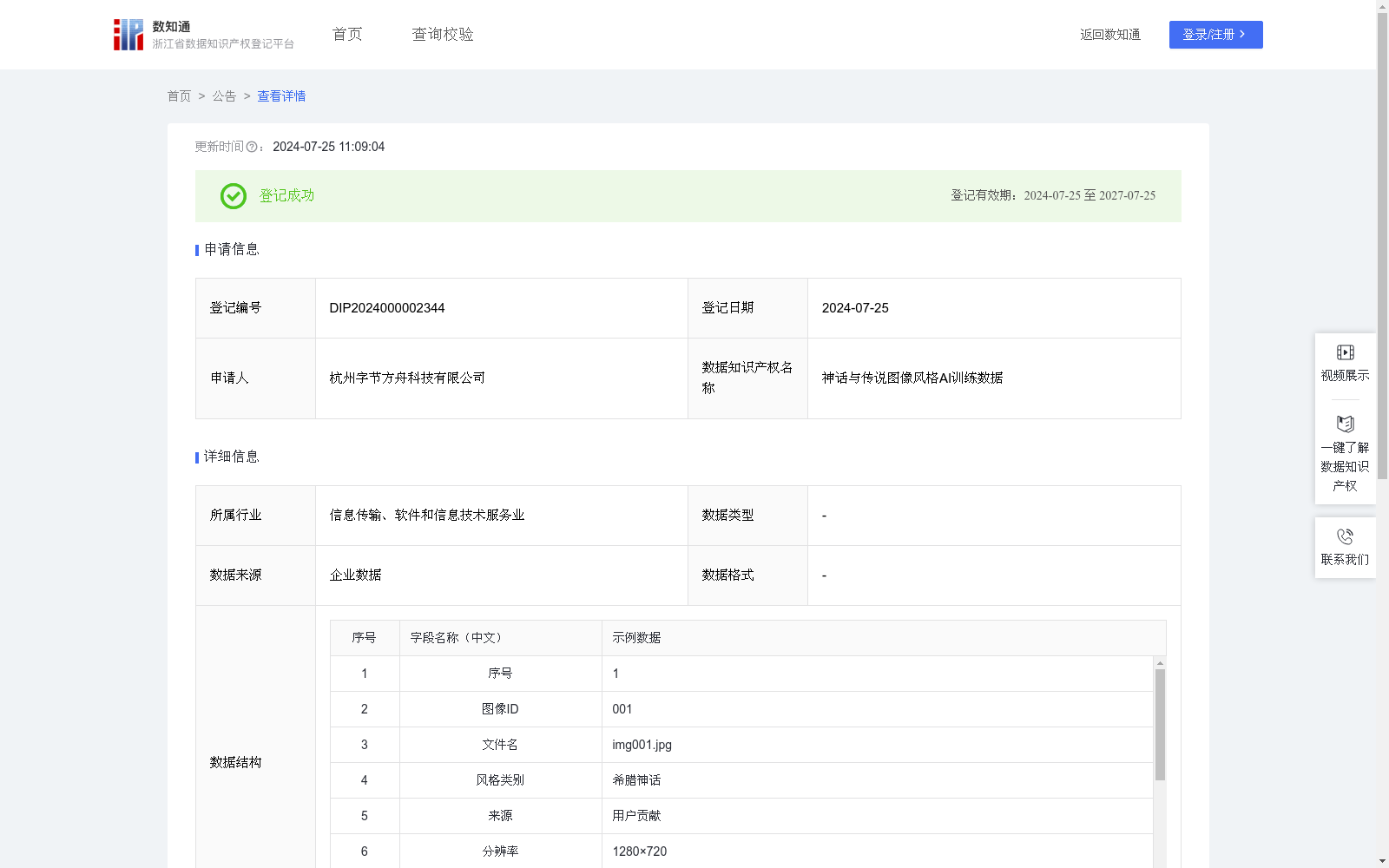
神话与传说图像风格AI训练数据
收藏资源简介:
通过数据处理和数据加工流程,神话与传说图像风格AI训练数据被转化为高质量、高标注准确性的训练集。这些数据可提供给AI模型进行训练,帮助模型深入学习并理解不同神话与传说图像的风格特征,包括神话人物、传说生物、幻想场景、文化符号、宗教故事等元素。经过训练的AI模型能够更准确地识别、分类和生成各种神话与传说图像,如希腊神话、中国传说、凯尔特民间故事等。此外,数据增强技术的运用能够增强模型对新场景的泛化能力,而超参数调优和模型优化能进一步提升模型的鲁棒性,确保了其在实际文化研究、教育传播和艺术创作中的应用有效性。(1)数据来源:原始图像数据来源于开放公共图像库、用户贡献以及神话与传说图像生成算法。来源于用户贡献的原始图像数据,已获得合法授权。 (2)图像标准化处理:对收集到的图像进行标准化处理,包括调整分辨率和裁剪。 (3)数据增强:应用旋转、缩放、颜色调整等技术,增强模型泛化能力。 (4)关键视觉特征提取:从图像中提取关键视觉特征,包括颜色直方图、纹理信息以及与神话故事、传说人物等神话传说场景风格紧密相关的特征,丰富模型输入。 (5)深度学习架构选择:采用卷积神经网络(CNN)作为深度学习架构。 (6)模型训练与评估:在标注好的数据集上训练CNN模型,通过监督学习的方式让模型学习识别不同的神话与传说风格。通过交叉验证和使用不同性能指标(如准确率、召回率)评估模型的识别能力。 (7)超参数调优:进行超参数调优,包括学习率、批量大小、网络层数、神经元数量等。 (8)模型优化与验证:根据评估结果,对模型进行剪枝、正则化等优化措施。在独立的测试集上验证模型的性能,确保模型在未见数据上也能表现良好。
Through data processing and refinement workflows, AI training datasets for myth and legend image styles are transformed into high-quality training sets with high annotation accuracy. These datasets can be provided for AI model training, enabling models to deeply learn and understand the stylistic features of different myth and legend images, including elements such as mythological figures, legendary creatures, fantasy scenes, cultural symbols, and religious stories. Trained AI models can more accurately identify, classify, and generate various myth and legend images, such as those from Greek mythology, Chinese legends, and Celtic folk tales. In addition, the application of data augmentation techniques enhances the model's generalization ability to new scenarios, while hyperparameter tuning and model optimization further improve the model's robustness, ensuring its effective application in practical cultural research, educational dissemination, and artistic creation. (1) Data Source: The original image data is sourced from open public image libraries, user contributions, and myth and legend image generation algorithms. The original image data from user contributions has obtained legal authorization. (2) Image Standardization Processing: Standardization processing is performed on the collected images, including resolution adjustment and cropping. (3) Data Augmentation: Techniques such as rotation, scaling, and color adjustment are applied to enhance the model's generalization ability. (4) Key Visual Feature Extraction: Key visual features are extracted from the images, including color histograms, texture information, and features closely related to the stylistic features of mythological and legendary scenes such as mythological stories and legendary figures, to enrich the model's input. (5) Deep Learning Architecture Selection: Convolutional Neural Network (CNN) is adopted as the deep learning architecture. (6) Model Training and Evaluation: The CNN model is trained on the annotated dataset, allowing the model to learn to identify different myth and legend styles through supervised learning. The model's recognition ability is evaluated via cross-validation and using different performance metrics (such as accuracy, recall rate). (7) Hyperparameter Tuning: Hyperparameter tuning is conducted, covering learning rate, batch size, network layers, number of neurons, and other parameters. (8) Model Optimization and Verification: Based on the evaluation results, optimization measures such as pruning and regularization are applied to the model. The model's performance is verified on an independent test set to ensure that the model performs well on unseen data.