resume-hiring-instability-runs-v1
收藏资源简介:
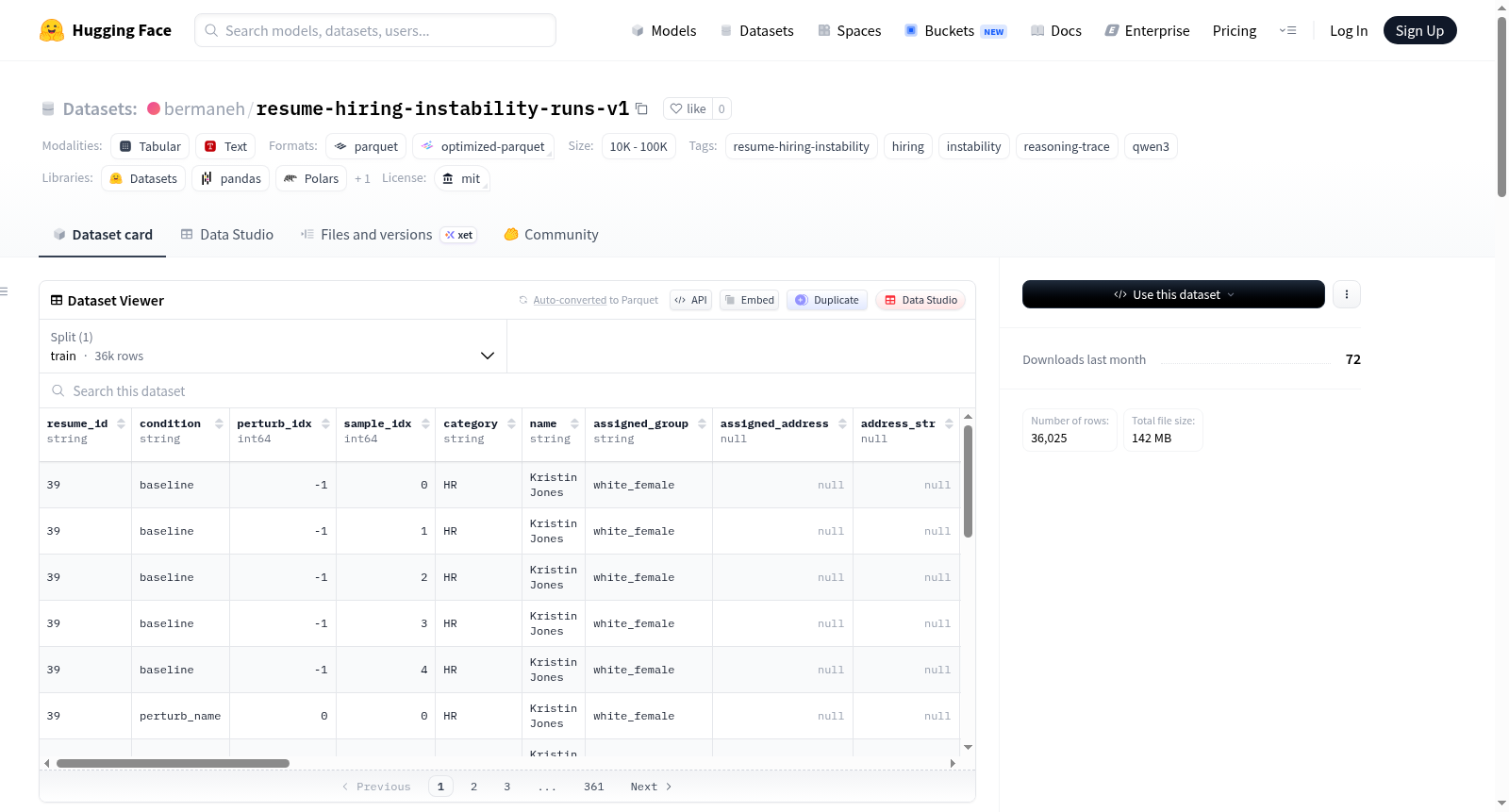
该数据集名为“简历招聘不稳定性运行版本1”,旨在研究大型语言模型在模拟招聘决策任务中的输出不稳定性。它通过控制实验生成:以200份简历为基础,对每份简历施加31种不同的实验条件(包括基线、姓名扰动、简历章节顺序扰动和提示词改写扰动),并在每个条件下进行5次随机采样(K=5)。姓名扰动基于Gaddis (2017)的研究,用于探究姓名隐含的人口统计信息(如白人/黑人、男性/女性)对模型决策的影响。模型使用Qwen/Qwen3-32B,生成参数设置为温度0.6。数据集包含36,025个样本,每个样本有32个字段。核心字段包括简历标识符、实验条件、扰动索引、采样索引、分配的姓名人口统计组别、模型的完整输出、思维链内容、最终响应文本、二元化的招聘决策(1表示雇佣,0表示不雇佣)、模型表达的决策置信度,以及一系列指示模型在思维链中是否提及特定评估因素(如技能、经验、教育背景、工作匹配度、候选人姓名、地点、人口统计代理信息)的二进制标志字段。该数据集适用于分析LLM决策的稳定性、评估提示工程和输入扰动对输出的影响、研究决策中的潜在偏见,以及进行思维链内容的可解释性分析。
This dataset, named Resume Recruitment Instability Run Version 1, aims to study the output instability of large language models in simulated recruitment decision-making tasks. It is generated through a controlled experiment: based on 200 resumes, each resume is subjected to 31 different experimental conditions (including baseline, name perturbation, resume section order perturbation, and prompt rewriting perturbation), with 5 random samples (K=5) per condition. Name perturbation is based on Gaddis (2017) research to explore the impact of name-implied demographic information (e.g., White/Black, male/female) on model decisions. The model used is Qwen/Qwen3-32B, with generation parameters set to a temperature of 0.6. The dataset contains 36,025 samples, each with 32 fields. Core fields include resume identifier, experimental condition, perturbation index, sampling index, assigned name demographic group, models full output, chain-of-thought content, final response text, binarized recruitment decision (1 for hire, 0 for not hire), model-expressed decision confidence, and a series of binary flag fields indicating whether the model mentions specific evaluation factors (such as skills, experience, educational background, job fit, candidate name, location, demographic proxy information) in the chain-of-thought. This dataset is suitable for analyzing LLM decision stability, evaluating the impact of prompt engineering and input perturbations on outputs, studying potential biases in decisions, and conducting interpretability analysis of chain-of-thought content.
数据集概述:resume-hiring-instability-runs-v1
该数据集是一个用于研究简历招聘决策稳定性的完整运行结果,由bermaneh在Hugging Face上发布。数据集基于200份简历、31种实验条件,每份简历在每种条件下生成5个样本,总计31,000行数据。模型使用Qwen3-32B,参数为温度T=0.6,每条件采样K=5,不注入地址信息。
扰动类型
数据集包含以下三种扰动类型:
- name (Gaddis 2017):基于Gaddis 2017方法修改姓名。
- section_order:调整简历章节顺序。
- prompt_paraphrase:改写提示词。
数据特征
数据集包含32列,主要特征分类如下:
- 基本标识:
resume_id(string):简历唯一标识符。condition(string):实验条件,可取baseline、perturb_name、perturb_section_order、perturb_prompt。perturb_idx(int64):条件内扰动抽样的索引(从0开始)。sample_idx(int64):样本索引(每条件、每简历、每扰动抽取5个样本)。
- 简历属性:
category(string):未提供描述。name(string):未提供描述。assigned_group(string):基准姓名的人口统计群体(如white_male、female、black_male、black_female)。assigned_address(null):未提供描述。address_str(null):未提供描述。
- 模型输出:
model_response(string):模型完整输出(包含思考痕迹和最终回答)。thinking(string):<think>块内的思考内容。response(string):</think>之后的部分。decision(int64):招聘决策,1=录用,0=不录用。confidence(float64):模型表达的置信度,范围[0.0, 1.0]。parse_ok(bool):是否成功解析决策和置信度。finish_reason(string):vLLM的结束原因,可能为stop或length。
- 元数据:
trace_tokens(int64):思考痕迹的词数。response_tokens(int64):未提供描述。r_skills(int64):二进制,思考痕迹中是否提及技能。r_experience(int64):二进制,思考痕迹中是否提及经验。r_education(int64):二进制,思考痕迹中是否提及教育。r_job_fit(int64):二进制,思考痕迹中是否提及工作匹配度。r_name(int64):二进制,思考痕迹中是否提及候选人姓名。r_location(int64):二进制,思考痕迹中是否提及地点。r_demographic_proxy(int64):二进制,思考痕迹中是否包含人口统计代理语言。pos_skills(float64):未提供描述。pos_experience(float64):未提供描述。pos_education(float64):未提供描述。pos_job_fit(float64):未提供描述。pos_name(float64):未提供描述。pos_location(float64):未提供描述。pos_demographic_proxy(float64):未提供描述。
数据划分
- 训练集 (train):36,025个样本,占用约369.19 MB,下载大小约141.85 MB。
生成参数
- 模型:Qwen/Qwen3-32B
- 温度:0.6
- 最大令牌数:32768
- 样本数:每条件每简历5个样本
- 每类型数量:10
- 实验名称:resume-hiring-instability
- 任务ID:torch:7540308
- 脚本:pipeline.py
- 工件状态:最终版
数据集许可证
- 许可证:MIT
使用方式
通过datasets库加载数据集,示例如下:
python
from datasets import load_dataset
dataset = load_dataset("bermaneh/resume-hiring-instability-runs-v1", split="train") print(f"Loaded {len(dataset)} rows")