
Ear-EEG Sleep Monitoring 2019 (EESM19)
收藏OpenNeuro2024-05-25 更新2026-03-14 收录
下载链接:
https://openneuro.org/datasets/ds005185
下载链接
链接失效反馈官方服务:
资源简介:
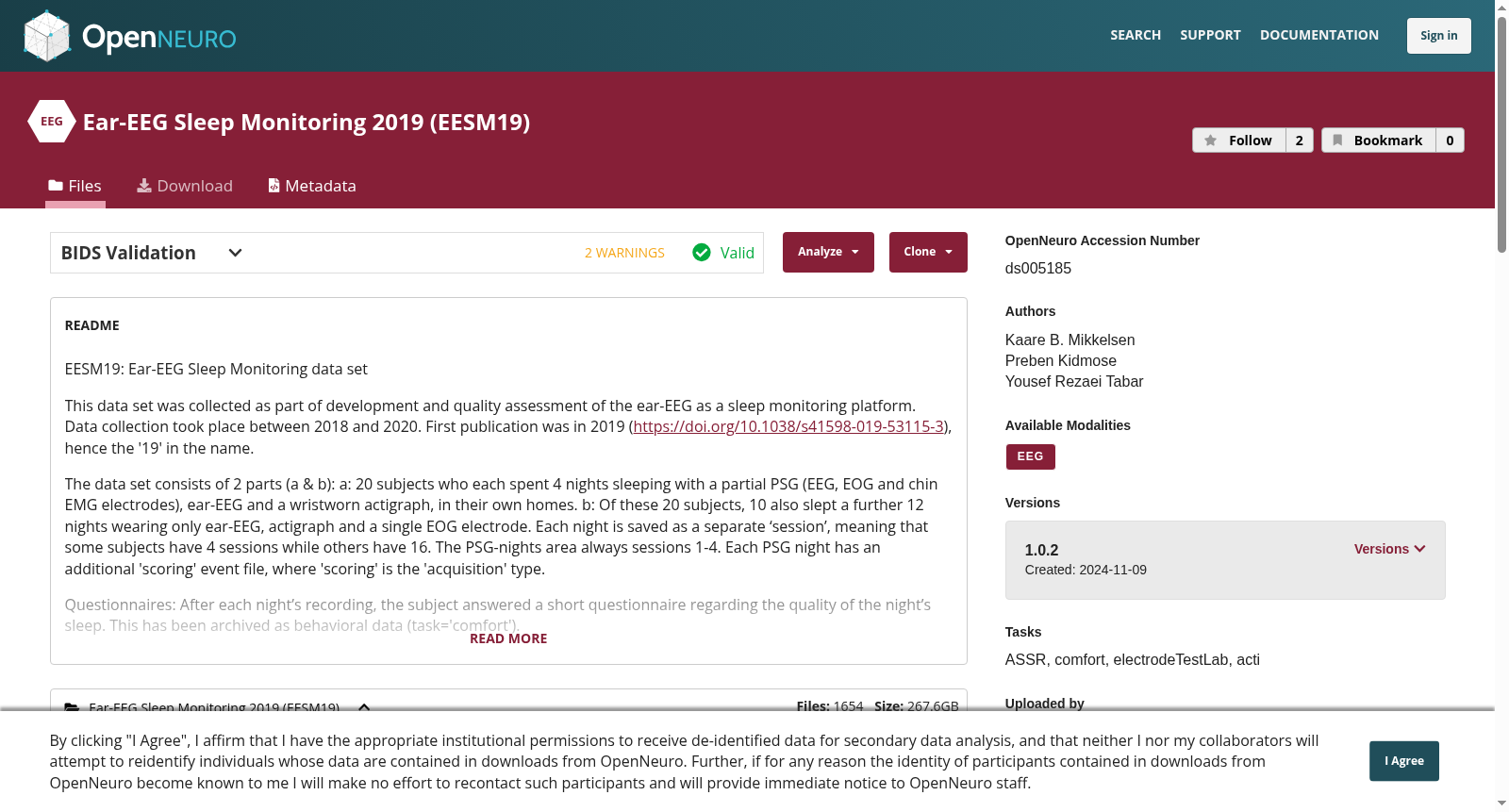
EESM19: Ear-EEG Sleep Monitoring data set
This data set was collected as part of development and quality assessment of the ear-EEG as a sleep monitoring platform. Data collection took place between 2018 and 2020. First publication was in 2019 (https://doi.org/10.1038/s41598-019-53115-3), hence the '19' in the name.
The data set consists of 2 parts (a & b):
a: 20 subjects who each spent 4 nights sleeping with a partial PSG (EEG, EOG and chin EMG electrodes), ear-EEG and a wristworn actigraph, in their own homes.
b: Of these 20 subjects, 10 also slept a further 12 nights wearing only ear-EEG, actigraph and a single EOG electrode.
Each night is saved as a separate ‘session’, meaning that some subjects have 4 sessions while others have 16. The PSG-nights area always sessions 1-4. Each PSG night has an additional 'scoring' event file, where 'scoring' is the 'acquisition' type.
Questionnaires:
After each night’s recording, the subject answered a short questionnaire regarding the quality of the night’s sleep. This has been archived as behavioral data (task='comfort').
Diaries:
Besides the comfort questionnaire, the subjects also kept a standardized diary regarding the events of the night. This have been imported too, however only the requried fields 'Syncronization','Electrodetest','Went to bed', 'Lights out' and 'Got up' have been translated from Danish to English. We suggest using an online translation tool for any additional entries.
The diaries have a column 'pressedTrigger', which indicates that the subject marked the precise time of the event on their wrist worn actigraph. As there is some interpretation necessary due to both spurious extra trigger presses and also missing trigger presses, and these event markings eventually turned out not to be important for our own research, we have not exported these trigger times in the data set. However, as the full actigraphy file is included in this data set, any interested future user can do the matching themselves.
For consistency, we have chosen to use the starting time written in the scored edf file ('edf1') as the starting time of each PSG recording. For non-PSG recordings, the starting time is what is written in the diary. An alternative would be using the start time as seen in the wrist actigraph, described below.
Actigraphy:
Subjects wore GENEactive actigraphs ('actiwatches' for short). These record 3-axis acceleration as well as temperature, light and user button presses. Given that the temperature and light readings are very impacted by whether the subjects had their hand above or below the covers, we found that only the actigraphy and button presses had much use. However, all data is found in the actigraphy files (in the behavior folders).
The ensure the possibility of perfect alignment between actiwatch and EEG recorder (TMSI 'mobita'), at the beginning of each recording, the subjects shook the mobita and the actiwatch together in a repeated rythmical pattern. By accessing the mobita actigraphy data from the .set file (EEG.etc.acc.data) it is possible to get perfect alignment. This is advantageous if very high precision of various sleep events is desired, since the clock in in the actiwatch was very reliable. In practice, we have not used this option, and hence the actigraphy alignment is left up to the user.
Electrode test:
As a quality check on the electrode connections subjects viewed a short video containing various instructions: repeated jaw clenching, open/closed eyes, horizontal eye movements. These are marked in the diaries, and can be used as a simple test that the EEG equipment is working as intended. An analysis of these responses can be found in https://doi.org/10.3389/fncom.2021.565244.
Note regarding artifact rejection:
We advice against using the data directly from the .poly5 files. The primary reason for this is that we had some issues with faulty shielding on some of the electrodes (good shielding is necessary for dry-contact electrodes). This caused signal leakage between electrodes, which is highly unwanted, and which could make the ear-EEG channels contain PSG data, even after rereferencing. We went to great lengths to identify these electrodes, using both algorithms and physical inspection of all electrodes between recordings, and are confident that there are no issues in the .set files (for which these electrodes have been set to 'NaN'). Note that that this identification and discarding is the only preprocessing which has been done to the EEG data.
For questions regarding this data set, contact:
Kaare Mikkelsen, Mikkelsen.kaare@ece.au.dk, https://orcid.org/0000-0002-7360-8629
EESM19:耳电脑电图(Ear-EEG)睡眠监测数据集。本数据集用于耳电脑电图作为睡眠监测平台的开发与质量评估,数据采集于2018年至2020年间。首篇相关学术论文发表于2019年(https://doi.org/10.1038/s41598-019-53115-3),数据集名称中的"19"即来源于此。
本数据集包含a、b两个部分:
a部分:20名受试者在自家居住环境中,分别进行4个夜间的睡眠监测,同步采集部分多导睡眠图(Polysomnography, PSG)数据(含脑电图、眼电图(Electrooculography, EOG)与颏肌电图(Electromyography, EMG)电极)、耳电脑电图数据,以及腕部佩戴的活动记录仪(actigraph)数据。
b部分:上述20名受试者中,有10名额外完成了12个夜间的睡眠监测,仅佩戴耳电脑电图设备、活动记录仪与单通道眼电图电极。
每个夜间的监测数据保存为独立的"会话(session)",因此部分受试者仅拥有4个会话,其余受试者则拥有16个会话。多导睡眠图对应的夜间数据始终为会话1至4。每个多导睡眠图夜间数据附带额外的"评分(scoring)"事件文件,其中"scoring"属于"采集(acquisition)"类型。
问卷数据:
每次夜间监测结束后,受试者需填写一份简短问卷,以评估本次夜间的睡眠质量。该问卷数据已作为行为数据归档,对应任务标签为"comfort",意为睡眠舒适度。
日记数据:
除舒适度问卷外,受试者还需填写标准化日记,记录夜间相关事件。日记数据已同步导入数据集,但仅部分必填字段已从丹麦语译为英语,包括"Syncronization(同步)"、"Electrodetest(电极测试)"、"Went to bed(就寝时间)"、"Lights out(熄灯时间)"与"Got up(起床时间)"。对于其余条目,建议使用在线翻译工具进行处理。
日记中包含"pressedTrigger(触发按键)"列,用于标记受试者在腕部活动记录仪上标记事件的精确时间。由于存在误触额外按键与遗漏按键的情况,且经分析该事件标记对本研究并无实际价值,因此未将触发时间导出至本数据集。不过,由于完整的活动记录仪文件已包含在数据集中,后续有需求的用户可自行进行时间对齐。
为保证数据一致性,本数据集采用评分EDF文件(edf1)中记录的起始时间作为多导睡眠图记录的起始时间;对于非多导睡眠图记录,则采用日记中记录的起始时间。另一种可选方案是使用腕部活动记录仪的起始时间,详见下文。
活动记录仪数据:
受试者佩戴的是GENEactive活动记录仪(简称actiwatch),该设备可记录三轴加速度、体温、光照强度与用户按键事件。考虑到体温与光照读数极易受受试者手部是否盖被影响,本研究发现仅活动数据与按键事件具备较高使用价值,但所有采集数据均已保存至活动记录仪文件中(位于行为数据文件夹内)。
为实现活动记录仪与TMSI Mobita脑电图记录仪的精准对齐,每次记录开始前,受试者需以重复节律性动作同时摇晃Mobita设备与活动记录仪。通过访问.set文件中的Mobita活动数据(EEG.etc.acc.data),即可实现二者的完美对齐。由于活动记录仪的时钟精度极高,该对齐方式在需要精准定位各类睡眠事件时具备优势。但在本研究中并未使用该方法,因此活动记录仪的对齐工作需由用户自行完成。
电极测试:
为检查电极连接质量,受试者需观看一段包含多项指令的简短视频,内容包括反复咬紧牙关、睁眼/闭眼、水平眼球运动。这些操作已在日记中标记,可用于快速验证脑电图设备是否正常工作。针对该测试的相关分析可参考https://doi.org/10.3389/fncom.2021.565244。
伪迹剔除相关说明:
本数据集不建议直接使用.poly5文件中的原始数据。主要原因是部分电极存在屏蔽不良问题(干性接触电极需要良好的屏蔽性能),导致电极间出现信号串扰,这会使得耳电脑电图通道在重参考后仍可能混入多导睡眠图信号。本研究通过算法分析与录制间隙的物理电极检查,已完成问题电极的识别与修复,并将.set文件中的问题电极数据设置为"NaN(非数值)",确认所有.set文件均无此类问题。需注意,该识别与剔除操作是本数据集对脑电图数据进行的唯一预处理步骤。
如需咨询本数据集相关问题,请联系:Kaare Mikkelsen,邮箱:Mikkelsen.kaare@ece.au.dk,ORCID:https://orcid.org/0000-0002-7360-8629
创建时间:
2024-05-25
搜集汇总
数据集介绍
背景与挑战
背景概述
EESM19数据集是一个专注于耳部脑电图技术用于睡眠监测的研究数据集,包含20名受试者的多晚睡眠数据,结合了PSG、耳部脑电图和活动记录仪等多种监测手段。数据集不仅提供了丰富的生理信号数据,还包括了睡眠质量问卷和行为日记,为睡眠研究提供了全面的数据支持。
以上内容由遇见数据集搜集并总结生成



