
HuggingFaceH4/stack-exchange-preferences
收藏Hugging Face2023-03-08 更新2024-03-04 收录
下载链接:
https://hf-mirror.com/datasets/HuggingFaceH4/stack-exchange-preferences
下载链接
链接失效反馈资源简介:
---
license: cc-by-sa-4.0
task_categories:
- question-answering
language:
- en
pretty_name: H4 Stack Exchange Preferences Dataset
tags:
- RLHF
- preferences
- human-feedback
- Stack Exchange
download_size: 22132072448
size_categories:
- 10M<n<100M
---
# Dataset Card for H4 Stack Exchange Preferences Dataset
## Dataset Description
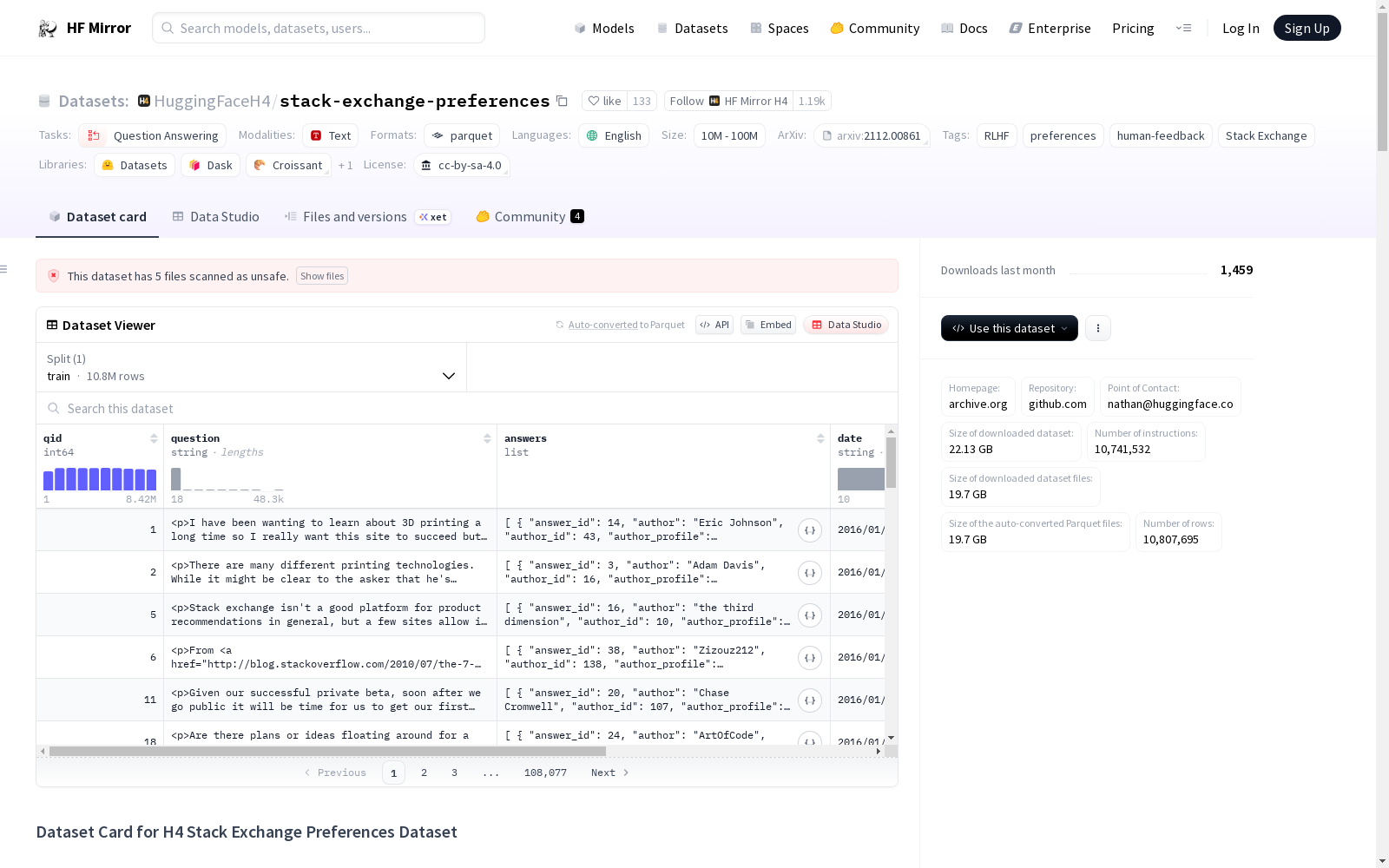
- **Homepage:** https://archive.org/details/stackexchange
- **Repository:** (private for now) https://github.com/huggingface/h4
- **Point of Contact:** Nathan Lambert, nathan@huggingface.co
- **Size of downloaded dataset:** 22.13 GB
- **Number of instructions:** 10,741,532
### Dataset Summary
This dataset contains questions and answers from the [Stack Overflow Data Dump](https://archive.org/details/stackexchange) for the purpose of **preference model training**.
Importantly, the questions have been filtered to fit the following criteria for preference models (following closely from [Askell et al. 2021](https://arxiv.org/abs/2112.00861)): *have >=2 answers*.
This data could also be used for instruction fine-tuning and language model training.
The questions are grouped with answers that are assigned a score corresponding to the Anthropic paper:
```
score = log2 (1 + upvotes) rounded to the nearest integer, plus 1 if the answer was accepted by the questioner (we assign a score of −1 if the number of upvotes is negative).
```
Some important notes when using this dataset for preference model pretraining (PMP), which can be ignored for other uses:
* the data will likely need to be filtered more due to matching scores.
* see section 4.1 of Askel et al 2021 for instructions on using each pair of samples twice via the following `binarization` (for better pre-training initialization):
```
Subsequently, we created a binary dataset by applying a ‘binarization’ procedure to the ranked dataset. That
is, for every ranked pair A > B, we transform it into two independent binary comparisons:
GOOD:A > BAD:A
BAD:B > GOOD:B
```
To see all the stackexchanges used in this data, please see [this file](https://huggingface.co/datasets/HuggingFaceH4/pmp-stack-exchange/blob/main/stack_exchanges.json).
Unfortunately, sharing the binarized data directly without metadata violates the license, so we have shared a script for binarization.
### Using the data
Here is a script from our internal tooling used to create a binarized dataset:
```
# Copyright 2023 The HuggingFace Team. All rights reserved.
#
# Licensed under the Apache License, Version 2.0 (the "License");
# you may not use this file except in compliance with the License.
# You may obtain a copy of the License at
#
# http://www.apache.org/licenses/LICENSE-2.0
#
# Unless required by applicable law or agreed to in writing, software
# distributed under the License is distributed on an "AS IS" BASIS,
# WITHOUT WARRANTIES OR CONDITIONS OF ANY KIND, either express or implied.
# See the License for the specific language governing permissions and
# limitations under the License.
import random
from argparse import ArgumentParser
from pathlib import Path
import numpy as np
from datasets import Dataset, concatenate_datasets, load_dataset
from h4.data.utils import save_dataset_shards
H4_DIR = Path(__file__).resolve().parents[3]
DATA_DIR = H4_DIR / "data"
if __name__ == "__main__":
parser = ArgumentParser()
parser.add_argument("--debug", action="store_true", help="Added print statements / limit data size for debugging")
parser.add_argument(
"--output_dir",
default=f"{DATA_DIR}/pmp-binarized",
type=str,
help="Where to save the processed dataset",
)
parser.add_argument(
"--exchange_name",
type=str,
default=None,
help="Optional argument to specify a specific subsection of the dataset",
)
parser.add_argument(
"--binary_score", type=int, default=8, help="Score assigned to binarized pairs for preference data."
)
parser.add_argument(
"--stream_data", action="store_true", help="Optionally stream data, which can be useful with weaker computers"
)
parser.set_defaults(debug=False, stream_data=False) # default will process full dataset
args = parser.parse_args()
specific_exchange = args.exchange_name
stream_dataset = args.stream_data
binary_score = args.binary_score
if specific_exchange:
data_dir = "data/" + args.exchange_name
else:
data_dir = None
if args.debug:
data_len_limit = 10000
else:
data_len_limit = np.inf
dataset = load_dataset(
"HuggingFaceH4/pmp-stack-exchange",
data_dir=data_dir,
split="train",
streaming=stream_dataset,
)
pmp_data = []
for i, d in enumerate(iter(dataset)):
# check debug limit, quit if in debug mode (don't save)
if i > data_len_limit:
print("Early exit for debug mode!")
print(pmp_data)
break
question = d["question"]
answers = d["answers"]
num_answers = len(answers)
answer_scores = [a["pm_score"] for a in answers]
if len(np.unique(answer_scores)) < 2:
print(f"PM Scores are {answer_scores}, skipping this question {i}")
else:
# Sample 2 unique scores for binarization
dif_scores = False
while not dif_scores:
# print("infinite loop...?")
two_answers = random.sample(answers, 2)
if two_answers[0]["pm_score"] != two_answers[1]["pm_score"]:
dif_scores = True
answer_0 = two_answers[0]
answer_1 = two_answers[1]
text_0 = "Question: " + question + "\n" + "Answer: " + answer_0["text"]
text_1 = "Question: " + question + "\n" + "Answer: " + answer_1["text"]
score_0 = binary_score
score_1 = binary_score
pmp_data.append({"context": text_0, "score": score_0})
pmp_data.append({"context": text_1, "score": score_1})
# Save binarized data
sublist_len = 100000
print(f"Dataset length is {len(pmp_data)}")
# bypass known issue in arrow https://issues.apache.org/jira/browse/ARROW-17137
print(f"Processed dataset length > {sublist_len}, processing to HF dataset in chunks")
chunks = [pmp_data[x : x + sublist_len] for x in range(0, len(pmp_data), sublist_len)]
ds_chunks = [Dataset.from_list(ch) for ch in chunks]
ds = concatenate_datasets(ds_chunks)
save_dataset_shards(ds, args.output_dir, subset="stackexchange", shard_size="100MB")
```
### Languages
This is intended to be English only, thought other languages may be present. Some Stack Exchanges that are omitted include:
```
spanish: es.meta.stackoverflow.com, es.stackoverflow.com
japanese: ja.meta.stackoverflow.com, ja.stackoverflow.com
portugese: pt.stackoverflow.com, pt.meta.stackoverflow.com
russian: ru.stackoverflow, ru.meta.stackoverflow
```
### Licensing Information
License: https://creativecommons.org/licenses/by-sa/4.0/
The cc-by-sa 4.0 licensing, while intentionally permissive, does require attribution:
Attribution — You must attribute the work in the manner specified by the author or licensor (but not in any way that suggests that they endorse you or your use of the work).
Specifically the attribution requirements are as follows:
1. Visually display or otherwise indicate the source of the content as coming from the Stack Exchange Network. This requirement is satisfied with a discreet text blurb, or some other unobtrusive but clear visual indication.
2. Ensure that any Internet use of the content includes a hyperlink directly to the original question on the source site on the Network (e.g., http://stackoverflow.com/questions/12345)
3. Visually display or otherwise clearly indicate the author names for every question and answer used
4. Ensure that any Internet use of the content includes a hyperlink for each author name directly back to his or her user profile page on the source site on the Network (e.g., http://stackoverflow.com/users/12345/username), directly to the Stack Exchange domain, in standard HTML (i.e. not through a Tinyurl or other such indirect hyperlink, form of obfuscation or redirection), without any “nofollow” command or any other such means of avoiding detection by search engines, and visible even with JavaScript disabled.
For more information, see the Stack Exchange Terms of Service.
### Citation Information
```
@online{h4stackexchange,
author = {Lambert, Nathan and Tunstall, Lewis and Rajani, Nazneen and Thrush, Tristan},
title = {HuggingFace H4 Stack Exchange Preference Dataset},
year = 2023,
url = {https://huggingface.co/datasets/HuggingFaceH4/stack-exchange-preferences},
}
```
提供机构:
HuggingFaceH4
原始信息汇总
H4 Stack Exchange Preferences Dataset 概述
数据集描述
- 数据集名称: H4 Stack Exchange Preferences Dataset
- 数据集用途: 主要用于偏好模型训练,也可用于指令微调和语言模型训练。
- 数据集内容: 包含从Stack Overflow数据转储中筛选出的问题及其至少两个答案,每个答案附有根据Anthropic论文定义的评分。
- 评分机制: 评分计算公式为
score = log2 (1 + upvotes) 四舍五入到最近的整数,如果答案被提问者接受则加1,如果upvotes为负则评分设为-1。 - 数据集大小: 下载大小为22.13 GB。
- 数据集语言: 主要为英语。
使用指南
- 数据预处理: 提供了一个脚本用于将数据集二值化,以便于偏好模型预训练。
- 注意事项: 使用此数据集进行偏好模型预训练时,可能需要进一步过滤数据以匹配评分。
许可证信息
- 许可证: CC-BY-SA-4.0
- 使用要求: 使用时必须按照许可证要求进行适当的归属,包括显示内容来源、作者信息及直接链接至原始问题和作者个人资料页。
引用信息
@online{h4stackexchange, author = {Lambert, Nathan and Tunstall, Lewis and Rajani, Nazneen and Thrush, Tristan}, title = {HuggingFace H4 Stack Exchange Preference Dataset}, year = 2023, url = {https://huggingface.co/datasets/HuggingFaceH4/stack-exchange-preferences}, }
搜集汇总
数据集介绍
构建方式
H4 Stack Exchange Preferences Dataset 数据集的构建基于Stack Overflow数据源,经过筛选以确保每个问题至少有两个答案,进而适用于偏好模型的训练。数据集通过特定的评分机制对答案进行排序,并采用二值化处理以优化偏好模型的预训练初始化。
特点
该数据集的特点在于,其包含的问答对源自Stack Overflow社区,且针对每个答案的评分机制旨在反映用户对答案的偏好程度。数据集遵循Creative Commons BY-SA 4.0许可,允许在一定条件下共享和改编。此外,数据集的二值化处理增加了其在偏好模型训练中的应用价值。
使用方法
使用该数据集时,用户需遵循特定的二值化脚本,将评分数据转换为二元比较形式,以支持偏好模型的预训练。用户可以通过脚本参数来控制输出目录、数据子集以及二值化分数等,以便于在较弱计算设备上进行数据流式处理。
背景与挑战
背景概述
H4 Stack Exchange Preferences Dataset是一款由HuggingFace团队开发的,用于偏好模型训练的数据集。该数据集的创建可追溯至2023年,主要研究人员包括Nathan Lambert、Lewis Tunstall、Nazneen Rajani和Tristan Thrush。该数据集的核心研究问题是利用Stack Overflow数据.dump中的问题和答案,来训练偏好模型,进而为指令微调和语言模型训练提供支持。该数据集在自然语言处理领域具有重要的研究价值,尤其是在偏好学习模型的研究和开发中,提供了丰富的实验资源和基准数据。
当前挑战
该数据集在构建和应用过程中面临的挑战主要包括:1)领域问题挑战:如何利用Stack Overflow数据.dump中的问题和答案,有效地训练出具有高准确度的偏好模型;2)构建挑战:数据集构建过程中,如何处理和匹配分数,以避免数据偏差和过拟合问题。此外,由于数据集采用cc-by-sa 4.0许可,如何在保证合规的前提下,有效利用和共享数据,也是一项重要挑战。
常用场景
经典使用场景
在机器学习领域,特别是在偏好模型训练中,H4 Stack Exchange Preferences Dataset数据集扮演着至关重要的角色。该数据集收集了Stack Overflow数据.dump中的问题及答案,旨在通过用户对答案的投票来训练模型,以区分答案的优劣。
实际应用
在实际应用中,该数据集被广泛用于改进问答系统的答案排序,优化搜索引擎结果,以及提升推荐系统的个性化水平。通过对用户偏好的深入理解,相关应用能够提供更加贴合用户需求的服务,从而增强用户体验。
衍生相关工作
基于该数据集,衍生出了众多相关研究工作,包括但不限于偏好模型训练的新算法、更高效的数据处理方法以及针对不同场景的模型微调策略,这些工作进一步拓展了数据集的应用范围,推动了人工智能领域的发展。
以上内容由遇见数据集搜集并总结生成



