
cgpotts/swda
收藏Hugging Face2024-01-18 更新2024-05-25 收录
下载链接:
https://hf-mirror.com/datasets/cgpotts/swda
下载链接
链接失效反馈官方服务:
资源简介:
---
annotations_creators:
- found
language_creators:
- found
language:
- en
license:
- cc-by-nc-sa-3.0
multilinguality:
- monolingual
size_categories:
- 100K<n<1M
source_datasets:
- extended|other-Switchboard-1 Telephone Speech Corpus, Release 2
task_categories:
- text-classification
task_ids:
- multi-label-classification
pretty_name: The Switchboard Dialog Act Corpus (SwDA)
dataset_info:
features:
- name: swda_filename
dtype: string
- name: ptb_basename
dtype: string
- name: conversation_no
dtype: int64
- name: transcript_index
dtype: int64
- name: act_tag
dtype:
class_label:
names:
'0': b^m^r
'1': qw^r^t
'2': aa^h
'3': br^m
'4': fa^r
'5': aa,ar
'6': sd^e(^q)^r
'7': ^2
'8': sd;qy^d
'9': oo
'10': bk^m
'11': aa^t
'12': cc^t
'13': qy^d^c
'14': qo^t
'15': ng^m
'16': qw^h
'17': qo^r
'18': aa
'19': qy^d^t
'20': qrr^d
'21': br^r
'22': fx
'23': sd,qy^g
'24': ny^e
'25': ^h^t
'26': fc^m
'27': qw(^q)
'28': co
'29': o^t
'30': b^m^t
'31': qr^d
'32': qw^g
'33': ad(^q)
'34': qy(^q)
'35': na^r
'36': am^r
'37': qr^t
'38': ad^c
'39': qw^c
'40': bh^r
'41': h^t
'42': ft^m
'43': ba^r
'44': qw^d^t
'45': '%'
'46': t3
'47': nn
'48': bd
'49': h^m
'50': h^r
'51': sd^r
'52': qh^m
'53': ^q^t
'54': sv^2
'55': ft
'56': ar^m
'57': qy^h
'58': sd^e^m
'59': qh^r
'60': cc
'61': fp^m
'62': ad
'63': qo
'64': na^m^t
'65': fo^c
'66': qy
'67': sv^e^r
'68': aap
'69': 'no'
'70': aa^2
'71': sv(^q)
'72': sv^e
'73': nd
'74': '"'
'75': bf^2
'76': bk
'77': fp
'78': nn^r^t
'79': fa^c
'80': ny^t
'81': ny^c^r
'82': qw
'83': qy^t
'84': b
'85': fo
'86': qw^r
'87': am
'88': bf^t
'89': ^2^t
'90': b^2
'91': x
'92': fc
'93': qr
'94': no^t
'95': bk^t
'96': bd^r
'97': bf
'98': ^2^g
'99': qh^c
'100': ny^c
'101': sd^e^r
'102': br
'103': fe
'104': by
'105': ^2^r
'106': fc^r
'107': b^m
'108': sd,sv
'109': fa^t
'110': sv^m
'111': qrr
'112': ^h^r
'113': na
'114': fp^r
'115': o
'116': h,sd
'117': t1^t
'118': nn^r
'119': cc^r
'120': sv^c
'121': co^t
'122': qy^r
'123': sv^r
'124': qy^d^h
'125': sd
'126': nn^e
'127': ny^r
'128': b^t
'129': ba^m
'130': ar
'131': bf^r
'132': sv
'133': bh^m
'134': qy^g^t
'135': qo^d^c
'136': qo^d
'137': nd^t
'138': aa^r
'139': sd^2
'140': sv;sd
'141': qy^c^r
'142': qw^m
'143': qy^g^r
'144': no^r
'145': qh(^q)
'146': sd;sv
'147': bf(^q)
'148': +
'149': qy^2
'150': qw^d
'151': qy^g
'152': qh^g
'153': nn^t
'154': ad^r
'155': oo^t
'156': co^c
'157': ng
'158': ^q
'159': qw^d^c
'160': qrr^t
'161': ^h
'162': aap^r
'163': bc^r
'164': sd^m
'165': bk^r
'166': qy^g^c
'167': qr(^q)
'168': ng^t
'169': arp
'170': h
'171': bh
'172': sd^c
'173': ^g
'174': o^r
'175': qy^c
'176': sd^e
'177': fw
'178': ar^r
'179': qy^m
'180': bc
'181': sv^t
'182': aap^m
'183': sd;no
'184': ng^r
'185': bf^g
'186': sd^e^t
'187': o^c
'188': b^r
'189': b^m^g
'190': ba
'191': t1
'192': qy^d(^q)
'193': nn^m
'194': ny
'195': ba,fe
'196': aa^m
'197': qh
'198': na^m
'199': oo(^q)
'200': qw^t
'201': na^t
'202': qh^h
'203': qy^d^m
'204': ny^m
'205': fa
'206': qy^d
'207': fc^t
'208': sd(^q)
'209': qy^d^r
'210': bf^m
'211': sd(^q)^t
'212': ft^t
'213': ^q^r
'214': sd^t
'215': sd(^q)^r
'216': ad^t
- name: damsl_act_tag
dtype:
class_label:
names:
'0': ad
'1': qo
'2': qy
'3': arp_nd
'4': sd
'5': h
'6': bh
'7': 'no'
'8': ^2
'9': ^g
'10': ar
'11': aa
'12': sv
'13': bk
'14': fp
'15': qw
'16': b
'17': ba
'18': t1
'19': oo_co_cc
'20': +
'21': ny
'22': qw^d
'23': x
'24': qh
'25': fc
'26': fo_o_fw_"_by_bc
'27': aap_am
'28': '%'
'29': bf
'30': t3
'31': nn
'32': bd
'33': ng
'34': ^q
'35': br
'36': qy^d
'37': fa
'38': ^h
'39': b^m
'40': ft
'41': qrr
'42': na
- name: caller
dtype: string
- name: utterance_index
dtype: int64
- name: subutterance_index
dtype: int64
- name: text
dtype: string
- name: pos
dtype: string
- name: trees
dtype: string
- name: ptb_treenumbers
dtype: string
- name: talk_day
dtype: string
- name: length
dtype: int64
- name: topic_description
dtype: string
- name: prompt
dtype: string
- name: from_caller
dtype: int64
- name: from_caller_sex
dtype: string
- name: from_caller_education
dtype: int64
- name: from_caller_birth_year
dtype: int64
- name: from_caller_dialect_area
dtype: string
- name: to_caller
dtype: int64
- name: to_caller_sex
dtype: string
- name: to_caller_education
dtype: int64
- name: to_caller_birth_year
dtype: int64
- name: to_caller_dialect_area
dtype: string
splits:
- name: train
num_bytes: 128498512
num_examples: 213543
- name: validation
num_bytes: 34749819
num_examples: 56729
- name: test
num_bytes: 2560127
num_examples: 4514
download_size: 14456364
dataset_size: 165808458
---
# Dataset Card for SwDA
## Table of Contents
- [Dataset Description](#dataset-description)
- [Dataset Summary](#dataset-summary)
- [Supported Tasks and Leaderboards](#supported-tasks-and-leaderboards)
- [Languages](#languages)
- [Dataset Structure](#dataset-structure)
- [Data Instances](#data-instances)
- [Data Fields](#data-fields)
- [Data Splits](#data-splits)
- [Dataset Creation](#dataset-creation)
- [Curation Rationale](#curation-rationale)
- [Source Data](#source-data)
- [Annotations](#annotations)
- [Personal and Sensitive Information](#personal-and-sensitive-information)
- [Considerations for Using the Data](#considerations-for-using-the-data)
- [Social Impact of Dataset](#social-impact-of-dataset)
- [Discussion of Biases](#discussion-of-biases)
- [Other Known Limitations](#other-known-limitations)
- [Additional Information](#additional-information)
- [Dataset Curators](#dataset-curators)
- [Licensing Information](#licensing-information)
- [Citation Information](#citation-information)
- [Contributions](#contributions)
## Dataset Description
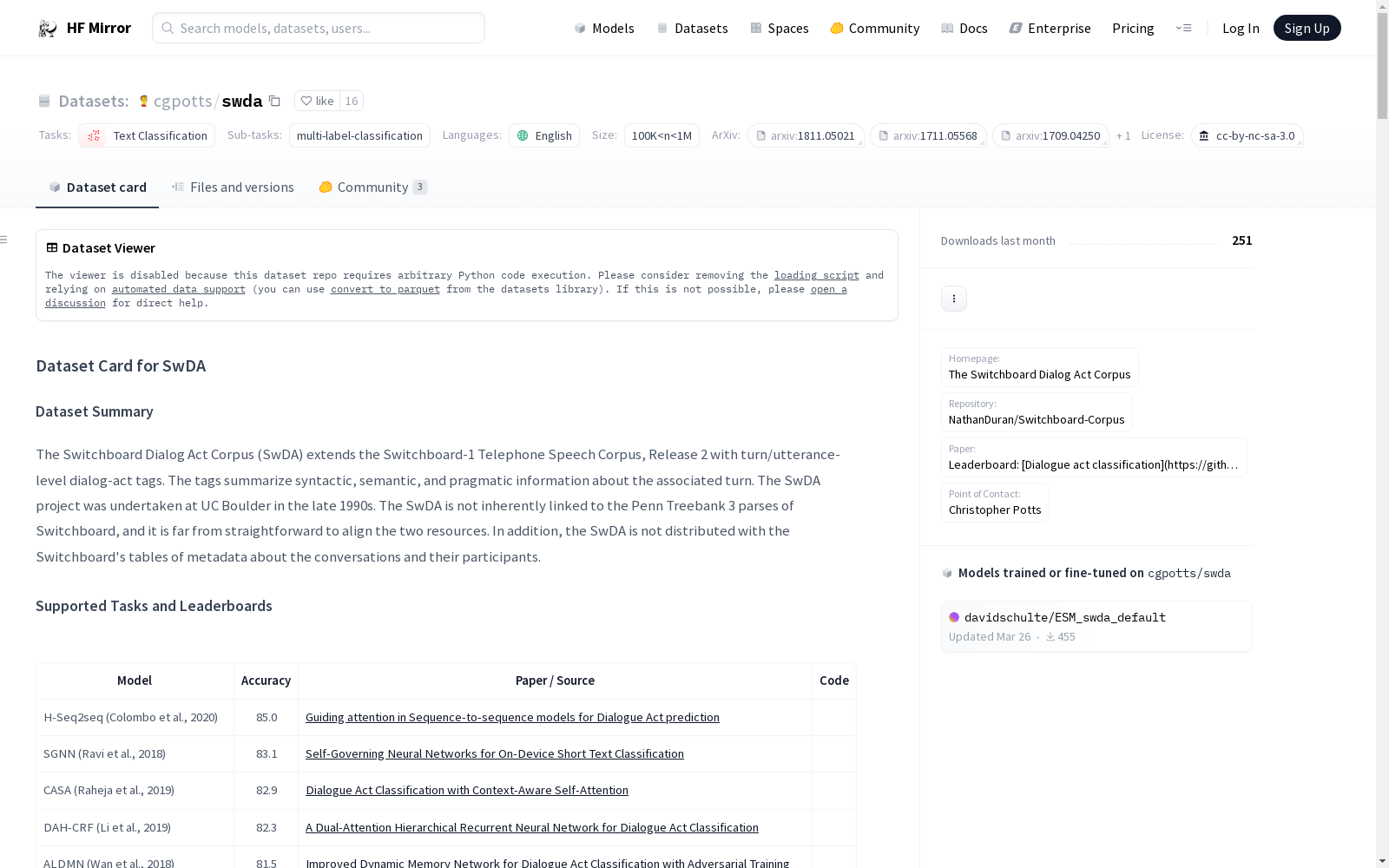
- **Homepage:** [The Switchboard Dialog Act Corpus](http://compprag.christopherpotts.net/swda.html)
- **Repository:** [NathanDuran/Switchboard-Corpus](https://github.com/cgpotts/swda)
- **Paper:** [The Switchboard Dialog Act Corpus](http://compprag.christopherpotts.net/swda.html)
= **Leaderboard: [Dialogue act classification](https://github.com/sebastianruder/NLP-progress/blob/master/english/dialogue.md#dialogue-act-classification)**
- **Point of Contact:** [Christopher Potts](https://web.stanford.edu/~cgpotts/)
### Dataset Summary
The Switchboard Dialog Act Corpus (SwDA) extends the Switchboard-1 Telephone Speech Corpus, Release 2 with
turn/utterance-level dialog-act tags. The tags summarize syntactic, semantic, and pragmatic information about the
associated turn. The SwDA project was undertaken at UC Boulder in the late 1990s.
The SwDA is not inherently linked to the Penn Treebank 3 parses of Switchboard, and it is far from straightforward to
align the two resources. In addition, the SwDA is not distributed with the Switchboard's tables of metadata about the
conversations and their participants.
### Supported Tasks and Leaderboards
| Model | Accuracy | Paper / Source | Code |
| ------------- | :-----:| --- | --- |
| H-Seq2seq (Colombo et al., 2020) | 85.0 | [Guiding attention in Sequence-to-sequence models for Dialogue Act prediction](https://ojs.aaai.org/index.php/AAAI/article/view/6259/6115)
| SGNN (Ravi et al., 2018) | 83.1 | [Self-Governing Neural Networks for On-Device Short Text Classification](https://www.aclweb.org/anthology/D18-1105.pdf)
| CASA (Raheja et al., 2019) | 82.9 | [Dialogue Act Classification with Context-Aware Self-Attention](https://www.aclweb.org/anthology/N19-1373.pdf)
| DAH-CRF (Li et al., 2019) | 82.3 | [A Dual-Attention Hierarchical Recurrent Neural Network for Dialogue Act Classification](https://www.aclweb.org/anthology/K19-1036.pdf)
| ALDMN (Wan et al., 2018) | 81.5 | [Improved Dynamic Memory Network for Dialogue Act Classification with Adversarial Training](https://arxiv.org/pdf/1811.05021.pdf)
| CRF-ASN (Chen et al., 2018) | 81.3 | [Dialogue Act Recognition via CRF-Attentive Structured Network](https://arxiv.org/abs/1711.05568)
| Pretrained H-Transformer (Chapuis et al., 2020) | 79.3 | [Hierarchical Pre-training for Sequence Labelling in Spoken Dialog] (https://www.aclweb.org/anthology/2020.findings-emnlp.239)
| Bi-LSTM-CRF (Kumar et al., 2017) | 79.2 | [Dialogue Act Sequence Labeling using Hierarchical encoder with CRF](https://arxiv.org/abs/1709.04250) | [Link](https://github.com/YanWenqiang/HBLSTM-CRF) |
| RNN with 3 utterances in context (Bothe et al., 2018) | 77.34 | [A Context-based Approach for Dialogue Act Recognition using Simple Recurrent Neural Networks](https://arxiv.org/abs/1805.06280) | |
### Languages
The language supported is English.
## Dataset Structure
Utterance are tagged with the [SWBD-DAMSL](https://web.stanford.edu/~jurafsky/ws97/manual.august1.html) DA.
### Data Instances
An example from the dataset is:
`{'act_tag': 115, 'caller': 'A', 'conversation_no': 4325, 'damsl_act_tag': 26, 'from_caller': 1632, 'from_caller_birth_year': 1962, 'from_caller_dialect_area': 'WESTERN', 'from_caller_education': 2, 'from_caller_sex': 'FEMALE', 'length': 5, 'pos': 'Okay/UH ./.', 'prompt': 'FIND OUT WHAT CRITERIA THE OTHER CALLER WOULD USE IN SELECTING CHILD CARE SERVICES FOR A PRESCHOOLER. IS IT EASY OR DIFFICULT TO FIND SUCH CARE?', 'ptb_basename': '4/sw4325', 'ptb_treenumbers': '1', 'subutterance_index': 1, 'swda_filename': 'sw00utt/sw_0001_4325.utt', 'talk_day': '03/23/1992', 'text': 'Okay. /', 'to_caller': 1519, 'to_caller_birth_year': 1971, 'to_caller_dialect_area': 'SOUTH MIDLAND', 'to_caller_education': 1, 'to_caller_sex': 'FEMALE', 'topic_description': 'CHILD CARE', 'transcript_index': 0, 'trees': '(INTJ (UH Okay) (. .) (-DFL- E_S))', 'utterance_index': 1}`
### Data Fields
* `swda_filename`: (str) The filename: directory/basename.
* `ptb_basename`: (str) The Treebank filename: add ".pos" for POS and ".mrg" for trees
* `conversation_no`: (int) The conversation Id, to key into the metadata database.
* `transcript_index`: (int) The line number of this item in the transcript (counting only utt lines).
* `act_tag`: (list of str) The Dialog Act Tags (separated by ||| in the file). Check Dialog act annotations for more details.
* `damsl_act_tag`: (list of str) The Dialog Act Tags of the 217 variation tags.
* `caller`: (str) A, B, @A, @B, @@A, @@B
* `utterance_index`: (int) The encoded index of the utterance (the number in A.49, B.27, etc.)
* `subutterance_index`: (int) Utterances can be broken across line. This gives the internal position.
* `text`: (str) The text of the utterance
* `pos`: (str) The POS tagged version of the utterance, from PtbBasename+.pos
* `trees`: (str) The tree(s) containing this utterance (separated by ||| in the file). Use `[Tree.fromstring(t) for t in row_value.split("|||")]` to convert to (list of nltk.tree.Tree).
* `ptb_treenumbers`: (list of int) The tree numbers in the PtbBasename+.mrg
* `talk_day`: (str) Date of talk.
* `length`: (int) Length of talk in seconds.
* `topic_description`: (str) Short description of topic that's being discussed.
* `prompt`: (str) Long decription/query/instruction.
* `from_caller`: (int) The numerical Id of the from (A) caller.
* `from_caller_sex`: (str) MALE, FEMALE.
* `from_caller_education`: (int) Called education level 0, 1, 2, 3, 9.
* `from_caller_birth_year`: (int) Caller birth year YYYY.
* `from_caller_dialect_area`: (str) MIXED, NEW ENGLAND, NORTH MIDLAND, NORTHERN, NYC, SOUTH MIDLAND, SOUTHERN, UNK, WESTERN.
* `to_caller`: (int) The numerical Id of the to (B) caller.
* `to_caller_sex`: (str) MALE, FEMALE.
* `to_caller_education`: (int) Called education level 0, 1, 2, 3, 9.
* `to_caller_birth_year`: (int) Caller birth year YYYY.
* `to_caller_dialect_area`: (str) MIXED, NEW ENGLAND, NORTH MIDLAND, NORTHERN, NYC, SOUTH MIDLAND, SOUTHERN, UNK, WESTERN.
### Dialog act annotations
| | name | act_tag | example | train_count | full_count |
|----- |------------------------------- |---------------- |-------------------------------------------------- |------------- |------------ |
| 1 | Statement-non-opinion | sd | Me, I'm in the legal department. | 72824 | 75145 |
| 2 | Acknowledge (Backchannel) | b | Uh-huh. | 37096 | 38298 |
| 3 | Statement-opinion | sv | I think it's great | 25197 | 26428 |
| 4 | Agree/Accept | aa | That's exactly it. | 10820 | 11133 |
| 5 | Abandoned or Turn-Exit | % | So, - | 10569 | 15550 |
| 6 | Appreciation | ba | I can imagine. | 4633 | 4765 |
| 7 | Yes-No-Question | qy | Do you have to have any special training? | 4624 | 4727 |
| 8 | Non-verbal | x | [Laughter], [Throat_clearing] | 3548 | 3630 |
| 9 | Yes answers | ny | Yes. | 2934 | 3034 |
| 10 | Conventional-closing | fc | Well, it's been nice talking to you. | 2486 | 2582 |
| 11 | Uninterpretable | % | But, uh, yeah | 2158 | 15550 |
| 12 | Wh-Question | qw | Well, how old are you? | 1911 | 1979 |
| 13 | No answers | nn | No. | 1340 | 1377 |
| 14 | Response Acknowledgement | bk | Oh, okay. | 1277 | 1306 |
| 15 | Hedge | h | I don't know if I'm making any sense or not. | 1182 | 1226 |
| 16 | Declarative Yes-No-Question | qy^d | So you can afford to get a house? | 1174 | 1219 |
| 17 | Other | fo_o_fw_by_bc | Well give me a break, you know. | 1074 | 883 |
| 18 | Backchannel in question form | bh | Is that right? | 1019 | 1053 |
| 19 | Quotation | ^q | You can't be pregnant and have cats | 934 | 983 |
| 20 | Summarize/reformulate | bf | Oh, you mean you switched schools for the kids. | 919 | 952 |
| 21 | Affirmative non-yes answers | na | It is. | 836 | 847 |
| 22 | Action-directive | ad | Why don't you go first | 719 | 746 |
| 23 | Collaborative Completion | ^2 | Who aren't contributing. | 699 | 723 |
| 24 | Repeat-phrase | b^m | Oh, fajitas | 660 | 688 |
| 25 | Open-Question | qo | How about you? | 632 | 656 |
| 26 | Rhetorical-Questions | qh | Who would steal a newspaper? | 557 | 575 |
| 27 | Hold before answer/agreement | ^h | I'm drawing a blank. | 540 | 556 |
| 28 | Reject | ar | Well, no | 338 | 346 |
| 29 | Negative non-no answers | ng | Uh, not a whole lot. | 292 | 302 |
| 30 | Signal-non-understanding | br | Excuse me? | 288 | 298 |
| 31 | Other answers | no | I don't know | 279 | 286 |
| 32 | Conventional-opening | fp | How are you? | 220 | 225 |
| 33 | Or-Clause | qrr | or is it more of a company? | 207 | 209 |
| 34 | Dispreferred answers | arp_nd | Well, not so much that. | 205 | 207 |
| 35 | 3rd-party-talk | t3 | My goodness, Diane, get down from there. | 115 | 117 |
| 36 | Offers, Options, Commits | oo_co_cc | I'll have to check that out | 109 | 110 |
| 37 | Self-talk | t1 | What's the word I'm looking for | 102 | 103 |
| 38 | Downplayer | bd | That's all right. | 100 | 103 |
| 39 | Maybe/Accept-part | aap_am | Something like that | 98 | 105 |
| 40 | Tag-Question | ^g | Right? | 93 | 92 |
| 41 | Declarative Wh-Question | qw^d | You are what kind of buff? | 80 | 80 |
| 42 | Apology | fa | I'm sorry. | 76 | 79 |
| 43 | Thanking | ft | Hey thanks a lot | 67 | 78 |
### Data Splits
I used info from the [Probabilistic-RNN-DA-Classifier](https://github.com/NathanDuran/Probabilistic-RNN-DA-Classifier) repo:
The same training and test splits as used by [Stolcke et al. (2000)](https://web.stanford.edu/~jurafsky/ws97).
The development set is a subset of the training set to speed up development and testing used in the paper [Probabilistic Word Association for Dialogue Act Classification with Recurrent Neural Networks](https://www.researchgate.net/publication/326640934_Probabilistic_Word_Association_for_Dialogue_Act_Classification_with_Recurrent_Neural_Networks_19th_International_Conference_EANN_2018_Bristol_UK_September_3-5_2018_Proceedings).
|Dataset |# Transcripts |# Utterances |
|-----------|:-------------:|:-------------:|
|Training |1115 |192,768 |
|Validation |21 |3,196 |
|Test |19 |4,088 |
## Dataset Creation
### Curation Rationale
[More Information Needed]
### Source Data
#### Initial Data Collection and Normalization
The SwDA is not inherently linked to the Penn Treebank 3 parses of Switchboard, and it is far from straightforward to align the two resources Calhoun et al. 2010, §2.4. In addition, the SwDA is not distributed with the Switchboard's tables of metadata about the conversations and their participants.
#### Who are the source language producers?
[More Information Needed]
### Annotations
#### Annotation process
[More Information Needed]
#### Who are the annotators?
[More Information Needed]
### Personal and Sensitive Information
[More Information Needed]
## Considerations for Using the Data
### Social Impact of Dataset
[More Information Needed]
### Discussion of Biases
[More Information Needed]
### Other Known Limitations
[More Information Needed]
## Additional Information
### Dataset Curators
[Christopher Potts](https://web.stanford.edu/~cgpotts/), Stanford Linguistics.
### Licensing Information
This work is licensed under a [Creative Commons Attribution-NonCommercial-ShareAlike 3.0 Unported License.](http://creativecommons.org/licenses/by-nc-sa/3.0/)
### Citation Information
```
@techreport{Jurafsky-etal:1997,
Address = {Boulder, CO},
Author = {Jurafsky, Daniel and Shriberg, Elizabeth and Biasca, Debra},
Institution = {University of Colorado, Boulder Institute of Cognitive Science},
Number = {97-02},
Title = {Switchboard {SWBD}-{DAMSL} Shallow-Discourse-Function Annotation Coders Manual, Draft 13},
Year = {1997}}
@article{Shriberg-etal:1998,
Author = {Shriberg, Elizabeth and Bates, Rebecca and Taylor, Paul and Stolcke, Andreas and Jurafsky, Daniel and Ries, Klaus and Coccaro, Noah and Martin, Rachel and Meteer, Marie and Van Ess-Dykema, Carol},
Journal = {Language and Speech},
Number = {3--4},
Pages = {439--487},
Title = {Can Prosody Aid the Automatic Classification of Dialog Acts in Conversational Speech?},
Volume = {41},
Year = {1998}}
@article{Stolcke-etal:2000,
Author = {Stolcke, Andreas and Ries, Klaus and Coccaro, Noah and Shriberg, Elizabeth and Bates, Rebecca and Jurafsky, Daniel and Taylor, Paul and Martin, Rachel and Meteer, Marie and Van Ess-Dykema, Carol},
Journal = {Computational Linguistics},
Number = {3},
Pages = {339--371},
Title = {Dialogue Act Modeling for Automatic Tagging and Recognition of Conversational Speech},
Volume = {26},
Year = {2000}}
```
### Contributions
Thanks to [@gmihaila](https://github.com/gmihaila) for adding this dataset.
提供机构:
cgpotts
原始信息汇总
数据集概述
数据集基本信息
- 名称: The Switchboard Dialog Act Corpus (SwDA)
- 语言: 英语
- 许可证: cc-by-nc-sa-3.0
- 多语言性: 单语种
- 大小类别: 100K<n<1M
- 源数据集: 扩展自Switchboard-1 Telephone Speech Corpus, Release 2
- 任务类别: 文本分类
- 任务ID: 多标签分类
数据集结构
- 数据实例: 包含多个字段,如
swda_filename,ptb_basename,conversation_no,transcript_index,act_tag等。 - 数据字段:
swda_filename: 文件名ptb_basename: 树库文件名conversation_no: 对话IDtranscript_index: 转录文本中的行号act_tag: 对话行为标签damsl_act_tag: 对话行为标签的217种变体caller: 呼叫者标识utterance_index: 话语索引subutterance_index: 子话语索引text: 话语文本pos: 词性标注trees: 树结构ptb_treenumbers: 树编号talk_day: 谈话日期length: 谈话时长topic_description: 话题描述prompt: 提示信息from_caller至to_caller_dialect_area: 呼叫者相关信息
数据分割
- 训练集: 213543个样本,大小为128498512字节
- 验证集: 56729个样本,大小为34749819字节
- 测试集: 4514个样本,大小为2560127字节
数据集创建
- 来源数据: 扩展自Switchboard-1 Telephone Speech Corpus, Release 2
- 注释: 包含对话行为标签,用于总结与话语相关的句法、语义和语用信息
使用数据注意事项
- 数据集不包含Switchboard的元数据表,需额外获取
- 数据集与Penn Treebank 3的解析资源对齐不直接,需进一步处理
搜集汇总
数据集介绍
构建方式
SwDA数据集构建于Switchboard-1 Telephone Speech Corpus的基础上,由对话的轮次/话语级别的对话行为标签扩展而来。这些标签概括了相关轮次的句法、语义和语用信息。SwDA项目于20世纪90年代末在UC Boulder启动,旨在提供对电话对话中话语行为的详细分类。
特点
SwDA数据集的主要特点包括:1) 对话行为标签的细致分类,涵盖了多种话语行为类型;2) 包含丰富的元数据,如通话时长、主题描述、参与者信息等;3) 提供了训练集、验证集和测试集,方便模型训练和评估。
使用方法
使用SwDA数据集时,首先需要了解数据集中的字段含义,包括话语行为标签、参与者信息、通话内容等。其次,根据研究目的选择合适的数据子集,如仅使用训练集进行模型训练。最后,使用适合的机器学习模型对数据集进行训练和评估,以实现对对话行为的准确分类。
背景与挑战
背景概述
在对话系统的研究中,对话行为分类是一项基础而重要的任务。对话行为分类旨在识别和分类对话中的语句,以了解对话的意图和功能。为了推动这一领域的研究,研究者们创建了多种数据集,其中之一便是Switchboard Dialog Act Corpus (SwDA)。SwDA数据集基于Switchboard-1 Telephone Speech Corpus, Release 2,添加了转/语句级别的对话行为标签,以概括与相关语句相关的句法、语义和语用信息。该项目由UC Boulder在20世纪90年代末发起,旨在为对话行为分类研究提供高质量的语料库。
当前挑战
SwDA数据集面临的主要挑战包括:1) 对话行为分类的挑战,即如何准确识别和分类对话中的不同行为;2) 数据集构建过程中的挑战,如如何有效地从原始语音数据中提取文本,以及如何确保标签的准确性和一致性。此外,SwDA数据集还面临着如何处理个人和敏感信息的挑战,以确保数据的安全性和隐私性。
常用场景
经典使用场景
在自然语言处理领域,特别是对话系统的研究中,对话行为分类是一项基础任务。SwDA数据集作为一项经典的对话行为分类数据集,提供了丰富的对话行为标签,包括陈述、同意、提问、感谢等。研究者可以利用这些标签,训练对话行为分类模型,使模型能够识别和理解对话中的行为意图,从而为构建智能对话系统提供基础。
衍生相关工作
SwDA数据集的发布,推动了对话行为分类领域的研究。基于SwDA数据集,研究者们提出了许多经典的工作,如H-Seq2seq、SGNN、CASA等。这些工作不仅提高了对话行为分类的性能,还为对话系统的构建提供了新的思路和方法。
数据集最近研究
最新研究方向
在对话系统与自然语言处理领域,对话行为分类是构建理解和生成自然对话的基础。Switchboard Dialog Act Corpus (SwDA) 作为这一领域的重要资源,其标签涵盖了对话中的语法、语义和语用信息,对于研究对话行为的多样性及上下文理解至关重要。近期研究集中在如何利用深度学习模型,如 Seq2seq、SGNN 和 CASA,来提高对话行为分类的准确性。这些模型通过引入注意力机制和上下文感知自注意力,在 SwDA 数据集上取得了显著的性能提升。同时,研究者们也在探索如何将 SwDA 与其他自然语言处理任务,如语义角色标注和情感分析,相结合,以构建更加全面的对话理解模型。这些研究不仅推动了对话系统的进步,也为人际交往中的语言理解提供了新的视角。
以上内容由遇见数据集搜集并总结生成



