
光伏串焊识别检测的集中控制系统NG率与返修率数据
收藏浙江省数据知识产权登记平台2024-01-13 更新2024-05-08 收录
下载链接:
https://www.zjip.org.cn/home/announce/trends/27489
下载链接
链接失效反馈官方服务:
资源简介:
本数据是通过光伏串焊识别检测识别光伏电池板与光伏电池板之间的焊接部位是否具有缺陷,获取实时集中控制下的两条或更多条光伏产线的所述焊接部位的光伏串焊图像,通过统计各机台的识别数据,了解机台的状态,方便及时调整。本数据基于一种光伏串焊识别检测的集中控制系统,包括:产线控制模块,用于进行进行集中控制;数据采集模块,包括:用于获取图像信息;视觉应用模块,用于进行视觉应用;算法模块,用于算法进行运算处理;功耗均衡模块,用于将集中控制下的产线进行功耗均衡调整;报警模块,将串焊机的机台报警信号接入成像模块,当焊机报警时,持续发送信号至集中控制模块,所述集中控制模块通知人工或者智能设备处理机台报警。以上各模块组合形成我们集中控制系统,将各机台图片传输至集控端,通过二次判定决定串是否OK,此过程,后台及集控端会统计判定数据,包含各机台总串数,集控端判定串数,人工返修串数,由此计算出测试NG率及返修率,公式如下:测试NG率=集控端判定传输(NG串数(机)/总串数;返修率=人工返修串数(NG串数(人))/总串数;先算法判定,算法判定NG的NG图片会传到人工判定端,人工二次判定,人工判定即为NG串数通过以上两种数据,可以获取机台状态,数据异常及时通知设备调机,有效提升OEE及产品良率。
This dataset is designed to inspect whether defects exist at the welding positions between photovoltaic panels via photovoltaic string welding detection, and acquires photovoltaic string welding images of the target welding positions from two or more photovoltaic production lines under real-time centralized control. By counting the recognition data of each machine station, the operating status of the machine stations can be monitored for timely adjustments.
This dataset is based on a centralized control system for photovoltaic string welding inspection, which consists of the following modules:
1. Production Line Control Module: For implementing centralized control over production lines;
2. Data Acquisition Module: For collecting image information;
3. Visual Application Module: For executing visual application tasks;
4. Algorithm Module: For performing algorithmic computation and processing;
5. Power Consumption Equalization Module: For adjusting power consumption equalization across production lines under centralized control;
6. Alarm Module: Connects the alarm signals of string welding machines to the imaging module. When a welding machine triggers an alarm, it continuously sends signals to the centralized control module, which will notify manual operators or intelligent devices to handle the abnormal machine station.
The aforementioned modules collectively form the centralized control system, which transmits images collected from each machine station to the centralized control terminal. A secondary judgment is then conducted to determine whether the string welding product is qualified (OK). During this process, the background system and centralized control terminal will count the judgment data, including the total number of strings per machine station, the number of strings judged as non-good (NG) by the centralized control terminal, and the number of manually reworked strings. Based on these statistics, the test NG rate and rework rate can be calculated with the following formulas:
Test NG rate = (number of NG strings judged by centralized control terminal) / total number of strings;
Rework rate = (number of manually reworked NG strings) / total number of strings;
The workflow starts with algorithm-based judgment: the NG images identified by the algorithm will be transferred to the manual judgment terminal for secondary confirmation. The manually confirmed NG strings refer to the number of NG strings determined through manual judgment.
By leveraging the above two sets of statistical data, the operating status of each machine station can be accurately obtained. Once abnormal data is detected, the system will promptly notify equipment operators to adjust the machine, effectively improving Overall Equipment Effectiveness (OEE) and product yield.
提供机构:
天合光能(义乌)科技有限公司
创建时间:
2023-12-01
搜集汇总
数据集介绍
特点
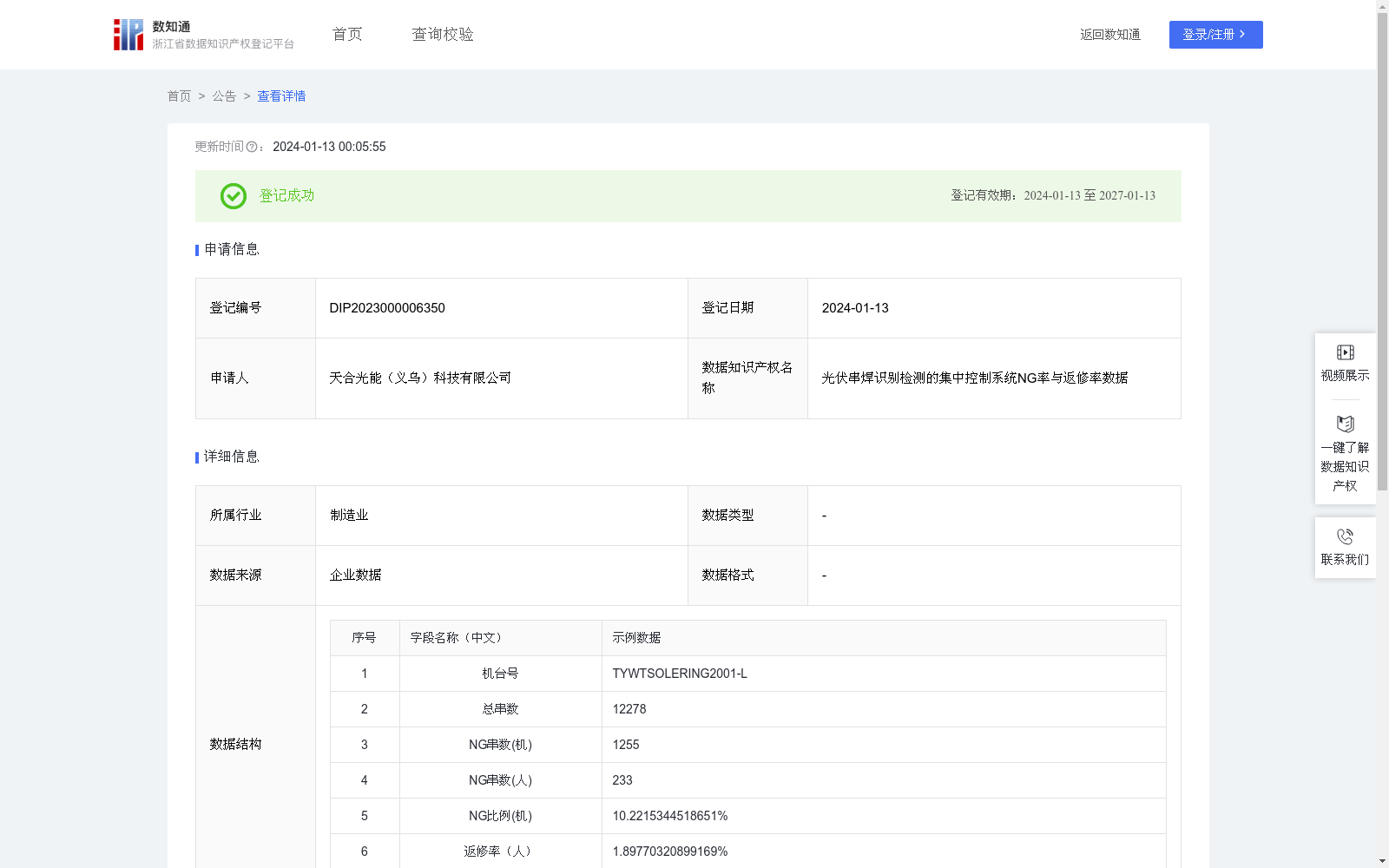
该数据集记录了光伏串焊识别检测的集中控制系统中NG率与返修率的相关数据,包括机台号、总串数、NG串数等字段,数据规模为297106条,每日更新。通过该数据可以实时监控机台状态,及时调整设备,提升产品良率。
以上内容由遇见数据集搜集并总结生成



