
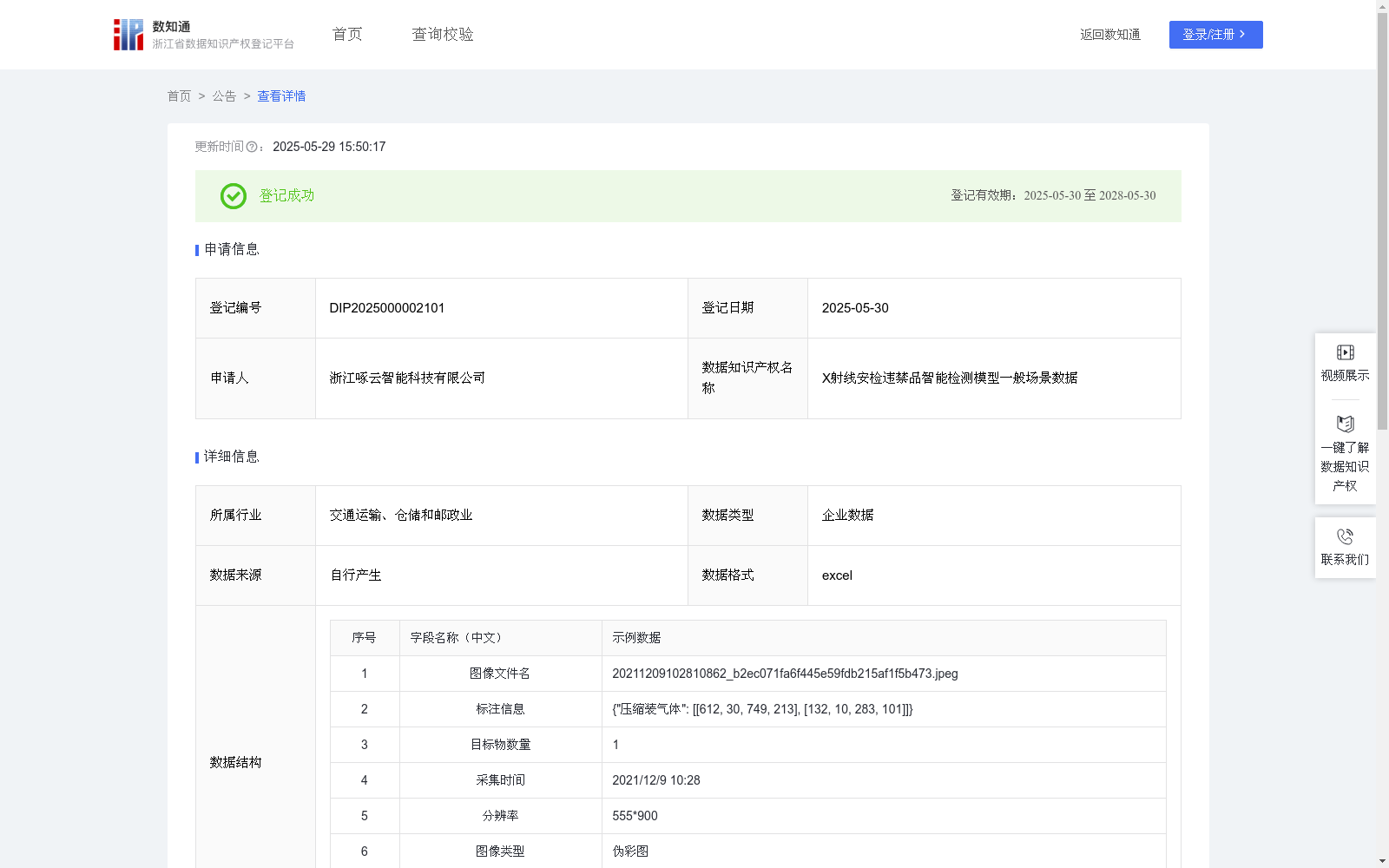
X射线安检违禁品智能检测模型一般场景数据
收藏浙江省数据知识产权登记平台2025-05-29 更新2025-05-30 收录
下载链接:
https://www.zjip.org.cn/home/announce/trends/133402
下载链接
链接失效反馈官方服务:
资源简介:
本数据集包含种类丰富、一般场景下的14类违禁品的X光安检图像,通过对图像的标注、抠图、增强、融合等处理,可作为优质样本训练生成智能检测X射线安检违禁品的算法模型,实现对一般场景下的14类X射线安检违禁品的精准识别。1)数据来源:原始数据使用自研X光安检设备自行采集得到;
2)数据清洗和标注:对收集到的数据使用传统 图像处理 方法,包括灰度化、二值化、腐蚀膨胀等操作去除包含噪声的图片数据;利用半自动标注工具得到伪标签,然后使用人工修正标注,并设置审核机制,保证标注的准确性和一致性。
3)违禁品数据集构建:构建一个包含烟花爆竹的违禁品数据集,用于在训练和推理过程中学习罐装易燃气体,气雾剂,压缩装气体,瓶装液体、打火机、电击器、管制刀具、锂电池、枪支及仿制品、日常刀具、手铐、蓄电池、烟花爆竹、子弹及仿制品等14类品项的特征,包括边缘、形状、颜色等。
4) 深度学习 架构选择:选择适合的视觉检测模型,本算法基于FasterRCNN模型构建。
5)模型训练:在标注好的数据集上训练模型,通过监督学习的方式让模型学习识别罐装易燃气体,气雾剂,压缩装气体,瓶装液体、打火机、电击器、管制刀具、锂电池、枪支及仿制品、日常刀具、手铐、蓄电池、烟花爆竹、子弹及仿制品等14类品项的特征。使用交叉验证和不同性能指标(如准确率、召回率)评估模型的识别能力。
6)超参数调优:进行超参数调优,包括学习率、模型结构和尺寸、目标损失函数等,以优化模型性能。
7)模型验证:在独立的测试集上验证模型的性能,确保模型在未见数据上也能表现良好。
8) 智能检测结果生成:通过训练好的模型和违禁品数据集,通过循证规则来完成上述14类违禁品的智能识别,最终基于算法模型输出相关属性,具体包括品项类别、品项位置和置信度;输出的置信度与阈值进行比较,如果置信度大于阈值,且品项类别为上述违禁品的具体类别,则表示检测出违禁物。
This dataset contains X-ray security images of 14 categories of prohibited items in rich general scenarios. After processing such as image annotation, matting, enhancement and fusion, it can serve as high-quality samples to train intelligent X-ray security prohibited item detection algorithms, enabling accurate identification of the 14 categories of prohibited items in general scenarios.
1) Data source: The original data was collected using self-developed X-ray security inspection equipment.
2) Data cleaning and annotation: Traditional image processing methods including grayscale conversion, binarization, erosion and dilation were applied to remove noisy image data from the collected dataset. Pseudo labels were generated via semi-automatic annotation tools, followed by manual correction of annotations and the establishment of an audit mechanism to guarantee the accuracy and consistency of the annotations.
3) Construction of the prohibited item dataset: A prohibited item dataset including firecrackers was constructed to learn the features (such as edges, shapes, colors, etc.) of 14 categories of items during training and inference, namely canned flammable gases, aerosols, compressed gases, bottled liquids, lighters, electric shock devices, controlled knives, lithium batteries, firearms and their replicas, daily knives, handcuffs, storage batteries, firecrackers, bullets and their replicas.
4) Deep learning architecture selection: A suitable visual detection model was selected, and this algorithm was built based on the Faster R-CNN model.
5) Model training: The model was trained on the annotated dataset, and it was taught to recognize the features of the 14 categories of items mentioned above through supervised learning. Cross-validation and multiple performance metrics (including accuracy and recall rate) were used to evaluate the model's recognition capability.
6) Hyperparameter tuning: Hyperparameter tuning was conducted, covering learning rate, model structure and size, target loss function and other parameters, to optimize the model's performance.
7) Model verification: The model's performance was verified on an independent test set to ensure that it performs well on unseen data.
8) Generation of intelligent detection results: Using the trained model and the prohibited item dataset, intelligent identification of the aforementioned 14 categories of prohibited items was completed through evidence-based rules. Finally, relevant attributes were output based on the algorithm model, specifically including item category, item location and confidence score. The output confidence score is compared with a predefined threshold; if the confidence score exceeds the threshold and the item category belongs to a specific type of the aforementioned prohibited items, it indicates that a prohibited item has been detected.
提供机构:
浙江啄云智能科技有限公司
创建时间:
2025-04-09
搜集汇总
数据集介绍
背景与挑战
背景概述
该数据集是一个包含14类违禁品的X光安检图像数据集,用于训练智能检测模型,数据规模大且每月更新,适用于交通运输、仓储和邮政业的安全检查场景。
以上内容由遇见数据集搜集并总结生成



