
智能床用户夜间翻身数据
收藏浙江省数据知识产权登记平台2023-11-14 更新2024-05-08 收录
下载链接:
https://www.zjip.org.cn/home/announce/trends/10405
下载链接
链接失效反馈官方服务:
资源简介:
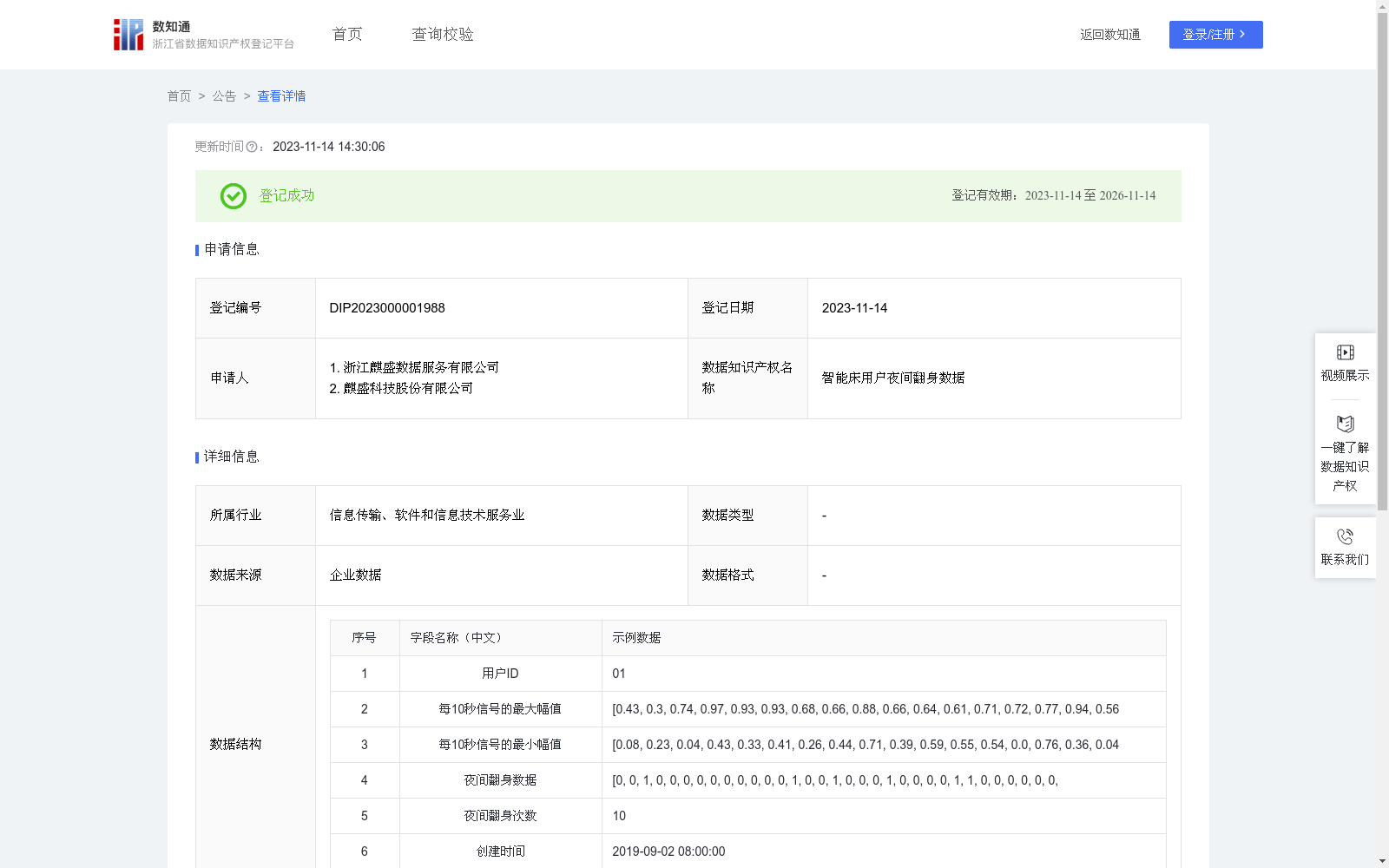
以智能床用户夜间翻身数据为基础,可以应用于多个领域和场景:1) 医疗监护:智能床可以监测床上患者的翻身情况,特别适用于长期卧床的病人,如重病、残疾或老年人。医护人员可以通过监测数据了解患者的翻身频率和时间,以便及时调整姿势,预防压疮和其他并发症的发生。2)长期护理:智能床可以用于老年人或患有运动障碍的人士的长期护理。通过监测翻身数据,护理人员可以及时提醒和协助患者翻身,减轻长时间固定姿势对身体的不适和压力,提高生活质量。3)健康管理:智能床可以与健康管理系统结合,记录用户的翻身数据并生成报告。用户可以通过分析报告了解自己的睡眠质量和翻身习惯,以便对睡眠和身体状况进行调整和改善。4)康复训练:智能床可以在康复训练中使用,通过监测翻身数据来评估患者的运动能力和进展情况。康复师可以根据数据调整训练计划,帮助患者恢复和改善运动功能。智能床的振动传感器每10秒记录信号的最大幅值和最小幅值数据。算法计算每10秒最大幅值和最小幅值之间的比值,这个比值表示为振动的相对的强度,如果10秒相对强度大于阈值10,则判定为翻身,在夜间翻身数据字段中记为1;或者连续20秒及以上的相对强度大于8,那么这20秒的数据也判断为翻身,在夜间翻身数据字段中记为连续的1。夜间翻身数据表示为每10秒中是否为翻身状态,1为翻身,0为非翻身。夜间翻身次数则根据夜间翻身数据中的数据统计获得,单个1记为1次,多个连续的1也记为1次,最后累加求和为整夜夜间的翻身次数。
Based on the nighttime turning-over data of smart bed users, this dataset can be applied to multiple domains and scenarios:
1) Medical Monitoring: Smart beds can monitor the turning-over status of in-bed patients, which is particularly suitable for long-term bedridden individuals such as those with severe illnesses, disabilities, or the elderly. Medical staff can acquire the frequency and timing of patients' turning-over via the monitoring data, enabling timely posture adjustments to prevent pressure ulcers and other complications.
2) Long-term Care: Smart beds can be utilized for long-term care of the elderly or people with motor impairments. By monitoring turning-over data, caregivers can timely remind and assist patients to reposition themselves, alleviating discomfort and pressure caused by prolonged fixed postures and improving quality of life.
3) Health Management: Smart beds can be integrated with health management systems to record users' turning-over data and generate corresponding reports. Users can analyze these reports to gain insights into their sleep quality and turning-over habits, thereby adjusting and optimizing their sleep and physical conditions.
4) Rehabilitation Training: Smart beds can be applied in rehabilitation training, where turning-over data is monitored to assess patients' motor capabilities and treatment progress. Rehabilitation therapists can adjust training plans based on the collected data to help patients recover and improve their motor functions.
The smart bed's vibration sensor records the maximum and minimum amplitude values of the signal every 10 seconds. An algorithm calculates the ratio between the maximum and minimum amplitude within each 10-second window, which represents the relative vibration intensity. If the 10-second relative intensity exceeds the threshold of 10, it is determined as a turning-over event, marked as 1 in the nighttime turning-over data field. Alternatively, if the relative intensity remains above 8 for 20 consecutive seconds or longer, this 20-second period is also classified as a turning-over event, marked as consecutive 1s in the nighttime turning-over data field.
The nighttime turning-over data indicates whether a turning-over event occurred within each 10-second interval, with 1 denoting a turning-over event and 0 denoting no turning-over. The nighttime turning-over count is derived by statistically analyzing the nighttime turning-over data: a single isolated 1 counts as one turning-over event, and multiple consecutive 1s are also counted as one single event. The final sum of these counts is the total number of nighttime turning-overs throughout the night.
提供机构:
浙江麒盛数据服务有限公司,麒盛科技股份有限公司
创建时间:
2023-10-18
搜集汇总
数据集介绍
特点
该数据集记录了智能床用户夜间翻身的相关数据,包括信号幅值和翻身次数等信息,数据来源于企业,每日更新,适用于医疗监护、长期护理、健康管理和康复训练等多个场景。
以上内容由遇见数据集搜集并总结生成



