
Bilateral international migration flow estimates for 200 countries (1990-1995 to 2015-2020)
收藏DataCite Commons2025-05-01 更新2024-07-28 收录
下载链接:
https://figshare.com/articles/dataset/Bilateral_international_migration_flow_estimates_for_200_countries_1990-1995_to_2010-2015_/7731233/5
下载链接
链接失效反馈官方服务:
资源简介:
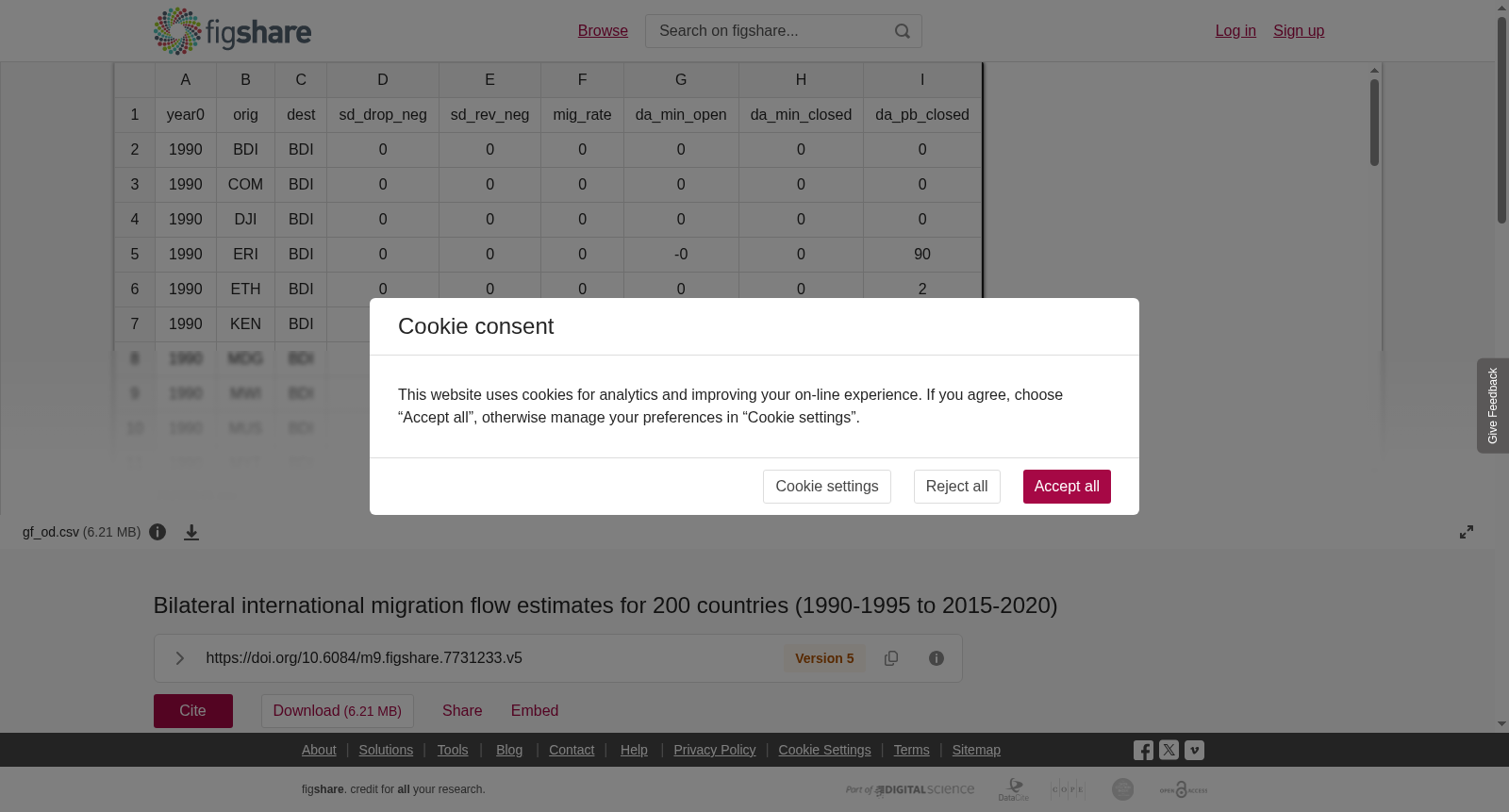
Version Details<br>Update of estimates of international migration flows from Abel & Cohen (2019) based on newly published International Migrant Stock (IMS2020) data inputs by the United Nations and the most recent WPP (WPP2019). <br><br>Also includes a correction for the treatment of Serbia, Montenegro, Sudan and South Sudan as separate countries prior to 2005. During 1990-1995, 1995-2000 and 2000-2005, 2005-2010 periods there are 197 countries, where the old three letter alpha numeric codes for Serbia and Montenegro (SCG) and Sudan (SUD) are used. The combination of these countries follows their representation in United Nations migrant stock data. In periods after 2005-2010 there are 200 countries, where Serbia, Montenegro, Sudan and South Sudan are separate (as in the paper and previous versions) and estimates for Curaçao are also feasible. A description of the changes in the estimates can be found here.<br>See Version 1 (link above) for estimates presented in the paper, based on WPP2017 and IMS2017.<br>Data Details<br><br>Row for each migration corridor - period combination (197 origins x 197 destinations x 4 periods + 200 origins x 200 destinations x 2 periods = 235,236).<br>year0 - first year of five year periodorig - origin ISO three letter country codedest - destination ISO three letter country<br> Columns for estimates based on the following migration flow estimation methods:<b><br>Stock Differencing Approaches:</b><br><br>sd_drop_neg - see for example Beine, M., Docquier, F., & Özden, Ç. (2011). Diasporas. Journal of Development Economics, 95(1), 30–41. https://doi.org/10.1016/j.jdeveco.2009.11.004<br><br>sd_rev_neg - see for example Beine, M., & Parsons, C. R. (2015). Climatic Factors as Determinants of International Migration. The Scandinavian Journal of Economics, 117(2), 723–767. https://doi.org/10.1111/sjoe.12098<br><br><b>Migration Rate Approach:</b><br><br>mig_rate - see Dennett, A. (2016). Estimating an Annual Time Series of Global Migration Flows - An Alternative Methodology for Using Migrant Stock Data. In Global Dynamics (pp. 125–142). Chichester, UK: John Wiley & Sons, Ltd. https://doi.org/10.1002/9781118937464.ch7<br><br><b>Demographic Accounting Approaches:</b><br><br>da_min_open - see Abel, G. J. (2013). Estimating global migration flow tables using place of birth data. Demographic Research, 28(March), 505–546. https://doi.org/10.4054/DemRes.2013.28.18<br><br>da_min_closed - see Abel, G. J. (2018). Estimates of Global Bilateral Migration Flows by Gender between 1960 and 2015. International Migration Review, (Fall), imre.12327. https://doi.org/10.1111/imre.12327<br><br>da_pb_closed - see Azose, J. J., & Raftery, A. E. (2018). Estimation of emigration, return migration, and transit migration between all pairs of countries. Proceedings of the National Academy of Sciences, 201722334. https://doi.org/10.1073/PNAS.1722334116<br>
版本详情
本数据集基于联合国最新发布的国际移民存量数据2020(International Migrant Stock 2020,IMS2020)以及联合国世界人口展望2019(World Population Prospects 2019,WPP2019),更新了Abel与Cohen(2019)中的国际移民流量估算结果。
此外,本数据集针对2005年之前将塞尔维亚、黑山、苏丹与南苏丹作为独立国家进行统计的处理方式作出了修正。在1990-1995、1995-2000、2000-2005及2005-2010这四个时期,数据集涵盖197个国家,此时使用塞尔维亚和黑山的旧三位字母国别代码(SCG)以及苏丹的旧代码(SUD),两国的合并规则遵循联合国移民存量数据中的分类标准。在2005-2010时期之后的统计时段,数据集涵盖200个国家,塞尔维亚、黑山、苏丹与南苏丹均作为独立国家呈现(与论文及早期版本一致),同时也支持生成库拉索(Curaçao)的移民流量估算结果。关于本次估算更新的详细说明可参见此处。如需查看基于世界人口展望2017(WPP2017)与国际移民存量数据2017(IMS2017)的论文版估算结果,请参见版本1(上方链接)。
数据详情
本数据集的每一行对应一个移民走廊(migration corridor)-时期组合,具体为:197个起源国×197个目的国×4个时期 + 200个起源国×200个目的国×2个时期 = 共计235236条数据。
各字段说明如下:
year0:五年时段的起始年份
orig:起源国ISO三位字母国别代码
dest:目的国ISO三位字母国别代码
以下为基于不同移民流量估算方法生成的估算结果列:
1. 存量差分法(Stock Differencing Approaches):
- sd_drop_neg:相关研究参见Beine, M., Docquier, F., & Özden, Ç. (2011). Diasporas. *Journal of Development Economics*, 95(1), 30–41. https://doi.org/10.1016/j.jdeveco.2009.11.004
- sd_rev_neg:相关研究参见Beine, M., & Parsons, C. R. (2015). Climatic Factors as Determinants of International Migration. *The Scandinavian Journal of Economics*, 117(2), 723–767. https://doi.org/10.1111/sjoe.12098
2. 移民率法(Migration Rate Approach):
- mig_rate:相关研究参见Dennett, A. (2016). Estimating an Annual Time Series of Global Migration Flows - An Alternative Methodology for Using Migrant Stock Data. In *Global Dynamics* (pp. 125–142). Chichester, UK: John Wiley & Sons, Ltd. https://doi.org/10.1002/9781118937464.ch7
3. 人口核算方法(Demographic Accounting Approaches):
- da_min_open:相关研究参见Abel, G. J. (2013). Estimating global migration flow tables using place of birth data. *Demographic Research*, 28(March), 505–546. https://doi.org/10.4054/DemRes.2013.28.18
- da_min_closed:相关研究参见Abel, G. J. (2018). Estimates of Global Bilateral Migration Flows by Gender between 1960 and 2015. *International Migration Review*, (Fall), imre.12327. https://doi.org/10.1111/imre.12327
- da_pb_closed:相关研究参见Azose, J. J., & Raftery, A. E. (2018). Estimation of emigration, return migration, and transit migration between all pairs of countries. *Proceedings of the National Academy of Sciences*, 201722334. https://doi.org/10.1073/PNAS.1722334116
提供机构:
figshare
创建时间:
2021-02-01
搜集汇总
数据集介绍
背景与挑战
背景概述
该数据集提供了1990-2020年间200个国家之间的双边国际移民流动估计数据,包含多种估计方法的结果。数据按五年周期组织,覆盖了197个来源国和目的国的四个时期以及200个国家的两个时期的移民流动情况。
以上内容由遇见数据集搜集并总结生成


