
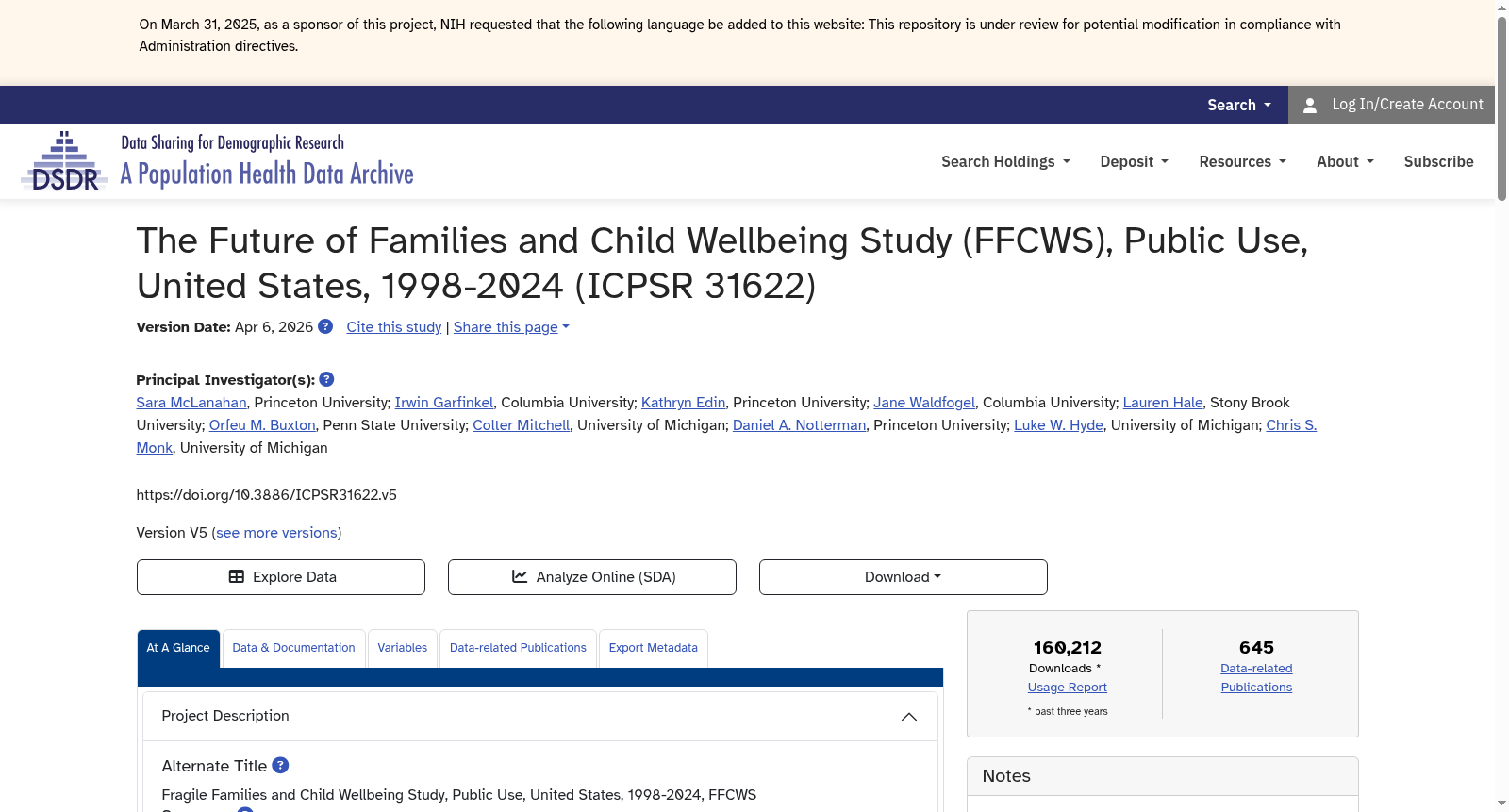
The Future of Families and Child Wellbeing Study (FFCWS), Public Use, United States, 1998-2024
收藏DataCite Commons2026-04-06 更新2025-04-16 收录
下载链接:
https://www.icpsr.umich.edu/web/DSDR/studies/31622
下载链接
链接失效反馈官方服务:
资源简介:
The Future of Families and Child Wellbeing Study (FFCWS, formerly known as the Fragile Families and Child Wellbeing Study) follows a cohort of nearly 5,000 children born in large, U.S. cities between 1998 and 2000. The study oversampled births to unmarried couples; and, when weighted, the data are representative of births in large U.S. cities at the turn of the century. The FFCWS was originally designed to address four questions of great interest to researchers and policy makers:
What are the conditions and capabilities of unmarried parents, especially fathers?
What is the nature of the relationships between unmarried parents?
How do children born into these families fare?
How do policies and environmental conditions affect families and children?
The FFCWS consists of interviews with mothers, fathers, and/or primary caregivers at birth and again when children are ages 1, 3, 5, 9, 15, and 22. The parent interviews collected information on attitudes, relationships, parenting behavior, demographic characteristics, health (mental and physical), economic and employment status, neighborhood characteristics, and program participation. Beginning at age 9, children were interviewed directly (either during the home visit or on the telephone). The direct child interviews collected data on family relationships, home routines, schools, peers, and physical and mental health, as well as health behaviors.
A collaborative study of the FFCWS, the In-Home Longitudinal Study of Pre-School Aged Children (In-Home Study) collected data from a subset of the FFCWS Core respondents at the Year 3 and 5 follow-ups to ask how parental resources in the form of parental presence or absence, time, and money influence children under the age of 5. The In-Home Study collected information on a variety of domains of the child's environment, including: the physical environment (quality of housing, nutrition and food security, health care, adequacy of clothing and supervision) and parenting (parental discipline, parental attachment, and cognitive stimulation). In addition, the In-Home Study also collected information on several important child outcomes, including anthropometrics, child behaviors, and cognitive ability. This information was collected through interviews with the child's primary caregiver, and direct observation of the child's home environment and the child's interactions with his or her caregiver.
Similar activities were conducted during the Year 9 follow-up. At the Year 15 follow-up, a condensed set of home visit activities were conducted with a subsample of approximately 1,000 teens. Teens who participated in the In-Home Study were also invited to participate in a Sleep Study and were asked to wear an accelerometer on their non-dominant wrist for seven consecutive days to track their sleep (Sleep Actigraphy Data) and that day's behaviors and mood (Daily Sleep Actigraphy and Diary Survey Data).
An additional collaborative study collected data from the child care provider (Year 3) and teacher (Years 9 and 15) through mail-based surveys. Saliva samples were collected at Year 9 and 15 (Biomarker file and Polygenic Scores). The Study of Adolescent Neural Development (SAND) COVID Study began data collection in May 2020 following the onset of the COVID-19 pandemic. It included online surveys with the young adult and their primary caregiver.
The FFCWS began its seventh wave of data collection in October 2020, around the focal child's 22nd birthday. Data collection and interviews continued through January 2024. The Year 22 wave included a young adult (YA) survey with the original focal child and a primary caregiver (PCG) survey. Data were also collected on the children of the original focal child (referred to as Generation 3, or G3).
In 2017, the FFCWS team announced the Fragile Families (FF) Challenge, a collaborative effort in which participants were tasked with using machine learning methods and FFCWS data (Baseline to Year 9) to build a model that would predict six key outcomes at Year 15. Materials used in the FF Challenge have been archived in this collection.
Documentation for these files is available on the FFCWS website under Data and Documentation. For details of updates made to the FFCWS data files, please see the project's Data Alerts page.
Data collection for the Future of Families and Child Wellbeing Study was supported by the Eunice Kennedy Shriver National Institute of Child Health and Human Development (NICHD) of the National Institutes of Health under award numbers R01HD36916, R01HD39135, and R01HD40421, as well as a consortium of private foundations.
Below is the citation for use of the FFCWS data accessed through ICPSR. For information on additional citation requirements when using FFCWS in publications, please refer to this FAQ on the FFCWS project site.
家庭与儿童福祉未来研究(The Future of Families and Child Wellbeing Study, 简称FFCWS,前身为脆弱家庭与儿童福祉研究(Fragile Families and Child Wellbeing Study))追踪了1998至2000年间美国大城市出生的近5000名儿童队列。本研究对非婚生育群体进行了过度抽样;经加权处理后,该数据可代表世纪之交美国大城市的生育情况。FFCWS最初旨在解决研究者与政策制定者高度关注的四大核心问题:
1. 非婚父母(尤其是父亲)的处境与能力如何?
2. 非婚父母之间的关系本质为何?
3. 成长于此类家庭的儿童发展状况如何?
4. 政策与环境条件如何对家庭及儿童产生影响?
FFCWS包含针对母亲、父亲及/或主要照料者的访谈,分别在儿童出生时,以及其1、3、5、9、15、22岁时开展。家长访谈涵盖态度、亲密关系、育儿行为、人口统计学特征、身心健康状况、经济与就业情况、社区环境特征以及项目参与情况等信息。自儿童9岁起,研究开始直接对儿童进行访谈(可通过家庭访问或电话进行)。直接儿童访谈采集的数据包括家庭关系、家庭日常、学校情况、同伴交往、身心健康状况以及健康行为等。
作为FFCWS的合作研究项目,家庭内学龄前儿童纵向研究(In-Home Longitudinal Study of Pre-School Aged Children, 简称In-Home Study)在第3年与第5年随访期间,从FFCWS核心受访者的子样本中采集数据,以探究以父母在场/缺席、时间与金钱为形式的亲代资源如何影响5岁以下儿童的发展。该研究采集了儿童所处环境的多维度信息,包括:物理环境(住房质量、营养与粮食安全、医疗保健、衣物与照料充足性)以及育儿行为(父母管教、亲子依恋与认知刺激)。此外,该研究还采集了多项重要的儿童结局指标数据,包括人体测量学指标、儿童行为与认知能力。此类信息通过对儿童主要照料者的访谈,以及对儿童家庭环境与儿童与其照料者互动情况的直接观察获取。
第9年随访期间开展了类似的研究活动。在第15年随访中,研究团队从约1000名青少年子样本中开展了精简版家庭访问活动。曾参与家庭内研究的青少年还被邀请参与睡眠研究,要求他们连续7天在非主导手腕佩戴加速度计,以追踪睡眠情况(睡眠活动记录仪数据(Sleep Actigraphy Data))以及当日的行为与情绪状态(每日睡眠活动记录仪与日记调查数据(Daily Sleep Actigraphy and Diary Survey Data))。
另有一项合作研究通过邮寄问卷,从儿童保育提供者(第3年)与教师(第9年与第15年)处采集数据。研究团队在第9年与第15年采集了唾液样本(生物标志物文件与多基因评分(Polygenic Scores))。青少年神经发育COVID研究(Study of Adolescent Neural Development (SAND) COVID Study)于2020年5月新冠疫情暴发后启动数据采集,包含针对成年早期受访者及其主要照料者的线上问卷。
FFCWS于2020年10月启动第七轮数据采集,恰逢核心研究儿童的22岁生日前后,数据采集与访谈工作持续至2024年1月。第22轮数据采集包含针对原始核心研究儿童的成年早期(Young Adult, 简称YA)问卷,以及针对主要照料者(Primary Caregiver, 简称PCG)的问卷。研究同时采集了原始核心研究儿童的子女数据(被称为第三代(Generation 3, 简称G3))。
2017年,FFCWS团队发起了脆弱家庭挑战(Fragile Families (FF) Challenge),该合作项目要求参与者利用机器学习方法与FFCWS数据(基线至第9年)构建模型,以预测儿童15岁时的六项关键结局指标。该挑战所用的相关材料已归档至本数据集集合中。
上述数据集的文档可在FFCWS官网的「数据与文档」板块获取。如需了解FFCWS数据文件的更新详情,请参见项目官网的数据警示页面。
家庭与儿童福祉未来研究的数据采集工作由美国国立卫生研究院下属的尤尼斯·肯尼迪·施莱佛国家儿童健康与人类发展研究所(Eunice Kennedy Shriver National Institute of Child Health and Human Development, 简称NICHD)提供资助,资助编号为R01HD36916、R01HD39135与R01HD40421,同时得到了一批私人基金会的联合支持。
以下为通过跨部门政治与社会研究联盟(Inter-university Consortium for Political and Social Research, 简称ICPSR)获取FFCWS数据时的引用格式说明。如需了解在出版物中使用FFCWS数据的额外引用要求,请参见FFCWS项目官网的常见问题解答页面。
提供机构:
ICPSR - Interuniversity Consortium for Political and Social Research
创建时间:
2014-01-11
搜集汇总
数据集介绍
背景与挑战
背景概述
该数据集是一个长期追踪研究,重点关注美国大城市中未婚父母家庭的儿童成长情况,收集了从出生到22岁的多方面数据。研究设计包括多次访谈和观察,涵盖了家庭关系、健康状况、教育、就业等多个领域,旨在了解政策和环境对家庭和儿童的影响。
以上内容由遇见数据集搜集并总结生成


