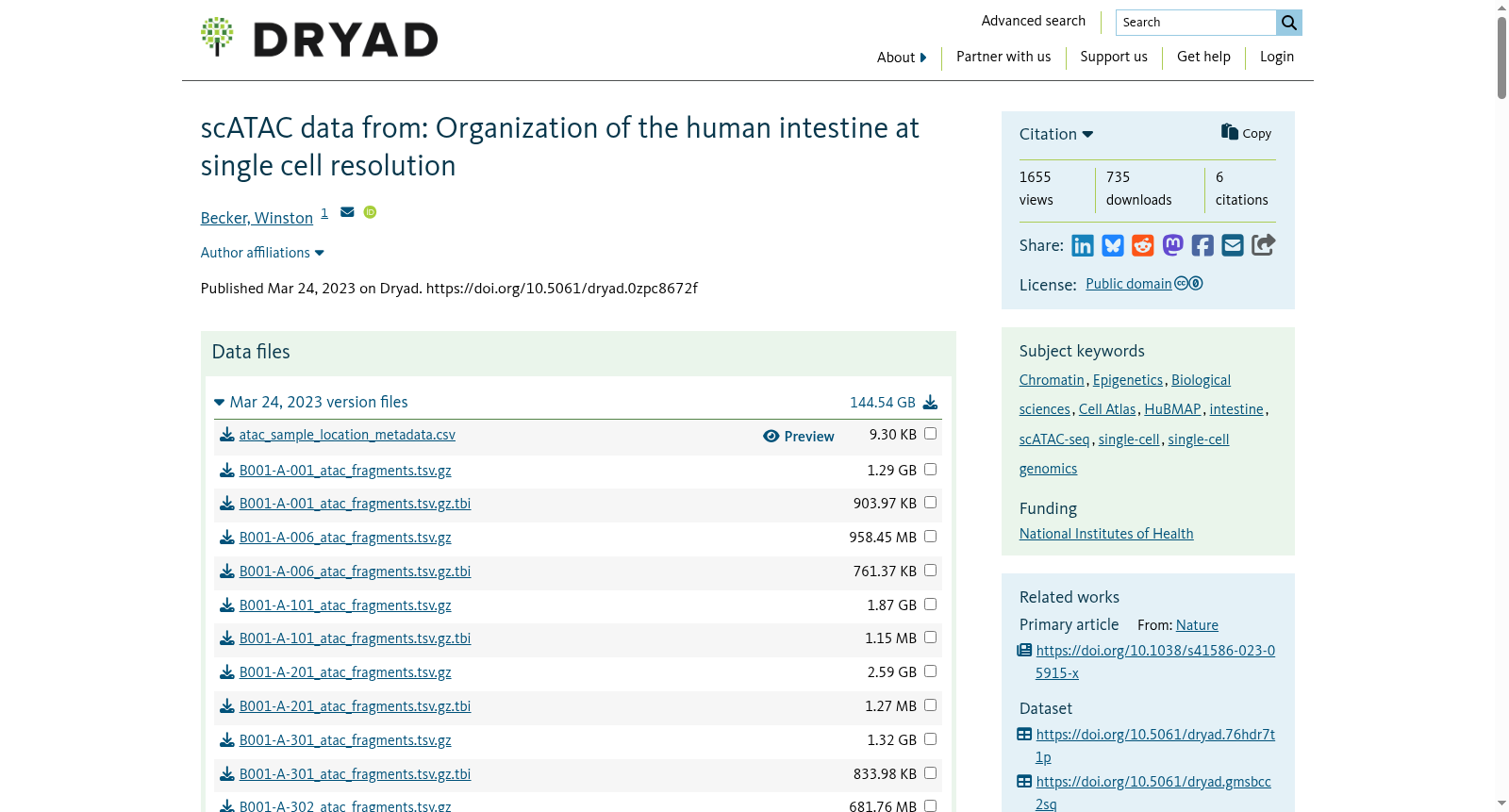
scATAC data from: Organization of the human intestine at single cell resolution
收藏资源简介:
The human adult intestinal system is a complex organ that is approximately 9 meters long and performs a variety of complex functions including digestion, nutrient absorption, and immune surveillance. We performed snATAC-seq on 8 regions of of the human intestine (duodenum, proximal-jejunum, mid-jejunum, ileum, ascending colon, transverse colon, descending colon, and sigmoid colon) from 9 donors (B001, B004, B005, B006, B008, B009, B010, B011, and B012). In the corresponding paper, we find cell compositions differ dramatically across regions of the intestine and demonstrate the complexity of epithelial subtypes. We map gene regulatory differences in these cells suggestive of a regulatory differentiation cascade, and associate intestinal disease heritability with specific cell types. These results describe the complexity of the cell composition, regulation, and organization in the human intestine, and serve as an important reference map for understanding human biology and disease.
成年人类肠道是一个复杂的器官,总长约9米,具备消化、营养吸收与免疫监视等多种复杂生理功能。我们对9名供者(B001、B004、B005、B006、B008、B009、B010、B011、B012的人体肠道8个区域——十二指肠、近端空肠、中端空肠、回肠、升结肠、横结肠、降结肠、乙状结肠开展了单细胞核转座酶可及性测序(snATAC-seq)。在本研究相关论文中,我们发现肠道不同区域的细胞组成存在显著差异,并证实了上皮细胞亚型的复杂性。我们解析了这些细胞中的基因调控差异,提示存在调控分化级联反应,并将肠道疾病遗传力与特定细胞类型建立关联。本研究结果揭示了人体肠道的细胞组成、调控机制与组织结构的复杂性,可为理解人类生物学及疾病提供重要的参考图谱。