
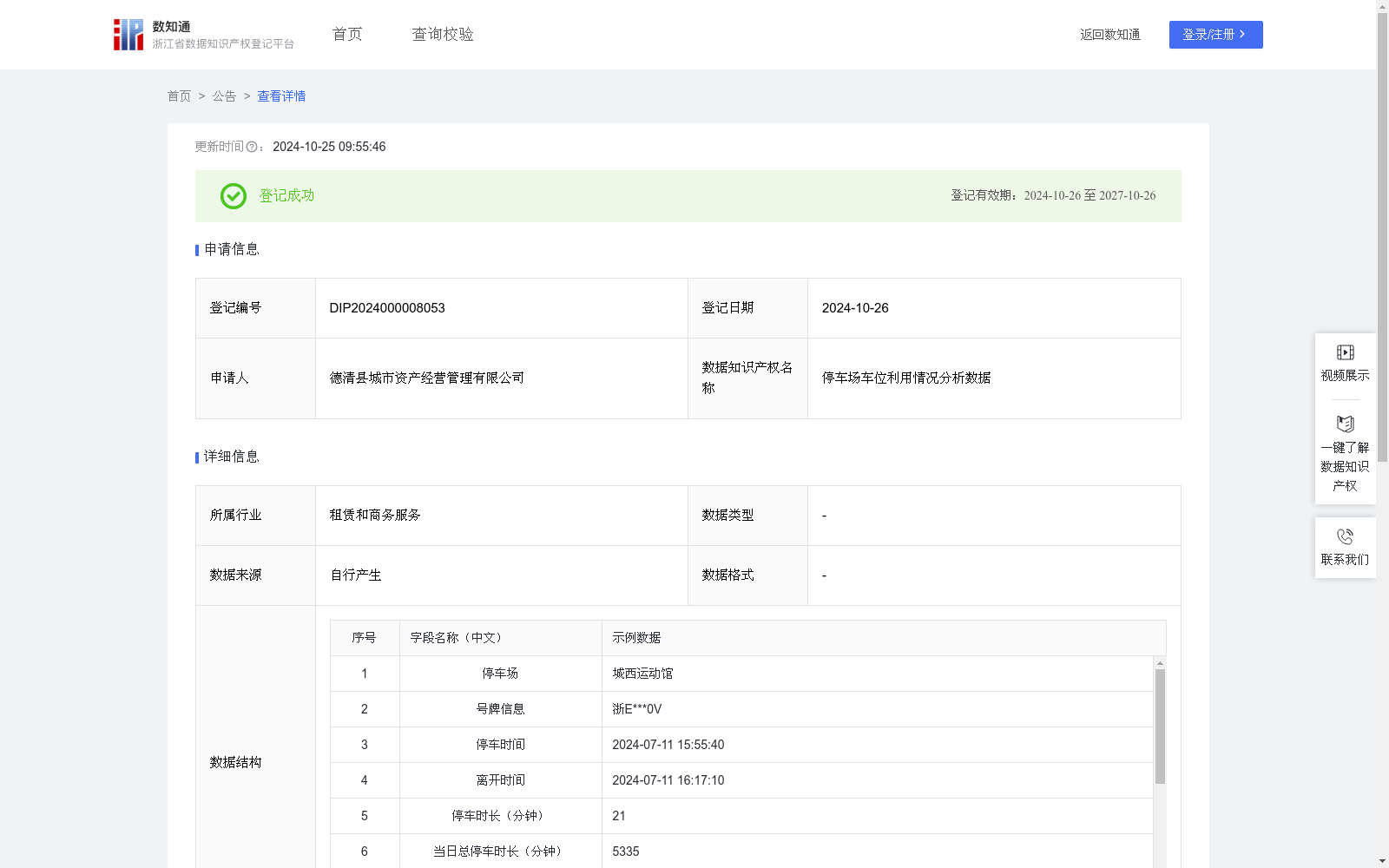
停车场车位利用情况分析数据
收藏浙江省数据知识产权登记平台2024-10-25 更新2024-10-26 收录
下载链接:
https://www.zjip.org.cn/home/announce/trends/75385
下载链接
链接失效反馈官方服务:
资源简介:
本数据对不同停车场每日的停车时长进行分析判断,可以应用到以下场景中:1、评估停车场的使用效率:如果停车场内车辆停留时间波动较大,意味着存在部分车辆长时间占用停车位,而另一部分车辆则频繁进出,这可能导致停车场资源的浪费和拥堵,不利于停车场的整体管理。2、指导停车管理策略:可以帮助判断是否采取分区管理、动态调整停车费用等措施,以鼓励车辆快速周转,提高停车位的利用率。3、优化停车场建设:根据停车时长的变化趋势,预测未来停车需求的变化,为停车场的规划和扩建提供依据。4、辅助交通规划:通过分析不同停车场的停车时长规律,了解交通流量的分布和变化特征,进而优化道路设计、交通信号控制等交通管理措施,缓解交通拥堵问题。5、提升用户体验:可以向车主反映出停车场内某些时段停车位紧张、某些区域停车不便等问题,帮助车主科学选择出行时间及停车地点。6、商业决策与布局:停车时间反映出商圈的活跃度,周边商户可以根据停车时长的特点调整经营策略,优化商业布局,如设置不同的促销活动时段。7、反映居民出行的特征:居民区停车时长较为稳定,意味着居民出行规律且集中,办公区停车时长波动较大则可能表明上班族的工作时间较为灵活。1、数据采集:系统实时抓取各个停车场车辆出入信息,记录号牌信息、停车时间、离开时间、停车时长等数据。2、对统计范围内同一停车场同一日期的停车时长进行累加,记为当日总停车时长,对统计范围内同一停车场同一日期的停车次数进行累计,记为当日总停车次数,当日平均停车时长=当日总停车时长/车位总数,3、各车辆的停车时长与当日平均停车时长的差的平方记为D,D=(各车辆停车时长-当日平均停车时长)²,4、方差S=(本停车场当日D值的和)/当日总停车次数,5、标准差σ=SQRT(S),6、根据停车场的计费规则以及以往停车时长情况,当σ小于30时,判断为当日停车时长较为稳定,停车场资源的管理和分配更加高效,减少了车位周转的不确定性和资源浪费,当σ大于30小于65时,判断为不同车辆的停车时长存在一定的差异,意味着在停车资源的分配和管理上仍有优化空间,当σ大于65时,判断为停车时间波动较大,可能存在部分车辆长时间占用停车位,而另一部分车辆则频繁进出的情况。
This dataset analyzes and judges the daily parking duration of different parking lots, and can be applied to the following scenarios:
1. Evaluate parking lot usage efficiency: If the parking duration of vehicles in a parking lot fluctuates greatly, it means that some vehicles occupy parking spaces for a long time while others enter and exit frequently, which may lead to waste of parking resources and congestion, which is not conducive to the overall management of the parking lot.
2. Guide parking management strategies: It can help determine whether to take measures such as zoning management and dynamic adjustment of parking fees to encourage rapid vehicle turnover and improve the utilization rate of parking spaces.
3. Optimize parking lot construction: According to the changing trend of parking duration, predict the changes of future parking demand, and provide a basis for the planning and expansion of parking lots.
4. Assist traffic planning: By analyzing the parking duration rules of different parking lots, understand the distribution and changing characteristics of traffic flow, and then optimize traffic management measures such as road design and traffic signal control to alleviate traffic congestion.
5. Improve user experience: It can inform car owners of problems such as tight parking spaces during certain periods and inconvenient parking in certain areas in the parking lot, helping car owners scientifically choose travel time and parking locations.
6. Support business decision-making and layout: Parking duration reflects the activity of the business district. Surrounding merchants can adjust their business strategies and optimize the commercial layout according to the characteristics of parking duration, such as setting different promotion time slots.
7. Reflect residents' travel characteristics: The relatively stable parking duration in residential areas means that residents travel regularly and intensively, while the large fluctuation of parking duration in office areas may indicate that office workers have flexible working hours.
1. Data Collection: The system captures the vehicle entry and exit information of each parking lot in real time, and records data such as license plate information, parking time, departure time, and parking duration.
2. Sum the parking durations of the same parking lot on the same date within the statistical scope, which is recorded as the total daily parking duration; accumulate the number of parking times of the same parking lot on the same date within the statistical scope, which is recorded as the total daily parking times. The average daily parking duration = total daily parking duration / total number of parking spaces.
3. The square of the difference between the parking duration of each vehicle and the average daily parking duration is recorded as D, where D = (vehicle parking duration - average daily parking duration)².
4. Variance S = (sum of D values of this parking lot on the same day) / total daily parking times.
5. Standard deviation σ = SQRT(S).
6. Based on the charging rules of the parking lot and the historical parking duration data, when σ is less than 30, it is judged that the parking duration on that day is relatively stable, and the management and allocation of parking resources are more efficient, reducing the uncertainty of parking space turnover and resource waste; when 30 < σ < 65, it is judged that there are certain differences in the parking duration of different vehicles, indicating that there is still room for optimization in the allocation and management of parking resources; when σ > 65, it is judged that the parking duration fluctuates greatly, and there may be situations where some vehicles occupy parking spaces for a long time while others enter and exit frequently.
提供机构:
德清县城市资产经营管理有限公司
创建时间:
2024-09-06
搜集汇总
数据集介绍
以上内容由遇见数据集搜集并总结生成


