UNCONSCIOUS RETENTION AND SEMANTIC PROCESSING OF SUBLIMINAL INFORMATION Data Set .xlsx
收藏资源简介:
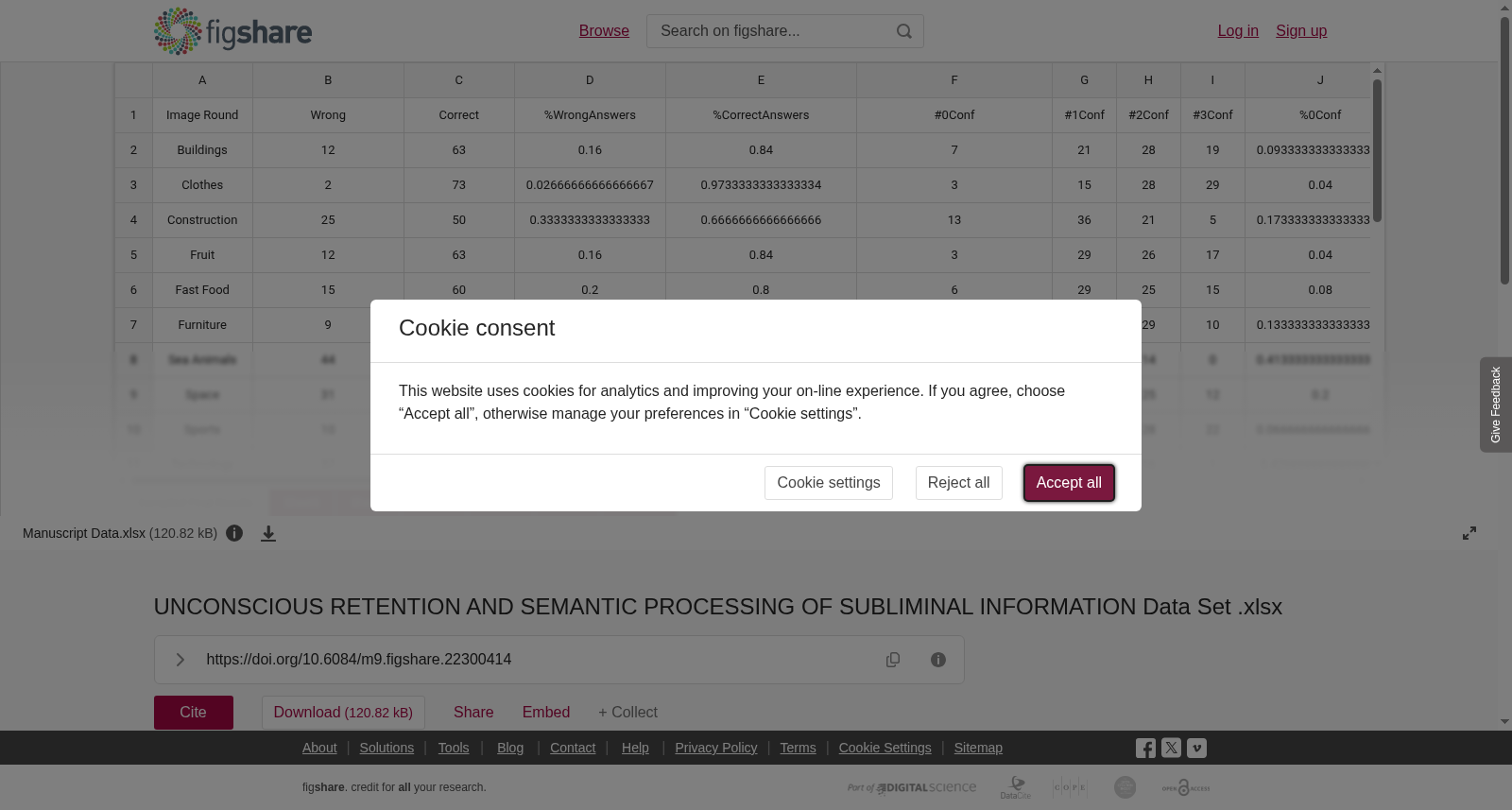
In the present study, we performed subliminal semantic priming of fifteen different object categories to explore if unconsciously retained information is processed up to the semantic level. We presented subjects with ten different strongly masked stimuli belonging to the same category and asked them to identify the category in a forced choice task (FCT). Data correspond to the responses of 25 participants in our semantic priming experiment performed through E-prime 2.0 on an ASUS VG248 Computer. The monitor was an HP ProDesk 400 G2 with a refresh rate of 144,001Hz. The following object categories were selected for this experiment: buildings, clothing items, construction items, fruits, fast food, furniture, sea animals, space objects, sports, technology gadgets, vegetables, musical instruments, mammals, insects, and vehicles. A total of 11 black-and-white line drawings depicting different objects were used for each category, 10 of which served as masked primes and one as the visible target in the forced choice task (FCT) following subliminal priming. Another 45 visually similar line drawings depicting random, unrelated objects were used for the forced choice tasks. A black-and-white hand-drawn abstract mask was used to make the stimuli subliminal. Each object category was presented 3 times over the course of the experiment, adding up to a total of 45 rounds of subliminal semantic priming. One round consisted of 10 masked stimuli, followed by a FCT, and a confidence scale. Within each round, the order in which the stimuli were presented was randomized. Although each individual category was primed 3 times total, the order of the concepts within the trial was random, with no two consecutive rounds priming the same concept. The experiment started with a focus image of 1500 milliseconds (ms), followed by the first round of priming. Each of the 10 stimuli was presented for 27 ms and followed by a 150 ms mask. The same procedure was repeated for all 45 rounds of priming. Between each concept round, the focus image was displayed for 3 seconds. The mask image remained the same throughout the entire experiment, and there were no blank intervals. Following the 10 subliminal presentations, participants were given a forced choice task. They were shown 2 images, one depicting a new object belonging to the primed category, and the other depicting a random, unrelated object. Participants were asked to identify which image they saw, without knowing that neither of the two images were previously presented to them. They were asked to press ‘1’ for the left-hand image or ‘2’ for the right-hand image. The parity of the correct answer was randomized and the images in the FCT were different in each round. After responding, participants were asked to rate their confidence in the answer on a scale from 0–not at all confident to 3–very confident. The question provided a subjective measure of participants’ level of awareness of what they had seen. Lower confidence ratings would suggest less awareness of visual perception. A binomial test was performed for the overall accuracy compiling the results from all participants and all categories. The results showed to be significant (alpha<0.05) with an overall accuracy of 77%. A Chi-Square was used to determine which specific categories were significantly different (alpha<0.05) in accuracy among participants as compared to each category.
本研究针对15种不同物体类别开展阈下语义启动实验,旨在探究无意识留存的信息是否可被加工至语义层面。实验中,我们向被试呈现10个隶属于同一类别的强掩蔽刺激,并要求其在迫选任务(forced choice task, FCT)中识别该物体类别。本数据集包含25名被试在本语义启动实验中的反应数据,实验通过E-prime 2.0在华硕(ASUS)VG248电脑上开展,所用显示器为惠普(HP)ProDesk 400 G2,刷新率达144.001Hz。 本实验选取的物体类别如下:建筑物、衣物、建筑用品、水果、快餐、家具、海洋动物、太空物体、运动器材、科技数码产品、蔬菜、乐器、哺乳动物、昆虫、交通工具。每个类别共使用11幅黑白线条画呈现不同物体;其中10幅作为掩蔽启动刺激,剩余1幅作为阈下启动后迫选任务中的可见目标刺激。此外,本实验还使用了45幅视觉相似的黑白线条画呈现随机无关物体,供迫选任务使用。实验采用手绘黑白抽象掩蔽刺激,使目标刺激处于阈下水平。 每个物体类别在实验中被呈现3次,总计开展45轮阈下语义启动实验。每一轮实验包含10个掩蔽刺激,随后开展迫选任务并进行自信心评分。每一轮中,刺激的呈现顺序均为随机化处理。尽管每个类别总计被启动3次,但实验试次内的概念呈现顺序为随机,且连续两轮不会启动同一类别概念。 实验以1500毫秒(ms)的注视点图像启动,随后进入第一轮启动任务。10个刺激中的每一个均呈现27毫秒,随后呈现时长150毫秒的掩蔽刺激。全部45轮启动任务均重复上述流程。每轮类别启动任务之间,注视点图像将呈现3秒。整个实验过程中掩蔽图像保持一致,且无空白间隔时段。 完成10次阈下呈现后,被试将接受迫选任务:屏幕上将呈现两张图像,一张为隶属于启动类别的新异物体,另一张为随机无关物体。要求被试判断自己看到的是哪一张图像,但被试并不知晓两张图像均未在之前的实验中呈现过。被试需按键盘"1"键选择左侧图像,或按"2"键选择右侧图像。正确答案的奇偶性为随机设置,且每轮迫选任务中的图像均不相同。 作答完成后,要求被试针对自身答案的自信程度进行评分,评分范围为0分(完全不自信)至3分(非常自信)。该评分用于主观衡量被试对所呈现视觉信息的觉知水平,评分越低则表明被试的视觉感知觉知程度越弱。 针对所有被试与所有类别的总准确率,本研究采用二项检验进行分析,结果显示总准确率达77%,具有统计学显著性(α<0.05)。为进一步探究各分类别间的准确率差异,本研究采用卡方检验进行分析,结果显示部分类别准确率存在统计学显著性差异(α<0.05)。