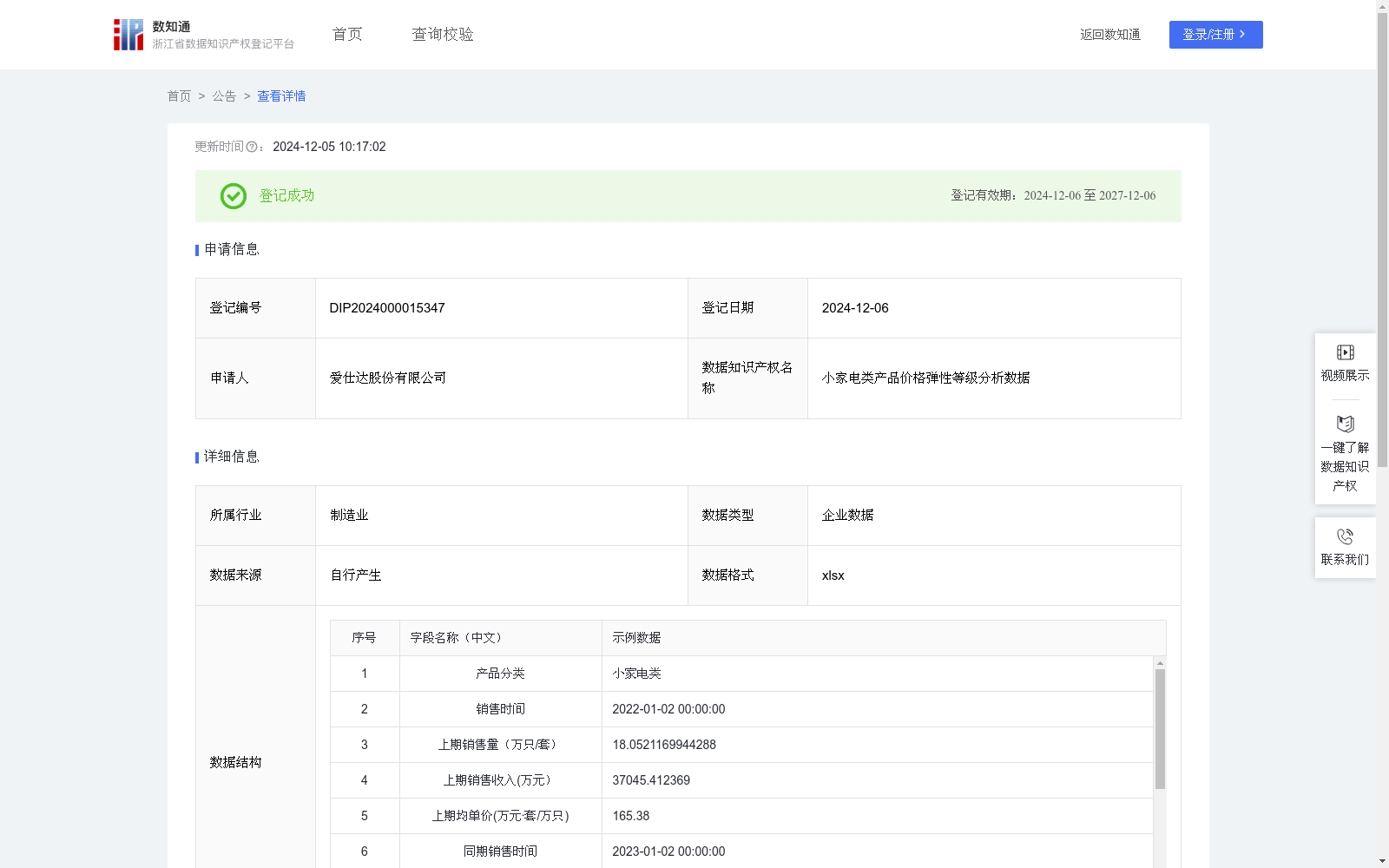
小家电类产品价格弹性等级分析数据
收藏资源简介:
通过分析小家电类增加销量;对于缺乏弹性的产品,可以通过提供增值服务来提高附加值。(1)竞争策略: 了解竞争对手的产品价格弹性,可以帮助企业在市场竞争中采取更有针对性的策略。如果竞争对手的产品是富有弹性的,企业可以通过降价来吸引客户;如果竞争对手的产品是缺乏弹性的,企业可以通过提高质量和服务来赢得市场份额。(2)成本控制:企业可以更好地预测不同价格策略下的收入变化,从而更有效地控制成本和优化资源配置。(3)风险管理:可帮助企业评估价格变动对业务的影响,从而更好地管理风险。例如,对于富有弹性的产品,企业需要更加关注市场价格波动,并及时调整策略。采集了小家电类产品的销售量和产品单价,分析该产品的价格弹性(Price Elasticity of Demand, PED)来评价该产品单价变化对销售量变化的敏感程度。 销售量变化=|(上期销售量-同期销售量)/上期销售量| 均单价变化=|(上期均单价-同期均单价)/上期均单价|; 价格弹性=销售量变化/均单价变化; 利用PED的绝对值,可以将商品的需求分为不同的弹性等级: (1)完全无弹性: |PED| = 0,无论价格如何变化,需求量保持不变,可以提高价格而不担心销量下降。 (2)缺乏弹性:0 < |PED| < 1,提高价格可能会增加总收入,因为需求量的变化相对较小,可以考虑适当提价以提高利润。 (3)单位弹性:|PED| = 1,价格上涨或下降的百分比与需求量变化的百分比相同,总收入不会因为价格变化而改变;企业可以考虑保持当前价格,或者通过其他方式(如提高产品质量、增加营销活动)来增加收入。 (4)富有弹性:1 < |PED| ≤ 10,降低价格可能会显著增加销售量,从而提高总收入;提高价格会显著减少销售量,导致总收入下降,应谨慎考虑调价。 (5)完全弹性:|PED| >10,微小价格变化都会导致需求量的显著变化,应非常小心地调整价格,以免失去大量客户。
This dataset is designed to analyze small household appliances for sales growth; for products with inelastic demand, value-added services can be provided to enhance their added value. (1) Competitive Strategy: Understanding the price elasticity of competitors’ products can help enterprises formulate more targeted competitive strategies. If a competitor’s product is price-elastic, the enterprise can attract customers via price cuts; if the competitor’s product is price-inelastic, the enterprise can seize more market share by improving product quality and services. (2) Cost Control: Enterprises can better forecast revenue changes under different pricing strategies, thus enabling more effective cost control and resource allocation optimization. (3) Risk Management: This analysis can assist enterprises in evaluating the impact of price adjustments on their business, thereby enhancing risk management capabilities. For instance, for price-elastic products, enterprises need to closely monitor market price fluctuations and adjust their strategies promptly. This dataset collects the sales volume and unit price of small household appliances, and analyzes the Price Elasticity of Demand (PED) to evaluate the sensitivity of product unit price changes to sales volume changes. The relevant calculation formulas are as follows: - Change in sales volume = |(sales volume of the previous period - sales volume of the same period) / sales volume of the previous period| - Change in average unit price = |(average unit price of the previous period - average unit price of the same period) / average unit price of the previous period| - Price Elasticity of Demand = change in sales volume / change in average unit price Based on the absolute value of PED, product demand can be categorized into the following elasticity levels: 1. Perfectly inelastic demand: |PED| = 0. No matter how prices change, demand remains unchanged, and enterprises can raise prices without fearing a drop in sales. 2. Relatively inelastic demand: 0 < |PED| < 1. Raising prices may increase total revenue, as the change in demand is relatively small; enterprises can consider appropriate price hikes to boost profits. 3. Unitary elastic demand: |PED| = 1. The percentage change in price is identical to the percentage change in demand, so total revenue will not change with price adjustments. Enterprises can maintain current prices, or increase revenue through other means such as improving product quality and launching marketing campaigns. 4. Relatively elastic demand: 1 < |PED| ≤ 10. Lowering prices may significantly boost sales volume and thus increase total revenue; raising prices will drastically reduce sales and lead to a decline in total revenue, so price adjustments should be made with great caution. 5. Perfectly elastic demand: |PED| > 10. Minor changes in prices will trigger significant shifts in demand, so enterprises must adjust prices extremely carefully to avoid losing a large number of customers.