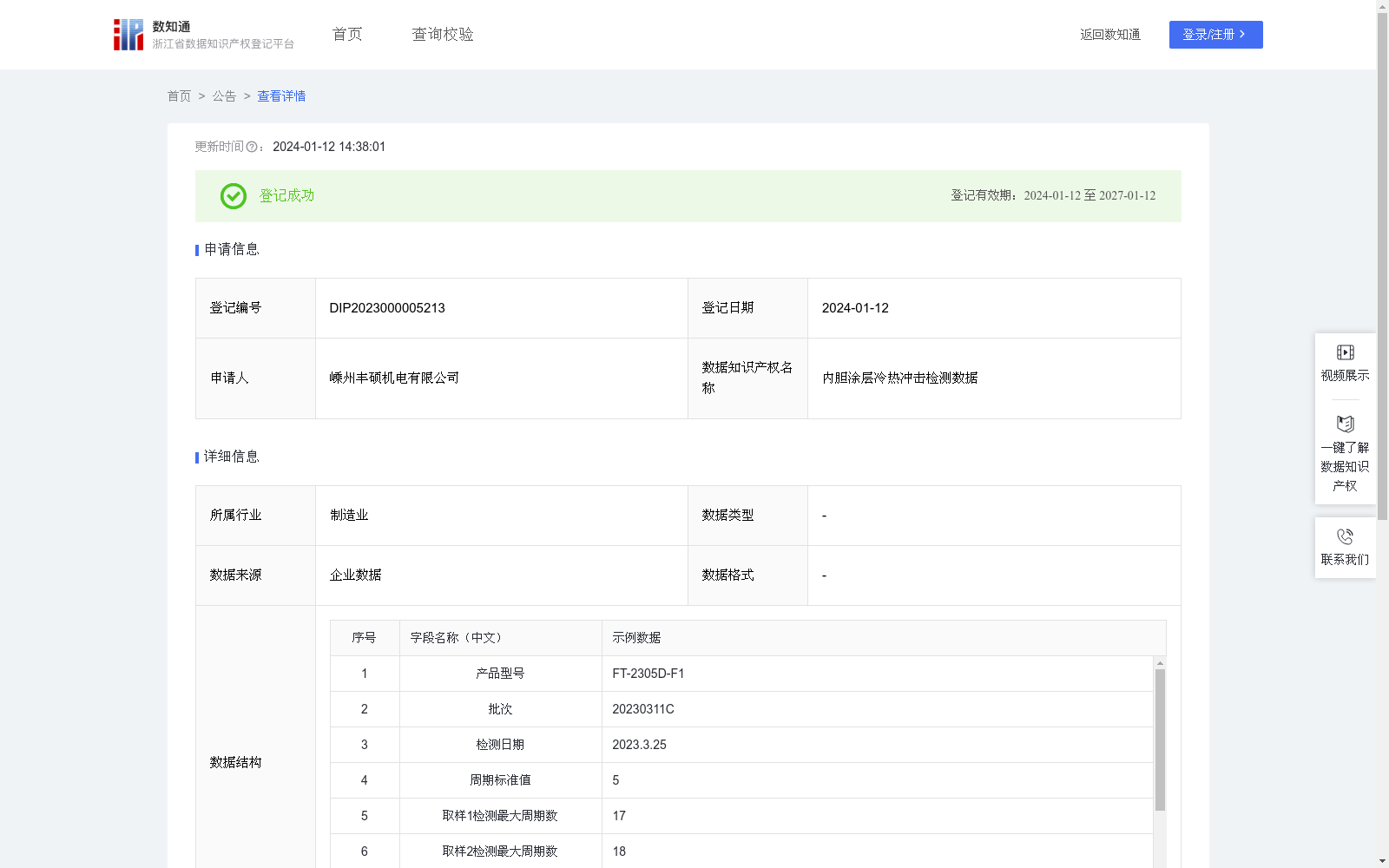
内胆涂层冷热冲击检测数据
收藏资源简介:
内胆涂层冷热冲击检测是考验内胆涂层稳定性的重要指标。内胆涂层冷热冲击试验时,将样品加热至250℃,稳定10min后,取出立即浸泡入室温水中,对涂层表面进行观察,要求涂层无开裂,脱落及其他可见的变化。统计公司内部质检部门对不同型号和批次的内胆涂层冷热冲击检测数据,分析取样检测时内胆涂层能够接受冷热冲击的平均周期数与周期标准值之间的差别,得到评级指数,通过评级指数对该型号和批次的内胆涂层进行质量评级,以便更好的把控产品的质量。1.数据统计:汇总公司质检部门提供的各型号和批次的内胆涂层冷热冲击检测最大周期数,明确内胆涂层冷热冲击周期标准值。2.数据处理:通过每种型号和批次内胆涂层冷热冲击检测最大周期数,计算得到平均周期数;再通过(平均周期数-周期标准值)÷周期标准值,计算得到该型号和批次的内胆涂层冷热冲击性能的评级指数,最后通过评级指数得到该内胆涂层冷热冲击性能的评级。其中,评级A为评级指数≥2,评级B为2>评级指数≥1,评级C为1>评级指数≥0,评级D为0>评级指数。3.数据应用:公司可以借助内胆涂层冷热冲击性能的评级,直观了解该批次产品的冷热冲击性能情况,以保证产品质量稳定。
The hot-cold shock test is a critical indicator for evaluating the stability of inner tank coatings. During the test, a coating sample is heated to 250°C, held at this temperature for 10 minutes, then immediately removed and immersed in room-temperature water. The coating surface is then inspected, with the requirement that no cracking, peeling, or other visible defects occur. This dataset compiles hot-cold shock test data of inner tank coatings across different models and batches from the company's internal quality inspection department. It analyzes the discrepancy between the average number of shock cycles the coatings can withstand during sampling inspection and the standard cycle value, derives a rating index, and uses this index to conduct quality grading for the coatings of the corresponding model and batch, thereby enabling better product quality control. 1. Data Statistics: Summarize the maximum hot-cold shock cycle counts from the tests of inner tank coatings of each model and batch provided by the company's quality inspection department, and confirm the standard cycle value for the hot-cold shock resistance of inner tank coatings. 2. Data Processing: Calculate the average number of cycles based on the maximum hot-cold shock cycle counts of each model and batch of inner tank coatings. Then, compute the rating index for the hot-cold shock resistance performance of the coatings using the formula: (average number of cycles - standard cycle value) / standard cycle value. Finally, assign a performance rating based on the rating index, with the following criteria: Rating A for rating index ≥2; Rating B for 2 > rating index ≥1; Rating C for 1 > rating index ≥0; Rating D for rating index <0. 3. Data Application: The company can use the performance ratings of the inner tank coatings' hot-cold shock resistance to intuitively understand the performance of each product batch, thus ensuring stable product quality.