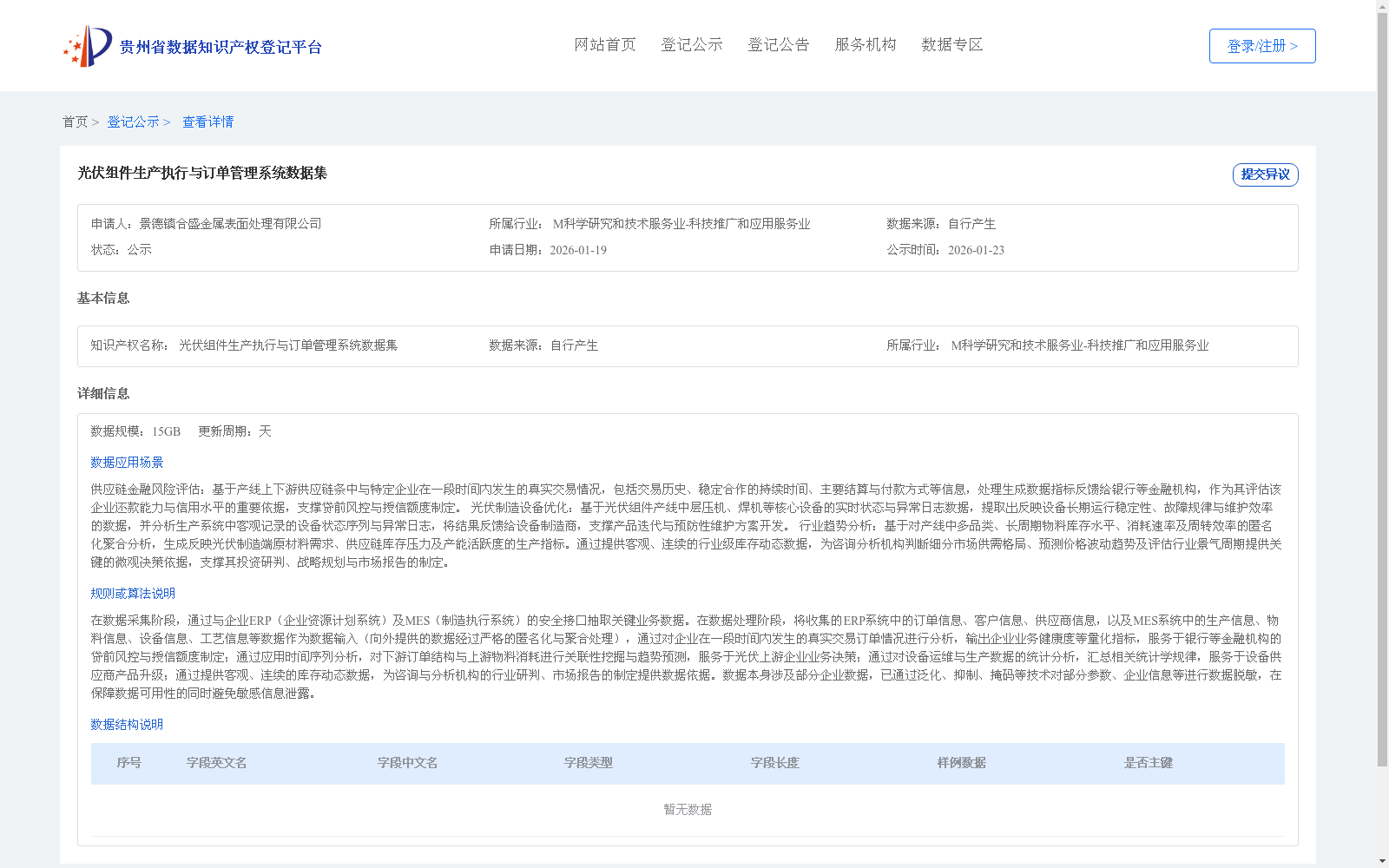
光伏组件生产执行与订单管理系统数据集
收藏资源简介:
在数据采集阶段,通过与企业ERP(企业资源计划系统)及MES(制造执行系统)的安全接口抽取关键业务数据。在数据处理阶段,将收集的ERP系统中的订单信息、客户信息、供应商信息,以及MES系统中的生产信息、物料信息、设备信息、工艺信息等数据作为数据输入(向外提供的数据经过严格的匿名化与聚合处理),通过对企业在一段时间内发生的真实交易订单情况进行分析,输出企业业务健康度等量化指标,服务于银行等金融机构的贷前风控与授信额度制定;通过应用时间序列分析,对下游订单结构与上游物料消耗进行关联性挖掘与趋势预测,服务于光伏上游企业业务决策;通过对设备运维与生产数据的统计分析,汇总相关统计学规律,服务于设备供应商产品升级;通过提供客观、连续的库存动态数据,为咨询与分析机构的行业研判、市场报告的制定提供数据依据。数据本身涉及部分企业数据,已通过泛化、抑制、掩码等技术对部分参数、企业信息等进行数据脱敏,在保障数据可用性的同时避免敏感信息泄露。
During the data collection phase, key business data is extracted via secure interfaces with enterprise ERP (Enterprise Resource Planning) and MES (Manufacturing Execution System) systems. During the data processing phase, collected data including order information, customer information, supplier information from ERP systems, as well as production information, material information, equipment information, process information and other relevant data from MES systems are employed as data inputs. Externally disseminated data has undergone rigorous anonymization and aggregation processing. By analyzing real transaction order records of enterprises over a specified period, quantitative indicators such as enterprise business health are generated, which support pre-loan risk control and credit limit formulation for financial institutions such as banks. By applying time series analysis to conduct correlation mining and trend prediction for downstream order structures and upstream material consumption, the outcomes facilitate business decision-making for upstream photovoltaic enterprises. Through statistical analysis of equipment operation and maintenance and production data, relevant statistical regularities are summarized to support product upgrades for equipment suppliers. By providing objective and continuous dynamic inventory data, this dataset offers data support for industry research and market report development by consulting and analysis institutions. The dataset involves partial enterprise-sensitive data, and data desensitization has been performed on certain parameters and enterprise information via technologies including generalization, suppression and masking, ensuring data availability while preventing sensitive information leakage.