ClarusC64/protein-folding-pathway-instability-v0.1
收藏资源简介:
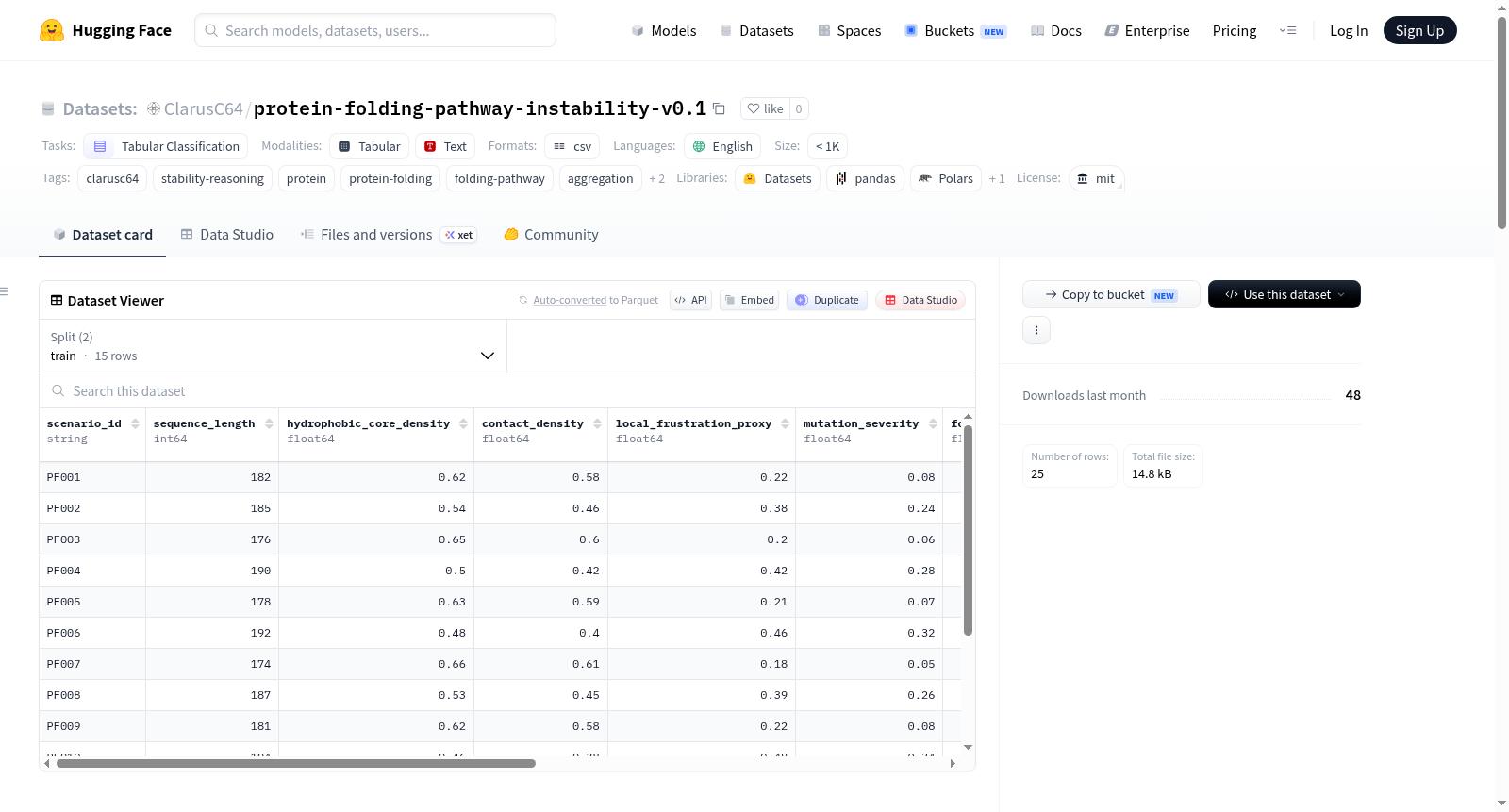
该数据集用于评估模型是否能检测蛋白质折叠路径中的不稳定性。每行代表一个简化的蛋白质折叠场景,包含结构稳定性的代理变量。任务是根据这些变量判断折叠路径是否稳定。蛋白质折叠稳定性取决于多个因素,如疏水核心形成、残基接触密度、突变压力、折叠路径延迟、伴侣蛋白依赖性和聚集风险。预测目标是判断折叠路径是否不稳定(label=1)或稳定(label=0)。每行包含的结构稳定性代理变量包括序列长度、疏水核心密度、残基接触密度、局部挫败代理、突变严重性、折叠延迟代理、伴侣蛋白依赖性代理、热稳定性代理和聚集风险代理。评估方法要求提交预测结果文件,计算指标包括准确率、精确率、召回率、F1分数和混淆矩阵。数据集反映了通过可观察结构代理表达的潜在折叠稳定性几何结构,但不包含生成器和潜在稳定性规则。
This dataset evaluates whether models can detect instability in protein folding pathways. Each row represents a simplified protein folding scenario defined by structural and interaction proxies. The task is to determine whether the folding pathway is stable or likely to produce misfolding or aggregation. Protein folding stability depends on interactions between: hydrophobic core formation, residue contact density, mutation pressure, folding pathway delay, chaperone dependency, and aggregation risk. A protein may have a plausible folded structure but still exhibit instability in the folding pathway. The prediction target is label = 1 → folding pathway instability, label = 0 → stable folding pathway. Each row contains proxies describing structural stability: sequence length, hydrophobic core density, residue contact density, local frustration proxy, mutation severity, folding delay proxy, chaperone dependency proxy, thermal stability proxy, and aggregation risk proxy. Predictions must follow scenario_id,prediction format. Evaluation metrics include accuracy, precision, recall, f1, and confusion matrix. This dataset reflects latent folding stability geometry expressed through observable structural proxies. The generator and underlying stability rules are not included.