<i>In</i><i>silico</i> models to predict tubular secretion or reabsorption clearance pathway using physicochemical properties and structural characteristics
收藏资源简介:
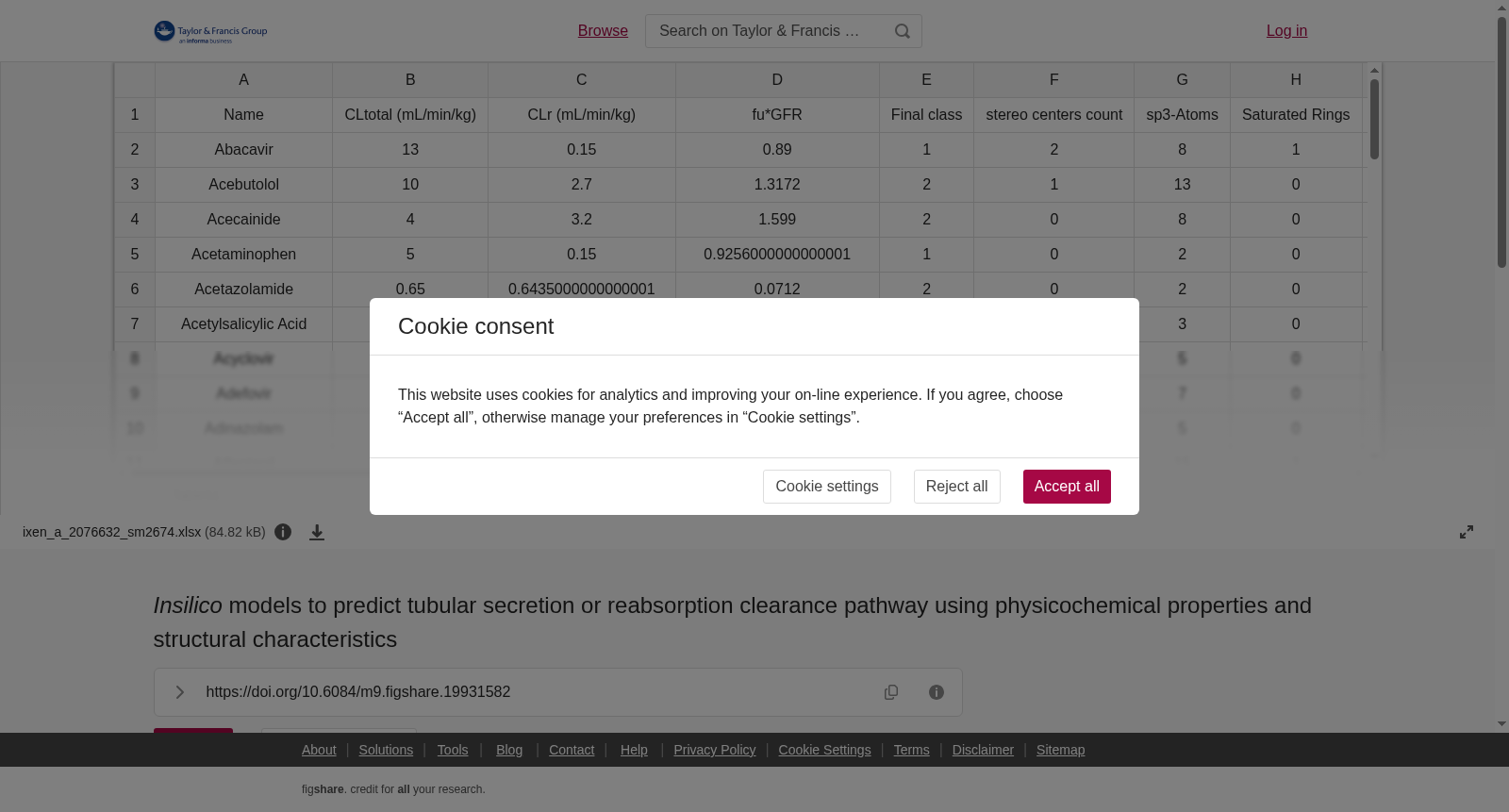
Renal clearance is one of the main pathways for a drug to be cleared from plasma. The aim of this study is to develop <i>in-silico</i> models to find out the relationship between the type of renal clearance, and structural parameters.Literature data were used to categorise the drugs into those that undergo tubular secretion and those that undergo reabsorption. Different structural descriptors (VolSurf descriptors, Abraham solvation parameters, data warrior descriptors, logarithm of distribution coefficient at pH = 7.4 (logD<sub>7.4</sub>)) were applied to develop a mechanistic model for estimating renal clearance class whether its secretion or reabsorption.The results of this study show that logD<sub>7.4</sub> and the number of hydrogen bond donors, as well as available uncharged species (AUS<sub>7.4</sub>), are the most effective descriptors to establish mechanistic models for predicting renal clearance class. The classification models were established with a level of accuracy of more than 75%.Developed models of this study can be helpful to predict renal clearance class for new drug candidates with an acceptable error. Hydrophilicity and hydrogen bond formation ability of drugs are among the main descriptors. Renal clearance is one of the main pathways for a drug to be cleared from plasma. The aim of this study is to develop <i>in-silico</i> models to find out the relationship between the type of renal clearance, and structural parameters. Literature data were used to categorise the drugs into those that undergo tubular secretion and those that undergo reabsorption. Different structural descriptors (VolSurf descriptors, Abraham solvation parameters, data warrior descriptors, logarithm of distribution coefficient at pH = 7.4 (logD<sub>7.4</sub>)) were applied to develop a mechanistic model for estimating renal clearance class whether its secretion or reabsorption. The results of this study show that logD<sub>7.4</sub> and the number of hydrogen bond donors, as well as available uncharged species (AUS<sub>7.4</sub>), are the most effective descriptors to establish mechanistic models for predicting renal clearance class. The classification models were established with a level of accuracy of more than 75%. Developed models of this study can be helpful to predict renal clearance class for new drug candidates with an acceptable error. Hydrophilicity and hydrogen bond formation ability of drugs are among the main descriptors.
肾脏清除率是药物从血浆中清除的主要途径之一。本研究旨在构建计算机模拟(in-silico)模型,以探究肾脏清除率类型与药物结构参数之间的关联。研究利用文献数据将药物分为经肾小管分泌和经肾小管重吸收两类。本研究采用多种结构描述符(包括VolSurf描述符、Abraham溶剂化参数、Data Warrior描述符以及pH=7.4条件下的分布系数对数(logD₇.₄)),构建用于预测肾脏清除率类型(分泌型或重吸收型)的机理模型。研究结果显示,logD₇.₄、氢键供体数量以及可利用不带电物种(AUS₇.₄)是构建预测肾脏清除率类型机理模型的最有效描述符。所构建的分类模型准确率均超过75%。本研究开发的模型可用于以可接受的误差范围预测候选新药的肾脏清除率类型。药物的亲水性与氢键形成能力亦是核心结构描述符之一。 肾脏清除率是药物从血浆中清除的主要途径之一。本研究旨在构建计算机模拟(in-silico)模型,以探究肾脏清除率类型与药物结构参数之间的关联。研究利用文献数据将药物分为经肾小管分泌和经肾小管重吸收两类。本研究采用多种结构描述符(包括VolSurf描述符、Abraham溶剂化参数、Data Warrior描述符以及pH=7.4条件下的分布系数对数(logD₇.₄)),构建用于预测肾脏清除率类型(分泌型或重吸收型)的机理模型。研究结果显示,logD₇.₄、氢键供体数量以及可利用不带电物种(AUS₇.₄)是构建预测肾脏清除率类型机理模型的最有效描述符。所构建的分类模型准确率均超过75%。本研究开发的模型可用于以可接受的误差范围预测候选新药的肾脏清除率类型。药物的亲水性与氢键形成能力亦是核心结构描述符之一。