
人肝球体中24种全氟和多氟烷基物质(PFAS)的高通量转录组学评估
收藏干细胞与再生医学数据中心2023-02-10 更新2024-03-06 收录
下载链接:
http://data.iscr.ac.cn/Article?id=ade98d1144db40e6891992fff2a04e9e
下载链接
链接失效反馈官方服务:
资源简介:
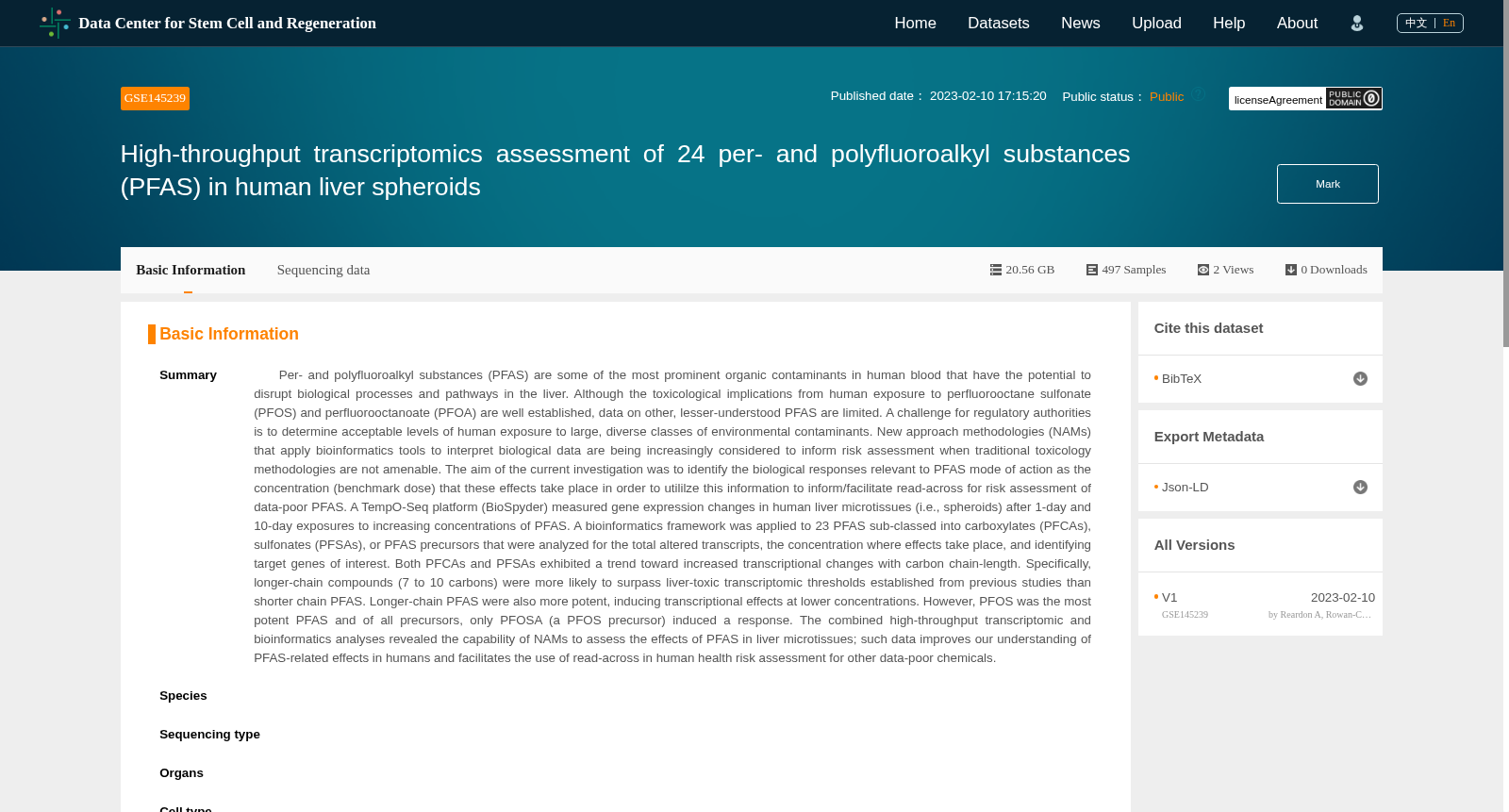
Per- and polyfluoroalkyl substances (PFAS) are some of the most prominent organic contaminants in human blood that have the potential to disrupt biological processes and pathways in the liver. Although the toxicological implications from human exposure to perfluorooctane sulfonate (PFOS) and perfluorooctanoate (PFOA) are well established, data on other, lesser-understood PFAS are limited. A challenge for regulatory authorities is to determine acceptable levels of human exposure to large, diverse classes of environmental contaminants. New approach methodologies (NAMs) that apply bioinformatics tools to interpret biological data are being increasingly considered to inform risk assessment when traditional toxicology methodologies are not amenable. The aim of the current investigation was to identify the biological responses relevant to PFAS mode of action as the concentration (benchmark dose) that these effects take place in order to utililze this information to inform/facilitate read-across for risk assessment of data-poor PFAS. A TempO-Seq platform (BioSpyder) measured gene expression changes in human liver microtissues (i.e., spheroids) after 1-day and 10-day exposures to increasing concentrations of PFAS. A bioinformatics framework was applied to 23 PFAS sub-classed into carboxylates (PFCAs), sulfonates (PFSAs), or PFAS precursors that were analyzed for the total altered transcripts, the concentration where effects take place, and identifying target genes of interest. Both PFCAs and PFSAs exhibited a trend toward increased transcriptional changes with carbon chain-length. Specifically, longer-chain compounds (7 to 10 carbons) were more likely to surpass liver-toxic transcriptomic thresholds established from previous studies than shorter chain PFAS. Longer-chain PFAS were also more potent, inducing transcriptional effects at lower concentrations. However, PFOS was the most potent PFAS and of all precursors, only PFOSA (a PFOS precursor) induced a response. The combined high-throughput transcriptomic and bioinformatics analyses revealed the capability of NAMs to assess the effects of PFAS in liver microtissues; such data improves our understanding of PFAS-related effects in humans and facilitates the use of read-across in human health risk assessment for other data-poor chemicals.
全氟和多氟烷基物质(Per- and polyfluoroalkyl substances, PFAS)是人体血液中最突出的有机污染物之一,具有干扰肝脏生物学过程与通路的潜在风险。尽管人体暴露于全氟辛烷磺酸(perfluorooctane sulfonate, PFOS)和全氟辛酸(perfluorooctanoate, PFOA)所带来的毒理学影响已得到充分证实,但针对其他认知度较低的PFAS相关数据仍十分有限。监管机构面临的一项挑战是,确定人类暴露于种类繁多的大型环境污染物的可接受水平。当传统毒理学方法难以适用时,借助生物信息学工具解读生物学数据的新方法学(New approach methodologies, NAMs)正越来越多地被用于风险评估参考。本研究的目的在于,明确与PFAS作用模式相关的生物学反应,以及这些反应发生时的浓度(即基准剂量,benchmark dose),以期利用该信息为数据匮乏的PFAS的风险评估交叉参照提供参考与便利。研究采用TempO-Seq测序平台(BioSpyder),检测了人肝脏微组织(即球体类器官)在暴露于梯度浓度PFAS后1天和10天的基因表达变化。研究人员将23种PFAS分为全氟羧酸(PFCAs)、全氟磺酸(PFSAs)以及PFAS前体物三类,通过生物信息学框架分析了其总差异转录本、效应发生浓度,并筛选出潜在的目标基因。全氟羧酸与全氟磺酸均呈现出随碳链长度增加,转录组改变程度升高的趋势。具体而言,长链化合物(碳链长度7至10)相比短链PFAS,更易超过既往研究确立的肝脏毒性转录组阈值。长链PFAS的效应效力也更强,可在更低浓度下诱导转录组改变。但值得注意的是,全氟辛烷磺酸是所有受试PFAS中效力最强的物质;在所有前体物中,仅全氟辛烷磺酸前体(PFOSA)可诱导产生转录反应。本次结合高通量转录组学与生物信息学的分析证实,新方法学可用于评估PFAS在肝脏微组织中的效应;此类数据有助于加深我们对PFAS相关人体健康效应的理解,并推动交叉参照法在其他数据匮乏化学品的人类健康风险评估中的应用。
创建时间:
2023-02-10
搜集汇总
数据集介绍
背景与挑战
背景概述
该数据集通过高通量转录组学方法评估了24种全氟和多氟烷基物质(PFAS)对人类肝球体的影响,包含497个样本,总大小为20.56 GB,使用Illumina NextSeq 500平台测序。研究发现,PFAS的碳链长度与转录变化相关,长链化合物(7-10碳)更易引发肝脏毒性效应且效力更强,其中PFOS效力最高;这为新方法(NAMs)在PFAS风险评估中的应用提供了数据支持。
以上内容由遇见数据集搜集并总结生成


