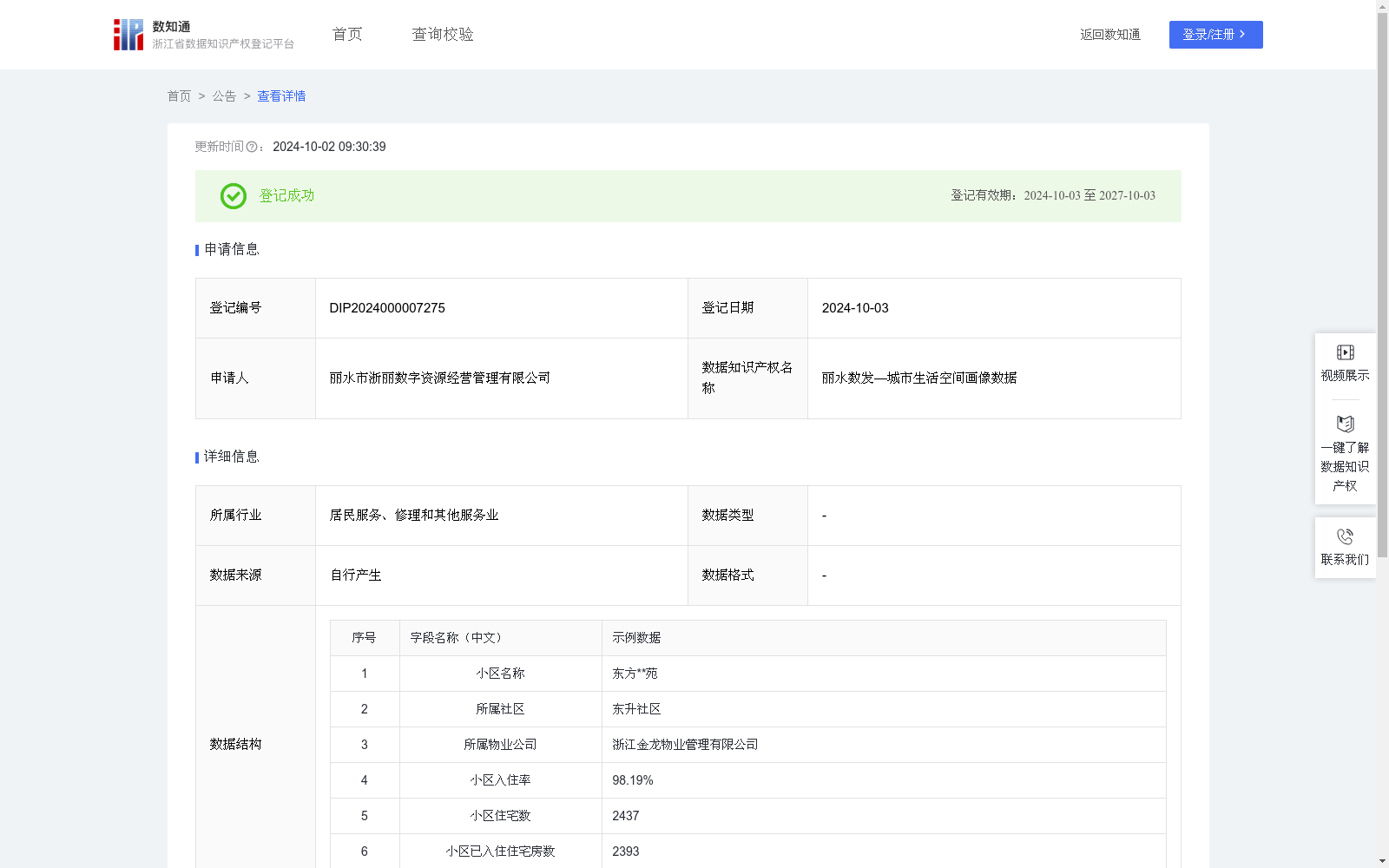
丽水数发—城市生活空间画像数据
收藏资源简介:
对采集归集的数据进行分析挖掘,得出各小区入住情况分析出小区入住率为想要在周边开设门店的商家店铺选址、选择店铺经营类型提供决策依据;高入住率意味着该区域的房产需求大,房价和租金相对稳定,为想要在小区投资房产者提供决策依据,高入住率意味着物业管理公司需要提供更高质量的服务以满足居民的需求,而低入住率则可能面临服务成本与收益的不匹配,影响物业服务的持续性和质量,小区入住率为物业管理公司投标提供决策依据。1、数据采集:通过丽水数发-城市生活空间画像平台采集数据;2、数据处理:对采集到的数据进行清洗分类汇总,对于敏感数据进行脱敏处理;3、数据加工:小区住宅居住率=小区已入住住宅房数/小区住宅房总数
Analyze and mine the collected and aggregated data to derive the occupancy rate of each residential community, which provides decision-making support for merchants intending to open stores nearby when selecting store locations and determining business types. A high occupancy rate indicates strong housing demand in the area and relatively stable housing prices and rents, offering decision basis for property investors in the community. Furthermore, a high occupancy rate means property management companies need to deliver higher-quality services to meet resident needs, while a low occupancy rate may cause a mismatch between service costs and revenues, affecting the sustainability and quality of property services. The community occupancy rate also serves as a decision-making basis for property management companies during project bidding. 1. Data Collection: Data is collected via the Lishui Shufa - Urban Living Space Portrait Platform. 2. Data Preprocessing: Clean, classify and summarize the collected data, and conduct desensitization processing on sensitive data. 3. Data Calculation: The residential occupancy rate of a community is calculated as the ratio of the number of occupied residential housing units in the community to the total number of residential housing units in the community.