
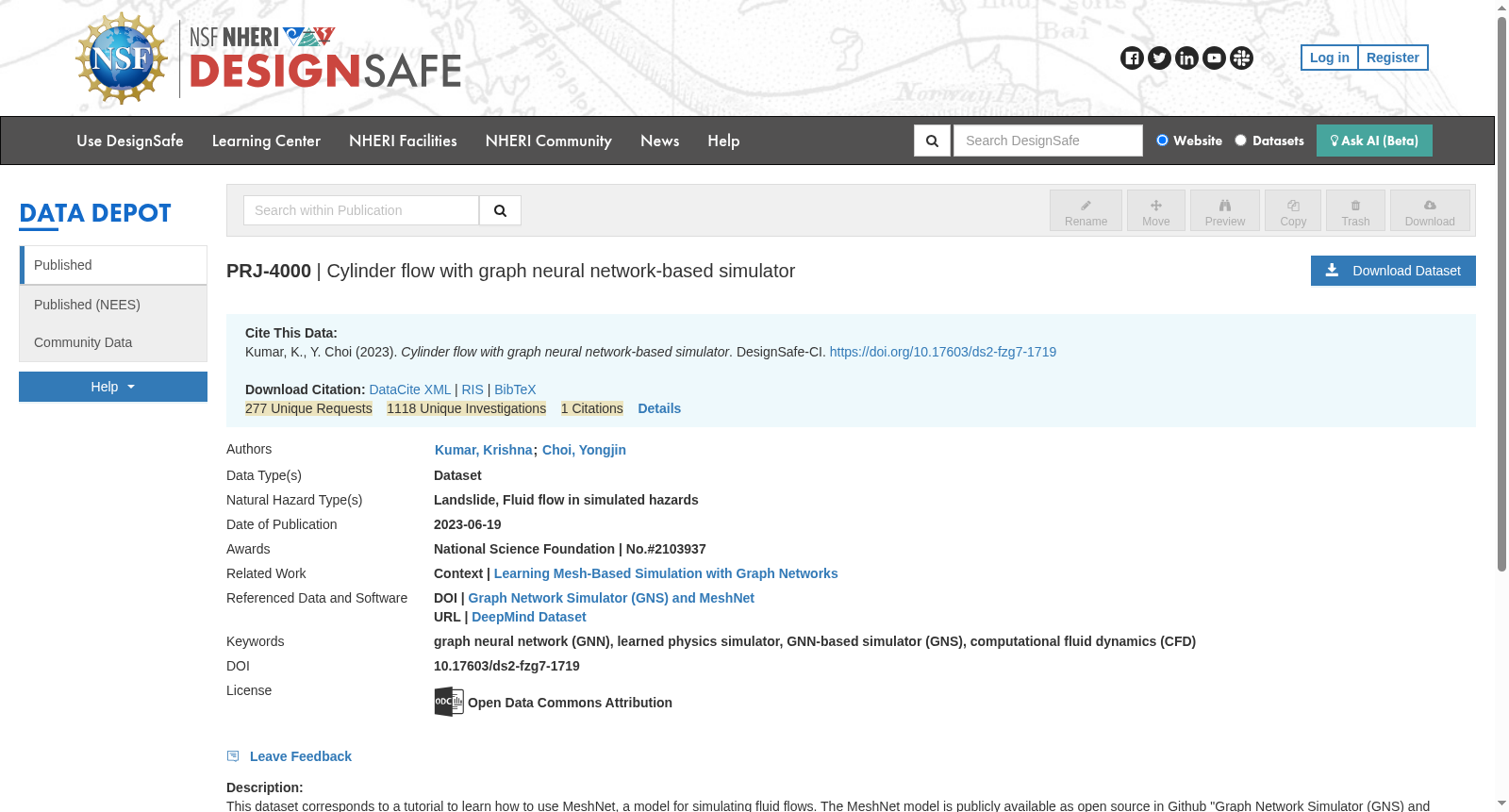
Cylinder flow with graph neural network-based simulator
收藏DataCite Commons2025-06-02 更新2025-04-16 收录
下载链接:
https://www.designsafe-ci.org/data/browser/public/designsafe.storage.published/PRJ-4000
下载链接
链接失效反馈官方服务:
资源简介:
This dataset corresponds to a tutorial to learn how to use MeshNet, a model for simulating fluid flows. The MeshNet model is publicly available as open source in Github "Graph Network Simulator (GNS) and MeshNet" (See Referenced Data and Software). GNS is a generalizable, efficient, and accurate machine learning (ML)-based surrogate simulator that uses Graph Neural Networks (GNNs). GNS is a viable surrogate for numerical methods such as Material Point Method, Smooth Particle Hydrodynamics and Computational Fluid dynamics and can be extended to simulate natural hazards. GNS can handle complex boundary conditions and multi-material interactions. GNS exploits distributed data parallelism to achieve fast multi-GPU training. The dataset in this publication includes training/testing/validating partitions to make GNS learn and simulate fluid flow through a cylinder obstacle. It was created using Computational Fluid Dynamics originally from DeepMind. A link to the dataset is available in Related Data and Software and a contextual paper about the MeshNet is available in Related Works.The data was transformed to `.npz` format for compatibility with the Pytroch-based multi-GPU parallel version of GNS code. Detailed instructions on how to use this data are published along with this version of the dataset and also located as a `README.md` file in the GitHub repository. The documentation lives with the model because instructions may change as the model is versioned in the GitHub repository. The main function of this dataset is for purposes of training new users. Once users know how to run the model they can use other kinds of datasets to train and simulate different natural hazards.
本数据集配套用于学习流体流动模拟模型MeshNet的使用方法。该MeshNet模型以开源形式公开于名为"Graph Network Simulator (GNS) and MeshNet"的GitHub仓库中(详见参考数据与软件部分)。GNS是一款基于机器学习(Machine Learning,简称ML)的通用、高效且精准的替代模拟器,其采用图神经网络(Graph Neural Networks,简称GNNs)架构。GNS可作为物质点法、光滑粒子流体动力学法、计算流体动力学等数值方法的可行替代方案,还可扩展用于模拟自然灾害。GNS能够处理复杂边界条件与多材料交互场景。GNS利用分布式数据并行技术实现快速多GPU训练。本出版物中的数据集包含训练、测试与验证分区,用于让GNS学习并模拟流体流经圆柱障碍物的场景。本数据集最初基于DeepMind(深度思维)公司的计算流体动力学方法生成。数据集链接可在「参考数据与软件」板块获取,关于MeshNet的背景论文可在「相关研究」板块查看。为适配基于PyTorch的GNS代码多GPU并行版本,数据已转换为`.npz`格式。本数据集版本配套发布了详细的使用说明,同时该说明也以`README.md`文件形式存储于上述GitHub仓库中。文档随模型同步更新,这是因为GitHub仓库中模型迭代更新时,使用说明可能随之调整。本数据集的核心用途是帮助新手用户入门学习。用户掌握模型运行方法后,可使用其他类型的数据集开展训练,模拟各类不同的自然灾害场景。
提供机构:
Designsafe-CI
创建时间:
2023-06-19
搜集汇总
数据集介绍
背景与挑战
背景概述
该数据集是一个教学工具,用于训练用户使用基于图神经网络的MeshNet模型模拟流体流动。数据集包含训练、测试和验证数据,以.npz格式存储,适用于多GPU并行计算,并与开源项目GNS和MeshNet相关联。
以上内容由遇见数据集搜集并总结生成



