

【我遇到的问题】 • 现象:该数据集的下载链接已失效 【相关信息】 • 可考虑访问这个链接获取类似文件~https://www.selectdataset.com/dataset/3688356173feccbcf1f1e490ddc6bc72
全球城市扩展过程数据集(1992-2070)V2.0
收藏国家青藏高原科学数据中心2023-12-06 更新2024-03-01 收录
下载链接:
https://data.tpdc.ac.cn/zh-hans/data/33000334-df82-4e5b-9b4f-74f3b69cce98
下载链接
链接失效反馈官方服务:
资源简介:
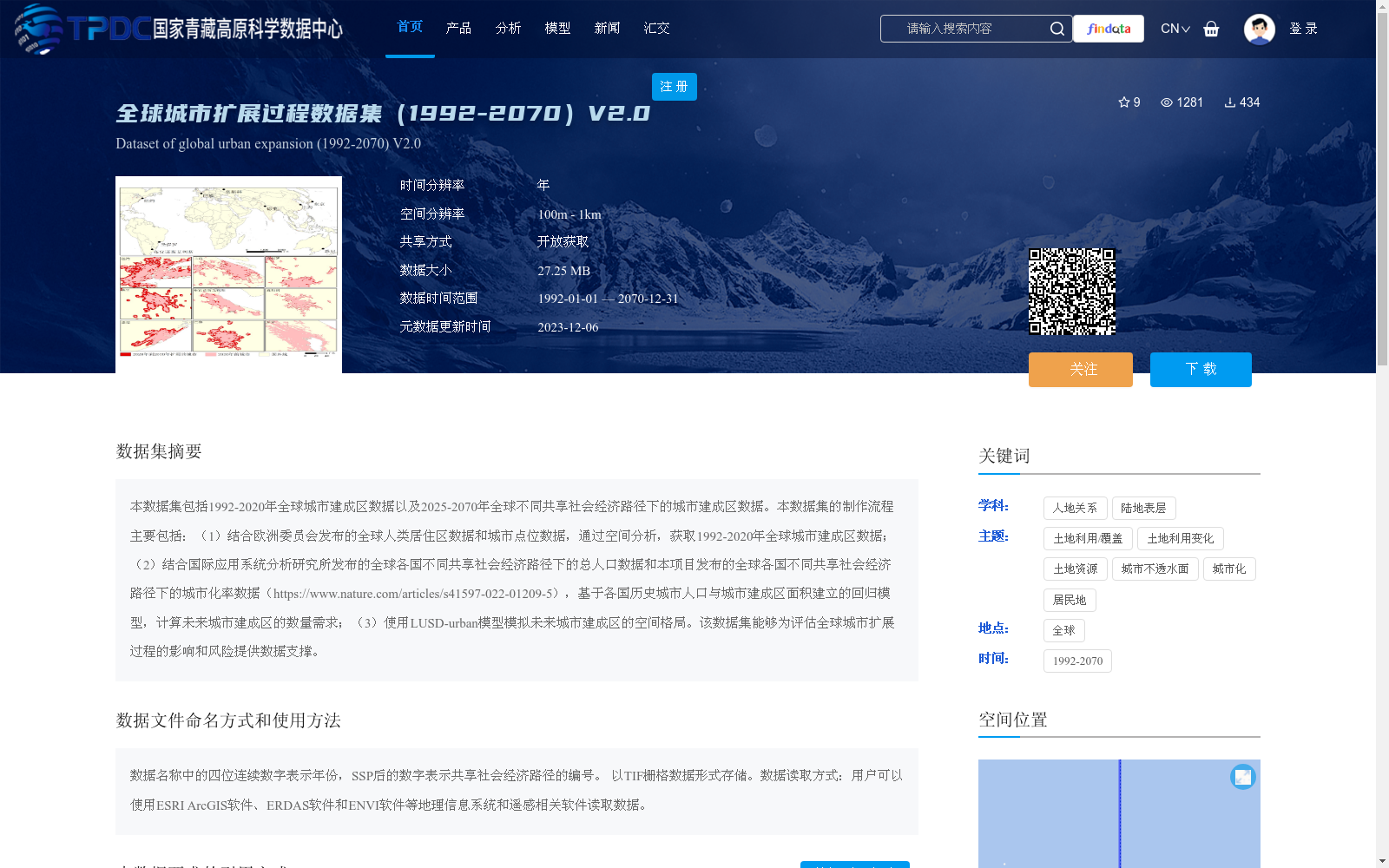
本数据集包括1992-2020年全球城市建成区数据以及2025-2070年全球不同共享社会经济路径下的城市建成区数据。本数据集的制作流程主要包括:(1)结合欧洲委员会发布的全球人类居住区数据和城市点位数据,通过空间分析,获取1992-2020年全球城市建成区数据;(2)结合国际应用系统分析研究所发布的全球各国不同共享社会经济路径下的总人口数据和本项目发布的全球各国不同共享社会经济路径下的城市化率数据(https://www.nature.com/articles/s41597-022-01209-5),基于各国历史城市人口与城市建成区面积建立的回归模型,计算未来城市建成区的数量需求;(3)使用LUSD-urban模型模拟未来城市建成区的空间格局。该数据集能够为评估全球城市扩展过程的影响和风险提供数据支撑。
This dataset encompasses global urban built-up area data spanning the period 1992–2020, alongside global urban built-up area data under different Shared Socioeconomic Pathways (SSPs) for the years 2025–2070. The production workflow of this dataset primarily consists of three steps: (1) Deriving global urban built-up area data for 1992–2020 through spatial analysis by integrating global human settlement datasets and urban point datasets released by the European Commission; (2) Calculating the quantitative demand for future urban built-up areas based on a regression model established between historical urban population and urban built-up area for individual countries, by combining total population data under different SSPs for all countries released by the International Institute for Applied Systems Analysis (IIASA) and urbanization rate data under different SSPs for all countries published by this project (https://www.nature.com/articles/s41597-022-01209-5); (3) Simulating the spatial pattern of future urban built-up areas using the LUSD-urban model. This dataset can provide data support for evaluating the impacts and risks of global urban expansion processes.
提供机构:
刘志锋,应嘉禾,白巧贤,潘鑫豪,何春阳,黄庆旭
创建时间:
2023-12-06
搜集汇总
数据集介绍
背景与挑战
背景概述
该数据集提供了全球城市扩展过程的长期数据,覆盖1992年至2070年,包括历史城市建成区(1992-2020年)和未来在不同共享社会经济路径(SSP)下的预测数据(2025-2070年)。数据以TIF栅格格式存储,空间分辨率为100m至1km,旨在支持全球城市扩展影响和风险的评估研究。
以上内容由遇见数据集搜集并总结生成



