
Long Beach Longitudinal Study
收藏DataCite Commons2025-04-07 更新2025-04-16 收录
下载链接:
https://www.icpsr.umich.edu/web/NACDA/studies/26561/versions/V2
下载链接
链接失效反馈官方服务:
资源简介:
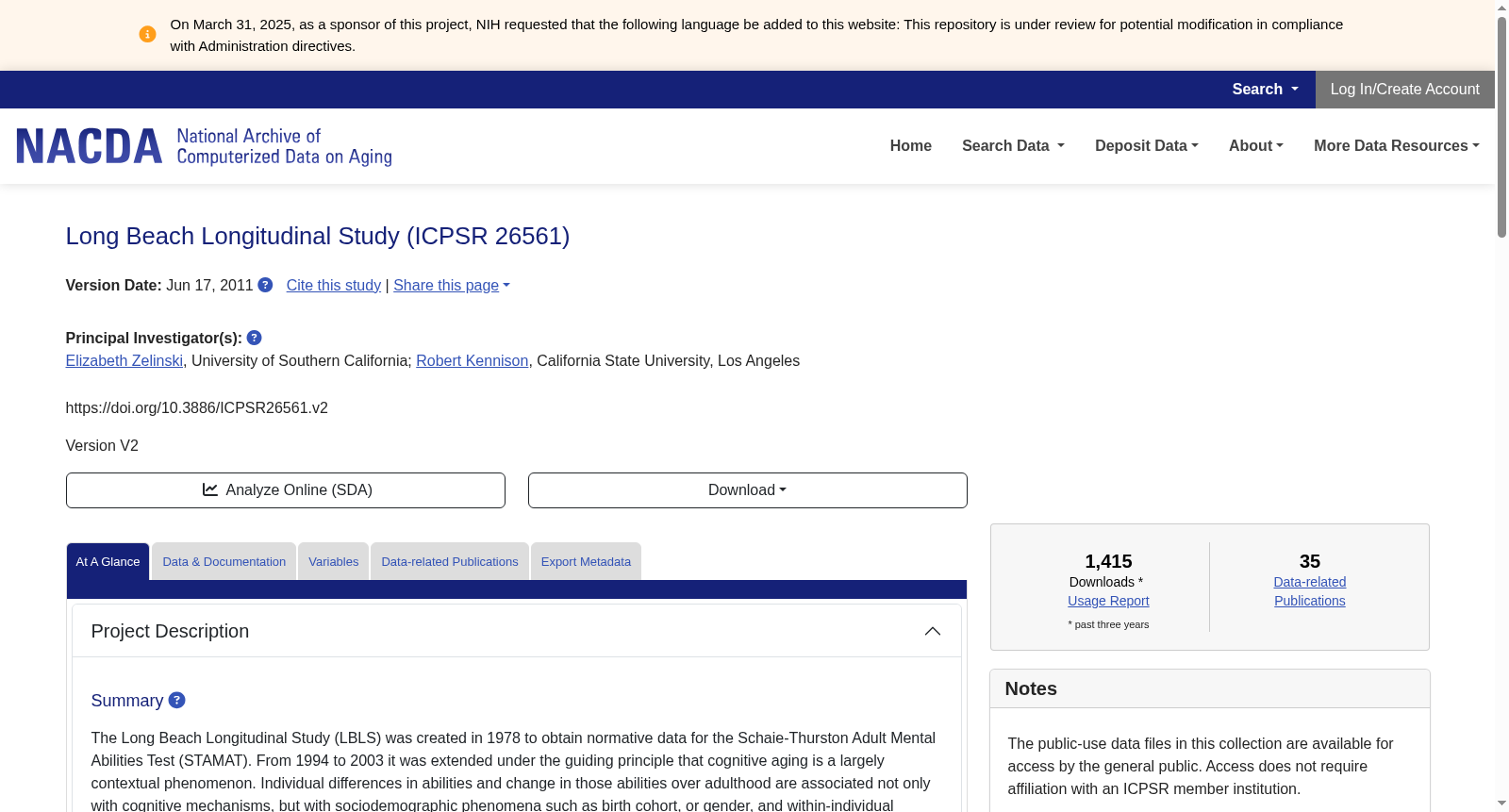
The Long Beach Longitudinal Study (LBLS) was created in 1978 to obtain normative data for the Schaie-Thurston Adult Mental Abilities Test (STAMAT). From 1994 to 2003 it was extended under the guiding principle that cognitive aging is a largely contextual phenomenon. Individual differences in abilities and change in those abilities over adulthood are associated not only with cognitive mechanisms, but with sociodemographic phenomena such as birth cohort, or gender, and within-individual characteristics, including health, affect, self-efficacy, personality, and other variables that impact health. This principle is reflected in the testing measures added to the original panel. Besides the original ability measures used by Schaie, the Life Complexity Inventory, has been included in all testing. Because these measures were included in the later generations of testing, independent and direct comparisons can be made with Seattle Longitudinal Study
(ICPSR 00158) to replicate findings and to generalize longitudinal samples.
<strong>Panel 1</strong>
The initial panel was sampled in 1978 and consisted of 65 adults aged 28-33 and 518 adults aged 55-84. This sample was tested using the STAMAT, as well as a 20-item list of common English nouns for testing free recall, and a brief essay to test text recall. In 1981, 264 participants from this sample were retested, 106 were again retested from 1994-1995, and 42 in 1997. Finally, 15 participants of the original sample were tested from 2000-2002 using additional tests adopted for the creation of a second panel, described below, as well as a test for measuring executive function.
<strong>Panel 2</strong>
In 1994, a second panel of 630 participants aged 30-97, a third of which were over 80, was added to the study. The testing for this sample included multiple indices of list recall, text recall, working memory, perceptual speed, and vocabulary for structural equation modeling. Assessment of language, autobiographical memory, personality, depression, health, health behaviors and other measures were also incorporated into the study. In 1997, 352 members of this second panel were retested. From 2000-2002, 179 participants of this second panel completed the 1994-1995 measures, as well as several tests extending the battery to indices of executive function. In 2003, 133 participants were retested.
<strong>Panel 3</strong>
A third sample was recruited during the 2000-2002 time frame consisting of 911 participants aged 30-98, again approximately a third of which were over the age of 80. In 2003, 513 members of this third panel were retested.
<strong>Datasets</strong>
The data are provided in 6 datasets.
<strong>Panel 1 and 2 1978 - 2003 Longitudinal File</strong>
Dataset 1 is a longitudinal file of data from Panel 1 for tests performed in 1978, 1981, 1994, 1997, and 2000-2002, and data from Panel 2 for tests performed in 1994, 1997, 2000-2002 and 2003.
<strong>Panels 1 and 2 1994 STAMAT File</strong>
Dataset 2 contains the STAMAT test variables for Panels 1 and 2.
<strong>Panel 1 and 2 1994-2000 Master Data Longitudinal File</strong>
Dataset 3 is a second longitudinal file containing the complete catalog of variables from Panels 1 and 2 for test performed in 1994, 1997 and 2000.
<strong>Panel 2 Wave 1 1994 Cross File</strong>
Dataset 4 contains variables for the first wave of Panel 2 which took place in 1994.
<strong>Panel 2 Wave 2 1997 Cross File</strong>
Dataset 5 contains variables for the second wave of Panel 2 which took place in 1997.
<strong>Panel 3 Wave 1 2000 Master File</strong>
Dataset 6 contains variables from the first wave of Panel 3 which took place in 2000.
长滩纵向研究(Long Beach Longitudinal Study, LBLS)于1978年创建,旨在获取谢伊-瑟斯顿成人智力测验(Schaie-Thurston Adult Mental Abilities Test, STAMAT)的常模数据。1994年至2003年,该研究在“认知衰老本质上属于情境化现象”的指导原则下完成扩展。成人期的能力个体差异及其变化不仅与认知机制相关,还与出生队列、性别等社会人口学现象,以及健康、情绪、自我效能感、人格等影响健康的个体内特征存在关联。这一研究原则体现在为原始追踪队列新增的测评工具中。除谢伊使用的原始能力测评工具外,生活复杂性量表(Life Complexity Inventory)已纳入所有测评环节。由于该批测评工具在后续测试批次中得到应用,因此可与西雅图纵向研究(ICPSR 00158)开展独立且直接的对比,以复现研究发现并推广纵向样本的研究结论。
<strong>追踪队列1(Panel 1)</strong>
初始队列于1978年招募,包含65名28~33岁的成年人与518名55~84岁的成年人。该样本接受了STAMAT测评、一项包含20个常见英语名词的自由回忆测试,以及一篇短文文本回忆测试。1981年,该样本中的264名参与者接受重测;1994~1995年,106名参与者再次接受重测;1997年,42名参与者接受重测。最终,2000~2002年,原始样本中的15名参与者接受了为构建第二队列新增的测评工具,以及一项执行功能测评。
<strong>追踪队列2(Panel 2)</strong>
1994年,研究新增第二队列,包含630名30~97岁的成年人,其中约三分之一年龄超过80岁。该样本的测评内容包括用于结构方程模型(structural equation modeling)分析的列表回忆、文本回忆、工作记忆(working memory)、知觉速度(perceptual speed)与词汇量等多项指标。此外,语言能力、自传体记忆(autobiographical memory)、人格、抑郁状况、健康及健康行为等测评工具也被纳入研究。1997年,该队列中的352名成员接受重测;2000~2002年,179名参与者完成了1994~1995年使用的测评工具,并新增一系列拓展测评以覆盖执行功能指标;2003年,133名参与者接受重测。
<strong>追踪队列3(Panel 3)</strong>
2000~2002年期间,研究招募第三队列,包含911名30~98岁的成年人,其中同样有约三分之一年龄超过80岁。2003年,该队列中的513名成员接受重测。
<strong>数据集</strong>
本研究数据共分为6个数据集。
<strong>队列1与队列2 1978-2003纵向文件</strong>
数据集1为纵向文件,包含队列1在1978年、1981年、1994年、1997年及2000~2002年的测试数据,以及队列2在1994年、1997年、2000~2002年与2003年的测试数据。
<strong>队列1与队列2 1994年STAMAT文件</strong>
数据集2包含队列1与队列2的STAMAT测试变量。
<strong>队列1与队列2 1994-2000主数据纵向文件</strong>
数据集3为第二份纵向文件,包含队列1与队列2在1994年、1997年及2000年的全部测评变量目录。
<strong>队列2 1994年第一波横向文件</strong>
数据集4包含队列2 1994年第一波测评的相关变量。
<strong>队列2 1997年第二波横向文件</strong>
数据集5包含队列2 1997年第二波测评的相关变量。
<strong>队列3 2000年第一波主文件</strong>
数据集6包含队列3 2000年第一波测评的相关变量。
提供机构:
ICPSR - Interuniversity Consortium for Political and Social Research
创建时间:
2014-01-08
搜集汇总
数据集介绍
背景与挑战
背景概述
Long Beach Longitudinal Study (LBLS)是一个关于认知与老龄化的纵向研究数据集,涵盖了1978年至2003年间的多个测试面板,研究内容包括认知能力、心理健康、人格特征等多个方面。数据集提供了6个不同的数据文件,适用于研究成年人生命周期内认知过程的变化及其预测因素。
以上内容由遇见数据集搜集并总结生成



