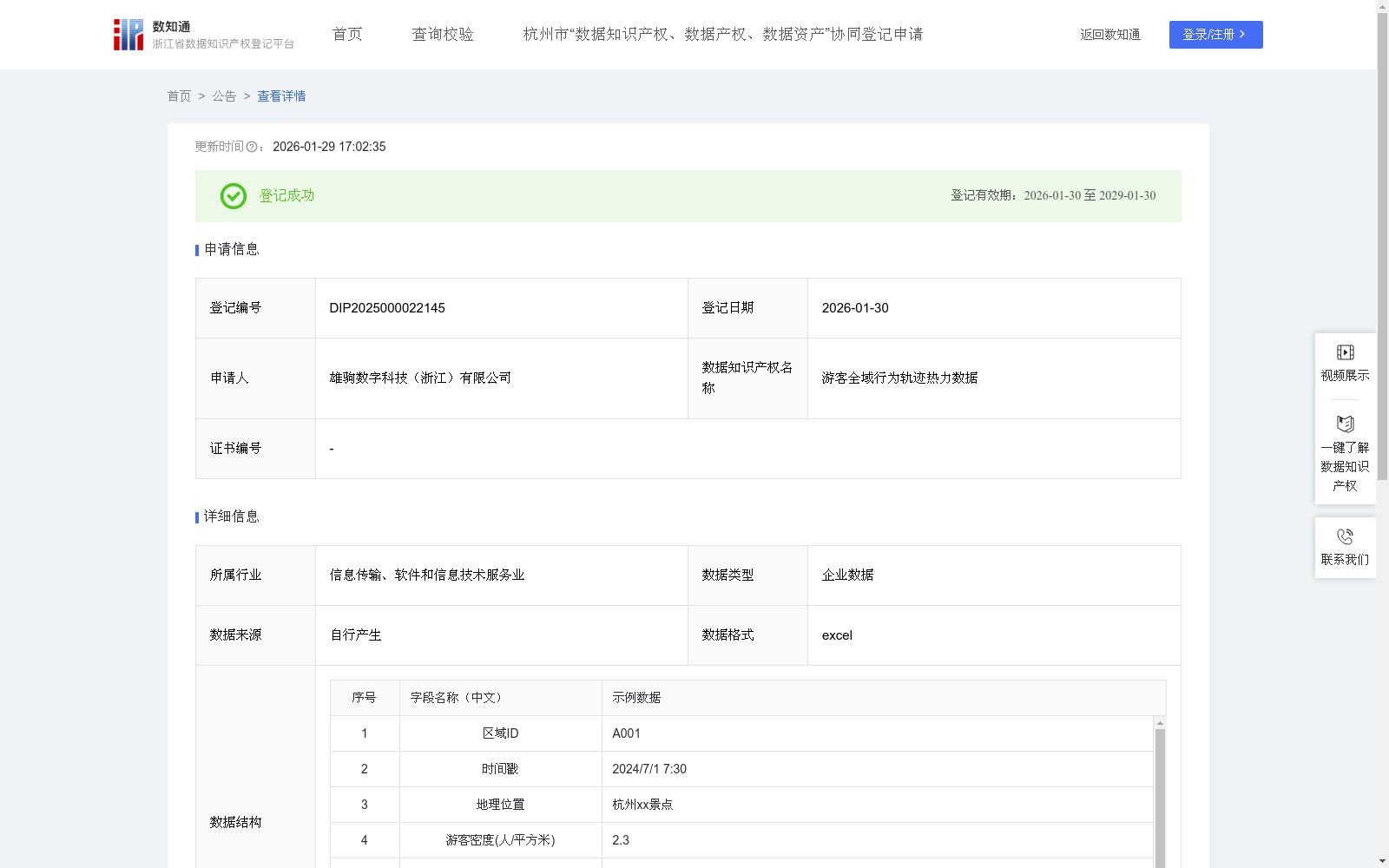
游客全域行为轨迹热力数据
收藏资源简介:
本数据集适用于旅游景区管理、智慧城市建设、商业区域规划等多个领域。适用条件为区域已部署游客行为数据采集系统,且游客活动具有一定规模。适用范围涵盖各类旅游景区、城市商圈、文化场馆等公共场所。服务对象包括景区运营方、城市规划部门、商业地产开发商、零售企业等。 通过分析数据集中的游客行为轨迹热力特征,可精准识别游客聚集区域、停留时长及移动路径。旅游景区可据此优化景点布局和游客分流方案,提升游客体验;城市规划部门能够科学评估公共空间使用效率,指导基础设施建设;商业地产开发商可依据热力数据优化商业业态布局,提高商业价值;零售企业能精准定位高流量区域,提升店铺选址科学性。1.数据采集:数据来源于企业自有系统; 2.数据处理:对采集到的原始数据进行清洗,去除异常数据; 采用哈希算法对区域ID、地理位置进行匿名化处理,保护区域隐私信息; 对游客密度、停留时长等数值型数据进行归一化处理,使其在同一量纲下便于计算和比较。 3.算法加工:运用热力分析算法构建游客行为轨迹模型。根据区域特性、历史数据相关性分析,为每个特征变量赋予相应权重。热力值的计算公式为: 热力值P={游客密度×密度权重(0.3)+平均停留时长×时长权重(0.4)+(1/移动速度)×移动权重(0.3)}×区域系数k×1000; 其中,区域系数k根据不同区域类型(如景区核心区、商业区、交通枢纽等)通过历史数据统计和经验分析确定,取值范围在0.8-1.2之间。 4.数据分类分级:根据计算出的热力值,将热力等级划分为:高热力:热力值≥10000;低热力:热力值<10000
This dataset is applicable to multiple fields such as tourist attraction management, smart city construction, and commercial area planning. The applicable conditions are that the target area has deployed a tourist behavior data collection system, and there is a certain scale of tourist activities. The applicable scope covers various public places including tourist attractions, urban commercial districts, cultural venues, etc. The target users include attraction operators, urban planning departments, commercial real estate developers, retail enterprises, etc. By analyzing the thermal characteristics of tourist behavior trajectories in the dataset, tourist gathering areas, average stay duration and movement paths can be accurately identified. Tourist attractions can optimize attraction layout and tourist diversion plans to enhance visitor experience; urban planning departments can scientifically evaluate the utilization efficiency of public spaces and guide infrastructure construction; commercial real estate developers can optimize commercial format layout based on thermal data to improve commercial value; retail enterprises can accurately locate high-traffic areas to enhance the scientificity of store site selection. 1. Data Collection: The data is sourced from the enterprise's own systems; 2. Data Processing: Clean the collected raw data and remove abnormal data; Use hash algorithms to anonymize region IDs and geographic locations to protect regional privacy information; Normalize numerical data such as tourist density and stay duration to bring them to the same dimension for easier calculation and comparison; 3. Algorithm Processing: Construct a tourist behavior trajectory model using thermal analysis algorithms. Assign corresponding weights to each feature variable based on regional characteristics and correlation analysis of historical data. The formula for calculating the thermal value P is: P = [Tourist Density × Density Weight (0.3) + Average Stay Duration × Duration Weight (0.4) + (1/Movement Speed) × Movement Weight (0.3)] × Regional Coefficient k × 1000; Where the regional coefficient k is determined through historical data statistics and empirical analysis based on different regional types (such as core attraction areas, commercial districts, transportation hubs, etc.), with a value range of 0.8 to 1.2; 4. Data Classification and Grading: According to the calculated thermal values, the thermal levels are divided into: High Thermal: Thermal value ≥ 10000; Low Thermal: Thermal value < 10000