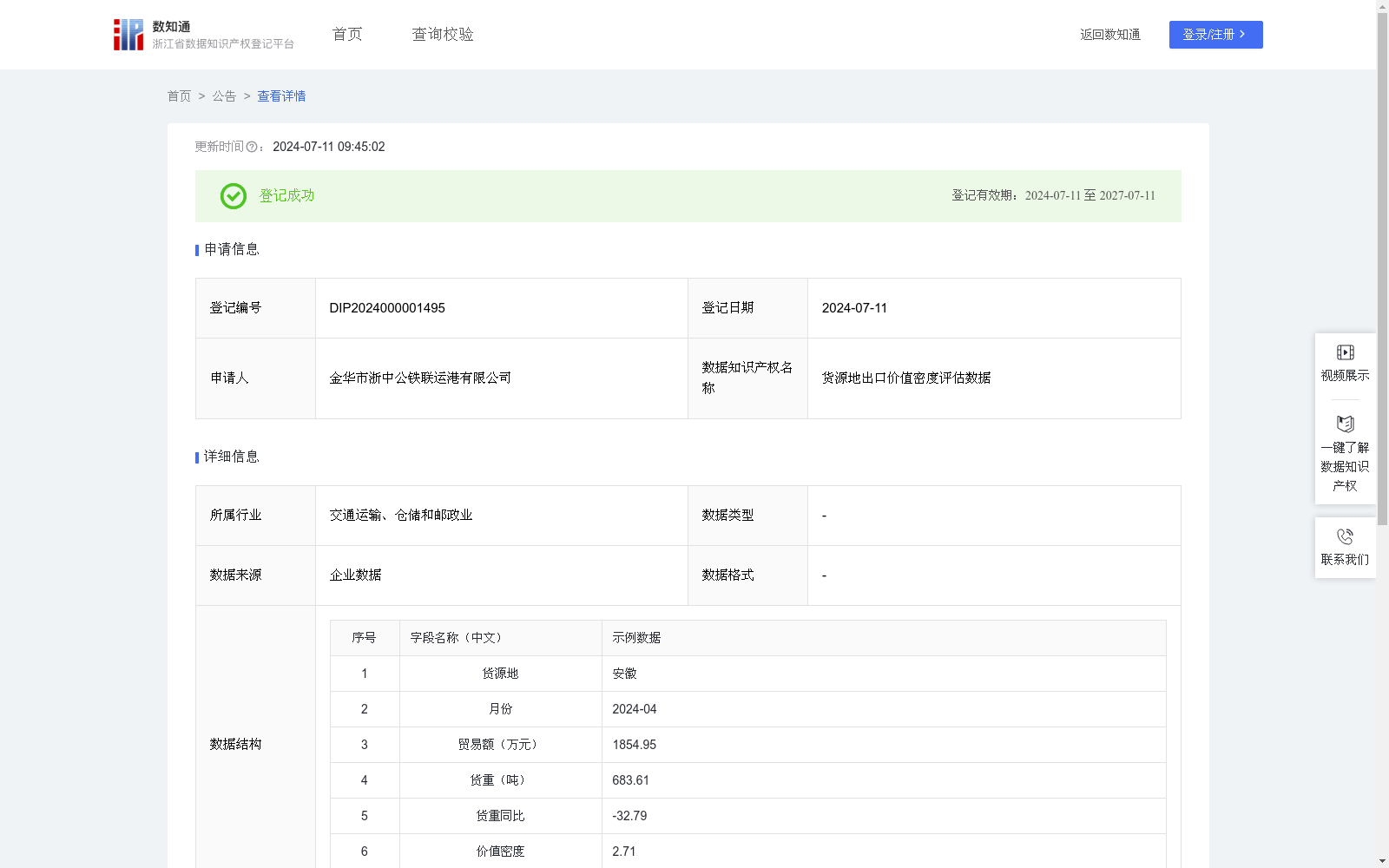
货源地出口价值密度评估数据
收藏资源简介:
通过“智慧联运管理平台”提供的出口货源数据,评估不同货源地的价值密度,分析评估不同区域的价值密度指数,可以了解各区域在出口贸易方面的优势和劣势,从而制定相应的发展策略。1.数据采集:采集中欧班列的发运日期,商品、货源地,贸易额,货重等数据; 2.数据处理:对采集到数据按月分组、清洗和剔除空值和无效数据; 3.数据加工:对清洗后的到数据按月合并、累加,得到货源地的贸易额及货重,计算价值密度指数X=货源地月贸易额Y/货源地月货重Z*100%,价值密度在大于5为高价值密度出口地;价值密度在(1,5)之间为中等价值密度出口地;价值密度小于1为低价值密度出口地。 4.数据应用:分析评估不同区域的价值密度指数的变化趋势,以反映市场需求变化,为贸易策略制定提供有力支持。对比不同货源地的价值密度指数,评估各货源地出口货物价值密度的差异,从而明确不同货源地的出口竞争力,为企业优化资源配置、制定差异化市场策略提供了科学依据。
Using the export cargo source data provided by "Smart Intermodal Management Platform", this dataset is used to evaluate the value density of different source locations and analyze the value density index of various regions, so as to understand the strengths and weaknesses of each region in export trade and formulate targeted development strategies. 1. Data Collection: Collect data including the shipment date, commodities, source location, trade volume and cargo weight of China-Europe Railway Express. 2. Data Preprocessing: Group the collected data by month, clean the dataset and remove null and invalid records. 3. Data Processing and Calculation: Merge and accumulate the cleaned data on a monthly basis to derive the monthly total trade volume and total cargo weight of each source location. Calculate the value density index X using the formula: X = (Monthly Trade Volume Y of the Source Location / Monthly Cargo Weight Z of the Source Location) * 100%. Then classify the export locations into three tiers: high-value density export locations (value density > 5), medium-value density export locations (1 < value density < 5), and low-value density export locations (value density < 1). 4. Data Application: Analyze the changing trends of the value density index of different regions to reflect shifts in market demand, providing robust support for trade strategy formulation. Compare the value density indexes of different source locations to assess the differences in the value density of export goods across various source regions, thereby clarifying the export competitiveness of each location, and offering a scientific basis for enterprises to optimize resource allocation and develop differentiated market strategies.