
中国盐生植物名录
收藏DataCite Commons2025-07-12 更新2025-09-08 收录
下载链接:
https://figshare.com/articles/dataset/_/28190972
下载链接
链接失效反馈官方服务:
资源简介:
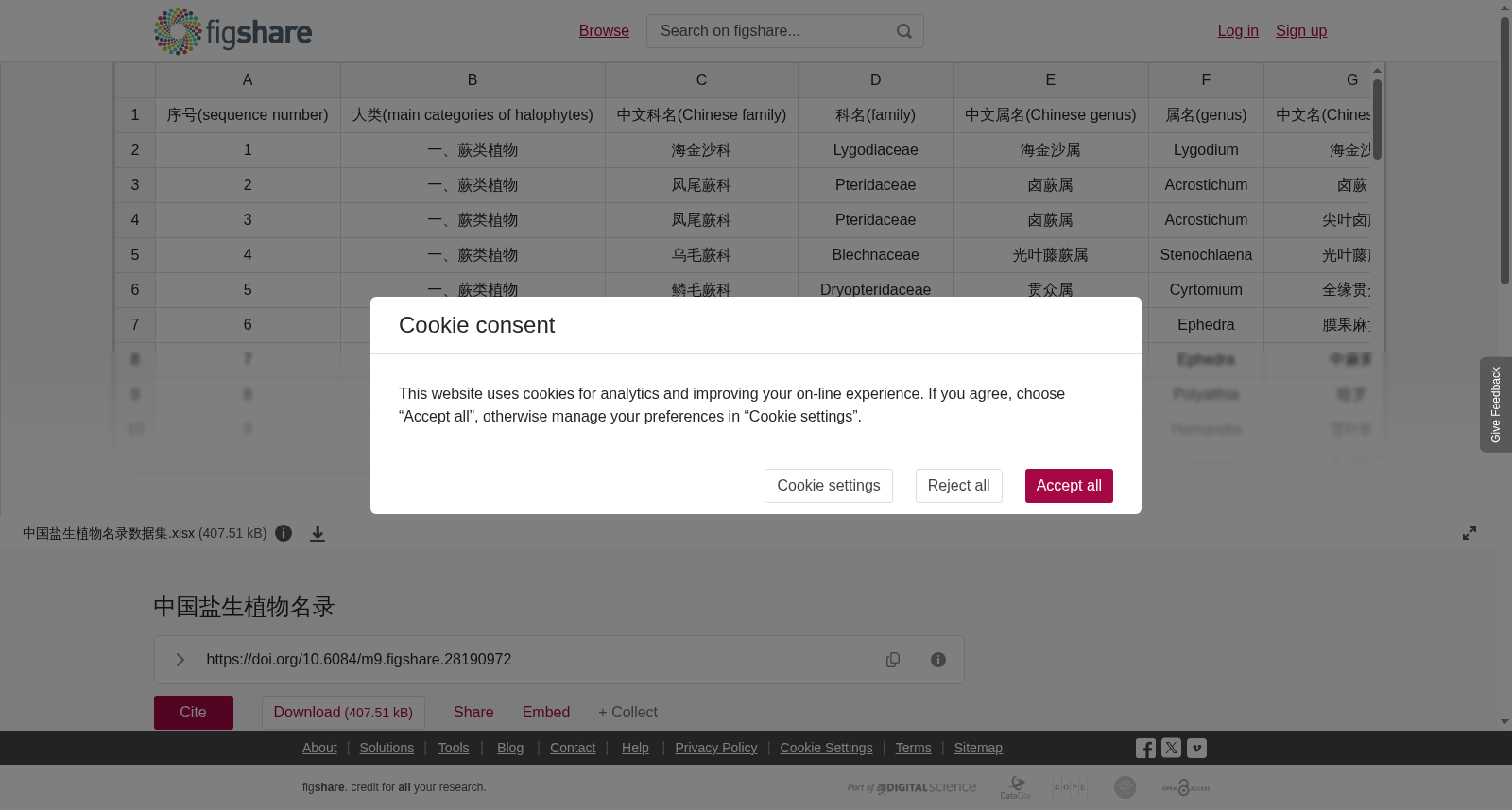
Halophytes, as a unique group of plants adapted to saline-alkaline environments, play a crucial role in ecological conservation, saline-alkaline land management, and sustainable resource utilization. However, compared to their significance, the systematic inventory of halophytes in China lags behind. Existing data mainly come from regional studies or scattered literature records, lacking systematicity and comprehensiveness. This study, based on the foundational data from <i>Halophytes of China</i><i> </i>(First and Second Editions) and the global halophyte database (<i>eHaloph</i>), integrates years of field investigations and systematically reviews and supplements the existing inventory data (adding new taxa and new records) while improving global distribution information. It also organizes ecological and functional data such as habitat, life form, height, morphology, halophyte type, ecological type, maximum salinity, photosynthetic pathway, and utilization value. Ultimately, we have composed a dataset on new inventory and geographical distributions of Chinese halophytes. Up to 2024, the dataset has a total of 102 families 538 genera 1,562species 31 subspecies 37 varieties of halophytes in China. There are totally 31 families 310 genera 1,026 species 22 subspecies 14 varieties should be supplemented to the <i>Halophytes of China</i><i> </i>(Second Editions). According to the data of the distribution of species in each province-level administrative division in China, Xinjiang has the largest number of species (40 families 199 genera 578 species 14 subspecies 14 varieties), Guizhou (only one species) has the least number of species records, and there are no distribution records of halophytes in Tianjin and Chongqing. Analysis of salt tolerance characteristics shows that the maximum salinity of halophytes is primarily concentrated at 300 mM (53 families 189 genera 450 species 10 subspecies 5 varieties) and 200 mM (46 families 188 genera 446 species 9 subspecies 14 varieties). Additionally, a significant number of species can tolerate extremely high salinity levels, with 42 families 110 genera158 species 2 subspecies 1 variety having a maximum salinity exceeding 500 mM. Among halophyte types, salt-exclusion halophyte is the most numerous (79 families 314 genera 720 species 19 subspecies 12 varieties), while salt-secretion halophyte isthe least numerous (12 families 60 genera 229 species 2 subspecies 8 varieties). The morphological characteristics of halophytes of China are diverse. Species with plant heights less than one meter account for 61 families 363 genera 1,058 species 18 subspecies 30 varieties, while those exceeding 10 meters include 27 families 42 genera 55 species 1 subspecies 1 variety. Perennial herbaceous species are the most prevalent life form (45 families 170 genera 470 species 15 subspecies 13 varieties), and species with geopnytes are the most common bud type (49 families 183 genera 520 species 14 subspecies 10 varieties). The statistical analysis of different ecological types shows that xerohalophytes have the highest number of species (41 families 189 genera 632 species 10 subspecies 20 varieties), while hydrohalophytes have the lowest number of species (18 families 37 genera 67 species 3 subspecies). Photosynthetic pathway data show that the type of C3 isthe most numerous (95 families, 444 genera, 1,278 species, 27 subspecies, and 30 varieties), while the type of CAM is represented by only one species. Halophytes of China have diverse uses, primarily for ecological applications, with additional uses in ornamental and medicinal fields. With the advancement of agricultural development and ecological restoration efforts, some introduced halophytes have gradually naturalized and become significant components of halophytes of China. However, related data remain incomplete and require further supplementation. The establishment of this dataset not only provides critical support for in-depth studies on the diversity, ecological functions, and application potential of halophytes of China but also offers a scientific basis for policymaking in saline-alkaline land management and biodiversity conservation.
盐生植物(Halophytes)是一类适应盐碱环境的独特植物类群,在生态保护、盐碱地治理与可持续资源利用中发挥着至关重要的作用。然而相较于其重要性,中国盐生植物的系统性编目工作仍相对滞后。现有数据主要来自区域研究或零散的文献记录,缺乏系统性与全面性。本研究以《中国盐生植物》(第一、二版)及全球盐生植物数据库(eHaloph)的基础数据为依托,整合多年野外调查结果,对现有编目数据进行系统梳理与补充(新增分类群与新记录),同时完善全球分布信息。此外,还整理了生境、生活型、株高、形态特征、盐生植物类型、生态型、最大耐盐度、光合途径以及利用价值等生态与功能数据。最终构建了中国盐生植物新编目与地理分布数据集。截至2024年,该数据集共收录中国盐生植物102科、538属、1562种、31亚种、37变种。其中,需补充至《中国盐生植物》(第二版)的类群共计31科、310属、1026种、22亚种、14变种。根据中国各省级行政区的物种分布数据,新疆维吾尔自治区的物种数量最多(40科、199属、578种、14亚种、14变种),贵州省仅记录有1种,为物种数量最少的省份,且天津市与重庆市无盐生植物分布记录。耐盐特性分析显示,盐生植物的最大耐盐度主要集中于300mM(53科、189属、450种、10亚种、5变种)与200mM(46科、188属、446种、9亚种、14变种)区间。此外,还有大量物种可耐受极高盐度,其中42科、110属、158种、2亚种、1变种的最大耐盐度超过500mM。在盐生植物类型中,拒盐型盐生植物数量最多(79科、314属、720种、19亚种、12变种),而泌盐型盐生植物数量最少(12科、60属、229种、2亚种、8变种)。中国盐生植物的形态特征多样:株高不足1米的物种共计61科、363属、1058种、18亚种、30变种,而株高超过10米的物种则包含27科、42属、55种、1亚种、1变种。多年生草本为最主要的生活型(45科、170属、470种、15亚种、13变种),地下芽植物为最常见的芽型(49科、183属、520种、14亚种、10变种)。不同生态类型的统计分析显示,旱生盐生植物的物种数量最多(41科、189属、632种、10亚种、20变种),而水生盐生植物的物种数量最少(18科、37属、67种、3亚种)。光合途径数据显示,C3型占比最高(95科、444属、1278种、27亚种、30变种),而CAM型仅记录有1个物种。中国盐生植物的用途多样,主要应用于生态领域,此外还可用于观赏与药用领域。随着农业发展与生态修复工作的推进,部分引种盐生植物逐渐归化,成为中国盐生植物区系的重要组成部分,但相关数据仍不完善,有待进一步补充。本数据集的构建不仅为中国盐生植物的多样性、生态功能与应用潜力的深入研究提供了关键支撑,同时也为盐碱地治理与生物多样性保护的政策制定提供了科学依据。
提供机构:
figshare
创建时间:
2025-01-12
搜集汇总
数据集介绍
以上内容由遇见数据集搜集并总结生成


