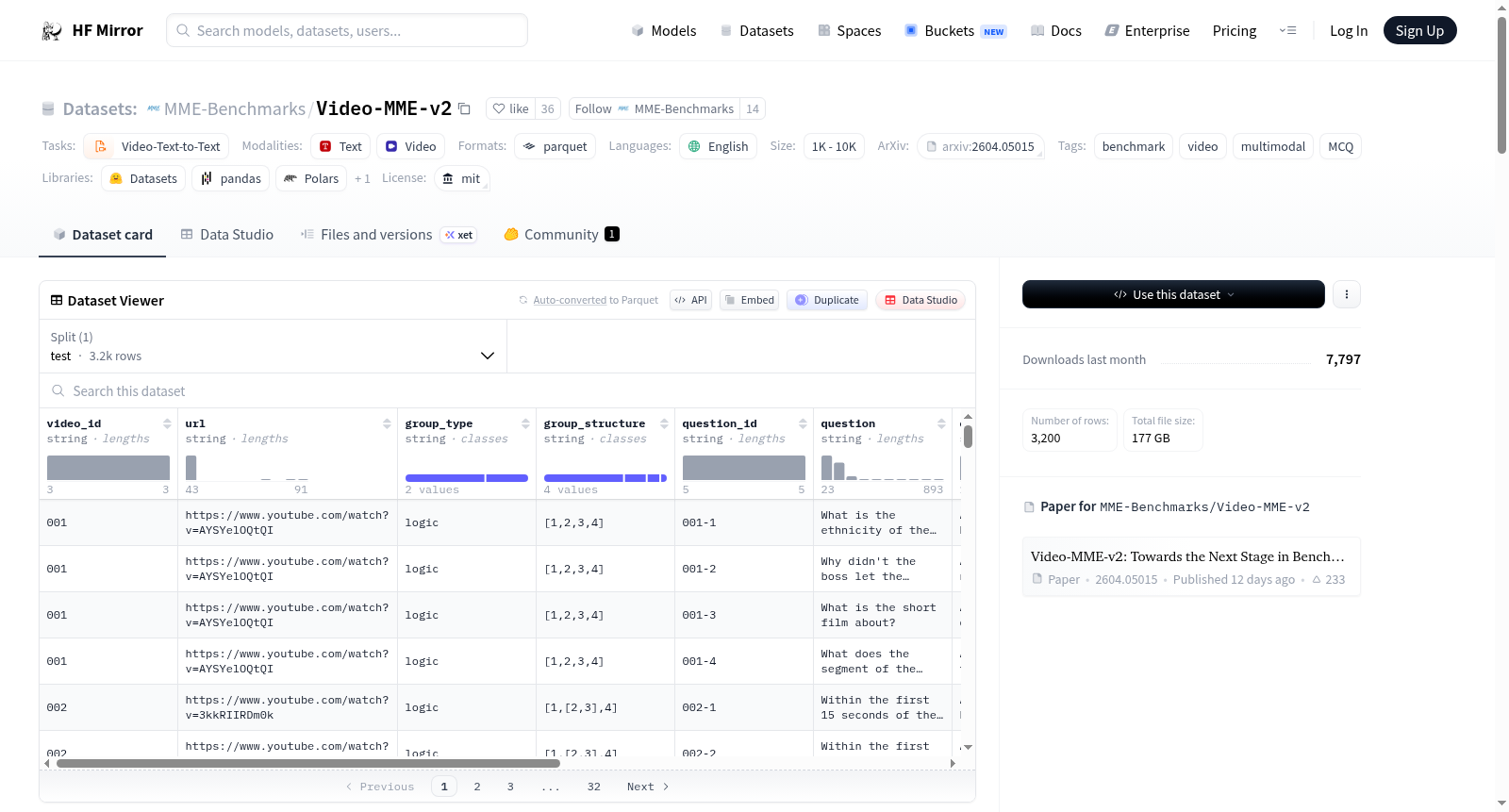
MME-Benchmarks/Video-MME-v2
收藏资源简介:
--- license: mit task_categories: - video-text-to-text language: - en tags: - benchmark - video - multimodal - MCQ pretty_name: Video-MME-v2 size_categories: - 1K<n<10K --- <p align="center"> <img src="assets/logo.png" width="100%" height="100%" alt="Video-MME-v2 logo"> </p> <div align="center"> [](https://video-mme-v2-tmp.netlify.app) [](https://arxiv.org/abs/2604.05015) [](https://github.com/MME-Benchmarks/Video-MME-v2) [](https://video-mme-v2-tmp.netlify.app/#leaderboard) </div> <!-- <p align="center"> <a href="https://video-mme-v2.netlify.app/">🍎 Project Page</a> | <a href="https://arxiv.org/abs/2604.05015">📖 Paper</a> | <a href="https://huggingface.co/datasets/MME-Benchmarks/Video-MME-v2">🤗 Dataset</a> | <a href="https://video-mme-v2.netlify.app/#leaderboard">🏆 Leaderboard</a> </p> --> --- # 🤗 About This Repo This repository contains annotation data for "[Video-MME-v2: Towards the Next Stage in Benchmarks for Comprehensive Video Understanding](https://arxiv.org/abs/2604.05015)". It mainly consists of three parts: `videos/`, `test.parquet`, and `subtitle.zip`. - `videos/` contains **800 1080p MP4 files**, organized sequentially into 40 zip archives. For example, `001.mp4` to `020.mp4` are stored in `001.zip`. - `test.parquet` contains **3200 QA instances**, with each video paired with **4 questions**. Each instance includes the **question**, **options**, **answer**, and auxiliary metadata such as the **video id** and **task type**. - `subtitle.zip` contains **800 JSONL files**, each corresponding to a unique **video id**, with word-level entries and timestamps. --- # 🩷 About This Benchmark In 2024, our [**Video-MME**](https://video-mme.github.io/) benchmark became a standard evaluation set for frontier models like Gemini and GPT. However, as model capabilities rapidly evolve, scores on existing benchmarks are saturating, yet a clear gap remains between **leaderboard performance and actual user experience**. This indicates that current evaluation paradigms fail to capture true video understanding abilities. To address this, we spent a year redesigning the evaluation system from first principles and now introduce **Video-MME v2**—a progressive and robust benchmark designed to drive the next generation of video understanding models. <p align="center"> <img src="assets/teaser.png" width="100%" height="100%" alt="Teaser"> </p> - **Dataset Size** The dataset consists of 800 videos and 3,200 QA pairs, with each video associated with four MCQ-based questions. - **Multi-level Evaluation Hierarchy** - 🔍 **Level 1:** Retrieval & Aggregation - ⏱️ **Level 2:** Level 1 + Temporal Understanding - 🧠 **Level 3:** Level 2 + Complex Reasoning. - **Group-based Evaluation Strategy** - **Capability consistency groups** examine the breadth of a specific fundamental perception skill. - **Reasoning coherence groups** assess the depth of a model’s reasoning ability. - **Video Sources** All videos are collected from YouTube. Over 80% were published in 2025 or later, with nearly 40% published after October 2025. - **Video Categories** The dataset includes four top-level domains, further divided into 31 fine-grained subcategories. - **Metrics** A non-linear scoring mechanism is applied to all question groups, and a first error truncation mechanism is used for reasoning coherence groups. --- # 🍺 About a Concrete Case > **💡 Why this example matters?** > This video QA group demonstrates our **Reasoning Coherence** evaluation strategy and **Multi-level Hierarchy**. To answer the final state correctly, a model must successfully track the object backwards through temporal swaps. If a model guesses the initial state correctly but fails the intermediate swaps, our **first error truncation mechanism** will accurately penalize it for flawed reasoning. <p align="left"> <a href="https://huggingface.co/datasets/MME-Benchmarks/Video-MME-v2/resolve/main/assets/demo.mp4"> <img src="assets/demo_cover.png" width="45%" alt="Demo video cover"/> </a> </p> <p align="left"> <strong>👆 Click the cover image to view the demo video.</strong> </p> <p> <strong>Q1:</strong> Did the ball exist underneath any of the shells?<br> A. No.<br> B. Yes. ✅<br> C. Cannot be determined. </p> <p> <strong>Q2:</strong> Underneath which shell was the ball located at the end?<br> A. There is no ball under any shell.<br> B. The third shell.<br> C. The sixth shell.<br> D. The second shell.<br> E. The seventh shell.<br> F. The fifth shell.<br> G. The fourth shell. ✅<br> H. The first shell. </p> <p> <strong>Q3:</strong> The host performed a total of two shell swaps (defining a single swap as an instance where all shells return to an approximately straight line). Underneath which shell was the ball located after the first swap?<br> A. There is no ball under any shell.<br> B. The seventh shell.<br> C. The fourth shell. ✅<br> D. The fifth shell.<br> E. The sixth shell.<br> F. The second shell.<br> G. The third shell.<br> H. The first shell. </p> <p> <strong>Q4:</strong> The host performed a total of two shell swaps (defining a single swap as an instance where all shells return to an approximately straight line). Underneath which shell was the ball located initially?<br> A. The seventh shell.<br> B. The fourth shell.<br> C. The fifth shell.<br> D. The third shell. ✅<br> E. The second shell.<br> F. There is no ball under any shell.<br> G. The first shell.<br> H. The sixth shell. </p>