
欧亚大陆草原和丝绸之路沿线史前人骨胶原碳同位素数据、农牧业元素分布数据及动植物遗存数据集
收藏国家青藏高原科学数据中心2023-08-17 更新2024-03-01 收录
下载链接:
https://data.tpdc.ac.cn/zh-hans/data/4d8a4dbc-48b0-49ef-9979-bc3707079b2a
下载链接
链接失效反馈官方服务:
资源简介:
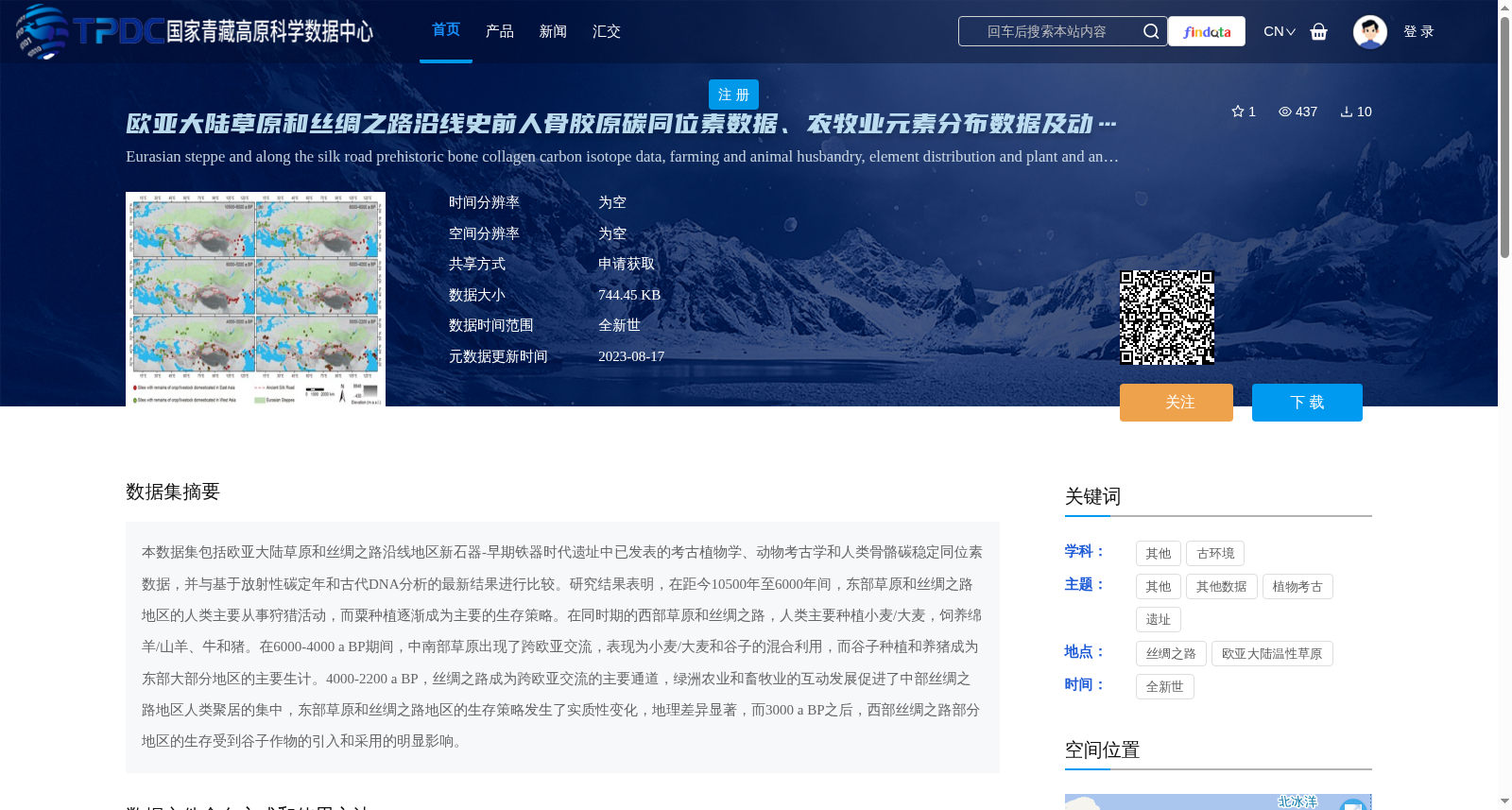
本数据集包括欧亚大陆草原和丝绸之路沿线地区新石器-早期铁器时代遗址中已发表的考古植物学、动物考古学和人类骨骼碳稳定同位素数据,并与基于放射性碳定年和古代DNA分析的最新结果进行比较。研究结果表明,在距今10500年至6000年间,东部草原和丝绸之路地区的人类主要从事狩猎活动,而粟种植逐渐成为主要的生存策略。在同时期的西部草原和丝绸之路,人类主要种植小麦/大麦,饲养绵羊/山羊、牛和猪。在6000-4000 a BP期间,中南部草原出现了跨欧亚交流,表现为小麦/大麦和谷子的混合利用,而谷子种植和养猪成为东部大部分地区的主要生计。4000-2200 a BP,丝绸之路成为跨欧亚交流的主要通道,绿洲农业和畜牧业的互动发展促进了中部丝绸之路地区人类聚居的集中,东部草原和丝绸之路地区的生存策略发生了实质性变化,地理差异显著,而3000 a BP之后,西部丝绸之路部分地区的生存受到谷子作物的引入和采用的明显影响。
This dataset comprises published archaeobotanical, zooarchaeological, and human skeletal carbon stable isotope data from Neolithic to Early Iron Age sites across the Eurasian steppes and regions along the Silk Road, and compares these data with recent findings based on radiocarbon dating and ancient DNA analysis. Research findings indicate that between 10500 and 6000 cal BP, humans in the eastern steppes and Silk Road regions primarily engaged in hunting, while foxtail millet cultivation gradually became the dominant subsistence strategy. In the western steppes and Silk Road regions during the same period, humans mainly cultivated wheat and barley, and raised sheep, goats, cattle, and pigs. During the period 6000–4000 cal BP, cross-Eurasian exchanges emerged in the central and southern steppes, characterized by the combined utilization of wheat/barley and foxtail millet, while foxtail millet cultivation and pig husbandry became the primary livelihoods in most of the eastern regions. Between 4000 and 2200 cal BP, the Silk Road emerged as the primary conduit for cross-Eurasian exchanges. The interactive development of oasis agriculture and animal husbandry promoted the concentration of human settlements in the central Silk Road regions. The subsistence strategies of the eastern steppes and Silk Road regions underwent substantial changes with significant geographic disparities. After 3000 cal BP, the subsistence patterns in parts of the western Silk Road regions were significantly affected by the introduction and adoption of foxtail millet.
提供机构:
董广辉
创建时间:
2023-08-10
搜集汇总
数据集介绍
背景与挑战
背景概述
该数据集包含欧亚大陆草原和丝绸之路沿线新石器至早期铁器时代的考古植物学、动物考古学和人类骨骼碳稳定同位素数据,揭示了不同时期和地区人类生存策略的演变。数据时间范围为全新世,大小为744.45 KB,涵盖了粟种植、小麦/大麦种植、畜牧业等关键农牧业元素分布信息。
以上内容由遇见数据集搜集并总结生成


