黄土高原渭南黄土剖面年代、磁化率和平均粒径数据集(全新世)
收藏资源简介:
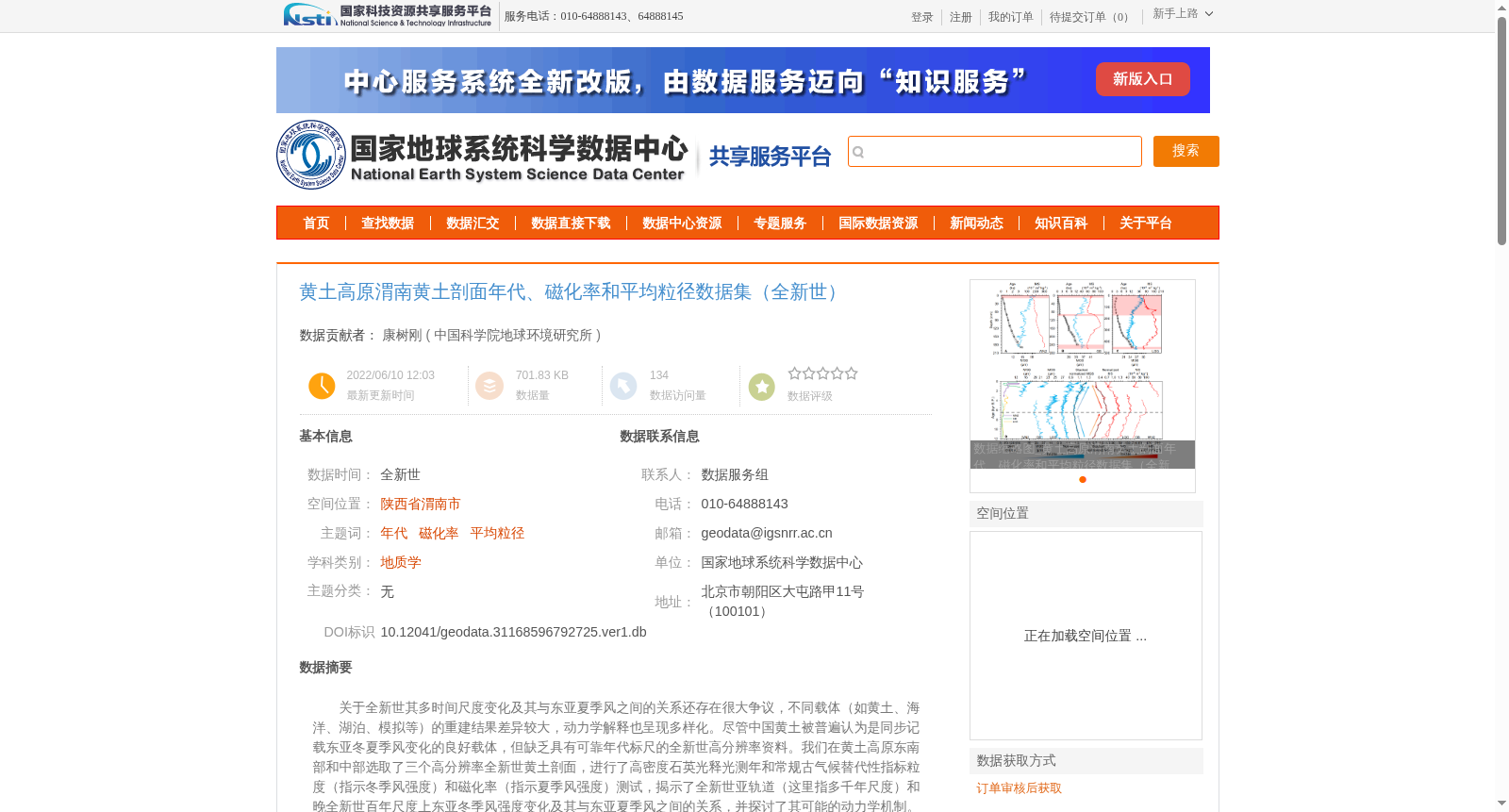
关于全新世其多时间尺度变化及其与东亚夏季风之间的关系还存在很大争议,不同载体(如黄土、海洋、湖泊、模拟等)的重建结果差异较大,动力学解释也呈现多样化。尽管中国黄土被普遍认为是同步记载东亚冬夏季风变化的良好载体,但缺乏具有可靠年代标尺的全新世高分辨率资料。我们在黄土高原东南部和中部选取了三个高分辨率全新世黄土剖面,进行了高密度石英光释光测年和常规古气候替代性指标粒度(指示冬季风强度)和磁化率(指示夏季风强度)测试,揭示了全新世亚轨道(这里指多千年尺度)和晚全新世百年尺度上东亚冬季风强度变化及其与东亚夏季风之间的关系,并探讨了其可能的动力学机制。 来自于三个黄土剖面的独立和集成结果均显示,早全新世(约11.7-6.5 ka BP)东亚冬季风呈现持续衰退趋势,在约6.5 ka BP达到最弱,之后的中-晚全新世则表现为逐渐增强趋势,在小冰期达到最强。我们认为,早全新世和中-晚全新世冬季风强度变化分别主要受控于北半球高纬冰量和中-高纬度温度变化,二者通过控制西伯利亚高压强度及其与低压系统(如阿留申低压、赤道低压)之间的梯度差来对冬季风强度产生影响。另外,上述冬季风变化与三个剖面独立和集成结果所反映的东亚夏季风变化呈明显的反相关关系,即东亚夏季风在6.5 ka BP之前持续增强,而之后逐渐减弱。本研究重建的全新世冬季风和夏季风变化及二者的反相关关系也得到了湖泊、石笋、海洋、沙漠等记录的广泛证实。由于黄土对冬季风变化的灵敏性及本研究具备的高准确度年代标尺,认为本研究获得的冬季风变化记录具有一定优势。本研究基于中国黄土提供了全新世亚轨道尺度东亚冬季风强度变化及其与东亚夏季风之间关系的重要证据,同时对于黄土记录的全新世之前东亚季风变化研究有启示意义,另外,现有结果支持在全球变暖的长期趋势下,冬季风将在长时间尺度上呈现减弱趋势。 基于渭南剖面揭示,晚全新世以来,在百年际尺度上,东亚冬季风和夏季风频繁波动,呈反相位并表现出明显的约700-800年周期。我们认为北半球夏季太阳辐射和太阳活动分别控制了上述千年际和百年际尺度上东亚冬季风和夏季风强度的变化,另外北大西洋经向翻转流的强度变化对百年际尺度上的变化亦有影响,而中间媒介可能是ITCZ年平均位置的南北移动。本研究首次基于东亚季风的可靠载体中国黄土揭示了东亚冬季风和夏季风强度在晚全新世多千年和多百年尺度上的反相位变化,同时也表明,中国黄土不仅可以揭示构造、轨道和千年尺度上,也可以进行百年尺度上的东亚季风变化研究。
There remains considerable debate regarding the multi-timescale changes of the Holocene and their relationships with the East Asian Summer Monsoon (EASM). Reconstructions based on different archives (e.g., loess, marine sediments, lacustrine records, model simulations, etc.) show large discrepancies, and dynamical interpretations are also diverse. Although Chinese loess is widely recognized as an excellent archive for synchronous records of East Asian Winter Monsoon (EAWM) and EASM changes, high-resolution Holocene datasets with robust chronological frameworks are still scarce. We selected three high-resolution Holocene loess sections from the southeastern and central Loess Plateau, and conducted high-density quartz optically stimulated luminescence (OSL) dating as well as conventional paleoclimate proxy analyses, including grain size (proxy for EAWM intensity) and magnetic susceptibility (proxy for EASM intensity). This study reveals the changes in EAWM intensity on the sub-orbital (here referring to multi-millennial scale) and late Holocene centennial scales, their relationships with EASM, and discusses the potential dynamical mechanisms. Both independent and integrated results from the three loess sections show that the EAWM exhibited a continuous weakening trend during the Early Holocene (ca. 11.7–6.5 ka BP), reaching its weakest intensity around 6.5 ka BP, followed by a gradual intensification during the Middle-Late Holocene, peaking during the Little Ice Age (LIA). We argue that the EAWM intensity changes during the Early Holocene and Middle-Late Holocene are primarily controlled by Northern Hemisphere high-latitude ice volume and mid-to-high latitude temperature changes, respectively. These factors modulate EAWM intensity by altering the strength of the Siberian High and the pressure gradient between it and low-pressure systems (e.g., Aleutian Low, equatorial low). Additionally, the aforementioned EAWM changes show a significant anti-correlation with EASM variations reflected by the independent and integrated results of the three sections: the EASM intensified continuously before 6.5 ka BP, and then weakened gradually afterward. The Holocene EAWM and EASM changes reconstructed in this study, as well as their anti-correlation, have been widely corroborated by records from lacustrine sediments, stalagmites, marine sediments, deserts, and other archives. Benefiting from the high sensitivity of loess to EAWM changes and the robust high-precision chronological framework established in this study, the EAWM records obtained here are considered to have notable advantages. This study provides critical evidence for multi-millennial scale EAWM intensity changes and their relationships with EASM during the Holocene based on Chinese loess, and also offers insights into pre-Holocene East Asian monsoon variations recorded by loess. Furthermore, the current results support the notion that the EAWM will exhibit a long-term weakening trend under the ongoing global warming. Based on the Weinan loess section, since the Late Holocene, the EAWM and EASM have fluctuated frequently at the centennial scale, showing anti-phase variations and a distinct periodicity of ~700–800 years. We argue that Northern Hemisphere summer solar radiation and solar activity control the EAWM and EASM intensity changes at the millennial and centennial scales, respectively. Additionally, changes in the strength of the Atlantic Meridional Overturning Circulation (AMOC) also influence centennial-scale variations, with the intermediate mediator likely being the north-south shift of the mean annual position of the Intertropical Convergence Zone (ITCZ). This study is the first to reveal the anti-phase variations of EAWM and EASM intensities at both multi-millennial and multi-centennial scales during the Late Holocene using Chinese loess, a reliable archive for East Asian monsoon research. It also demonstrates that Chinese loess can be used to investigate East Asian monsoon changes not only at tectonic, orbital, and millennial scales but also at the centennial scale.