
青藏高原植被覆盖度(FVC)数据集(1982-2020)
收藏国家青藏高原科学数据中心2025-03-20 更新2025-04-26 收录
下载链接:
https://data.tpdc.ac.cn/zh-hans/data/3a85515b-70fe-4cc1-b9d9-43a298199d6e
下载链接
链接失效反馈官方服务:
资源简介:
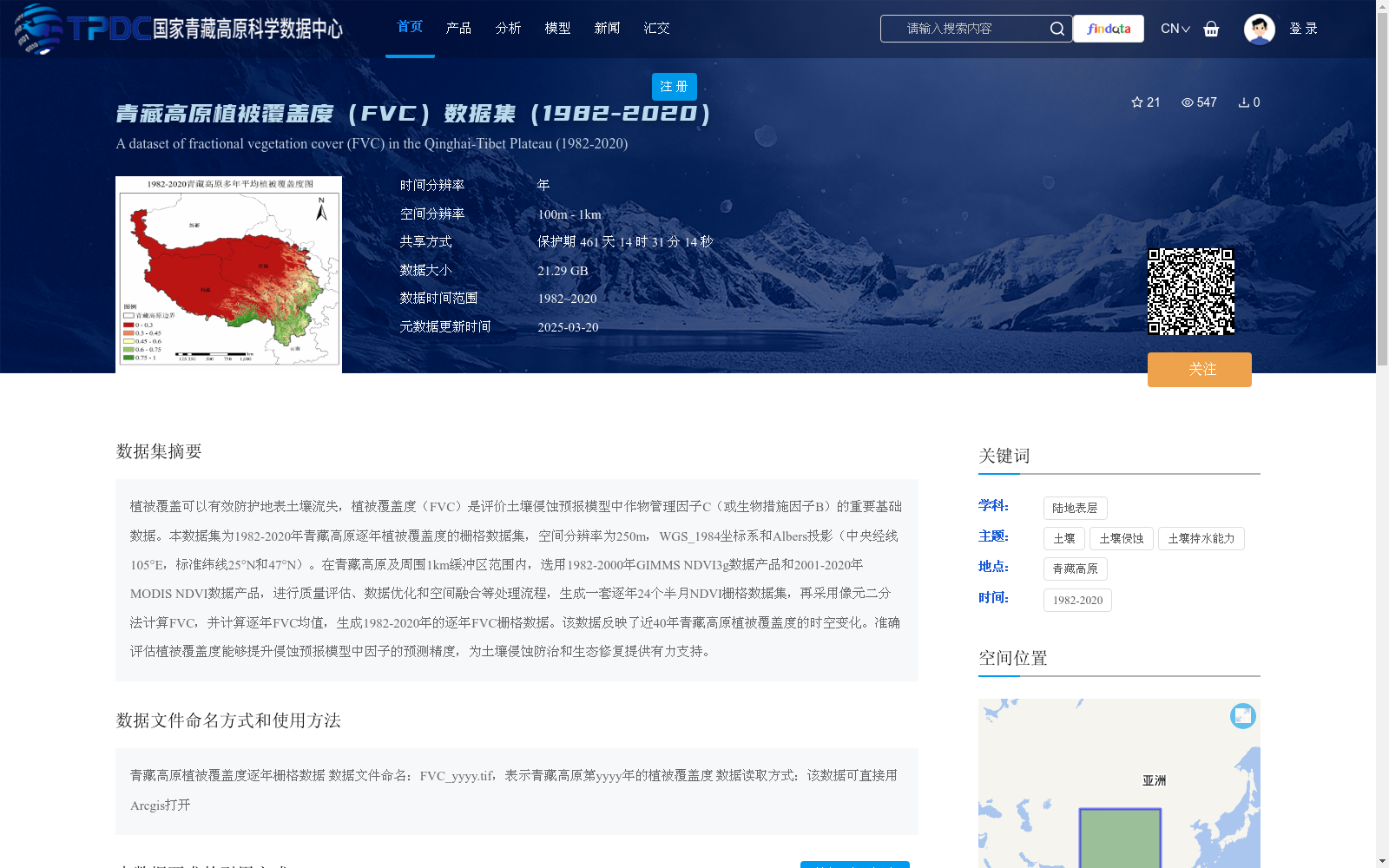
植被覆盖可以有效防护地表土壤流失,植被覆盖度(FVC)是评价土壤侵蚀预报模型中作物管理因子C(或生物措施因子B)的重要基础数据。本数据集为1982-2020年青藏高原逐年植被覆盖度的栅格数据集,空间分辨率为250m,WGS_1984坐标系和Albers投影(中央经线105°E,标准纬线25°N和47°N)。在青藏高原及周围1km缓冲区范围内,选用1982-2000年GIMMS NDVI3g数据产品和2001-2020年MODIS NDVI数据产品,进行质量评估、数据优化和空间融合等处理流程,生成一套逐年24个半月NDVI栅格数据集,再采用像元二分法计算FVC,并计算逐年FVC均值,生成1982-2020年的逐年FVC栅格数据。该数据反映了近40年青藏高原植被覆盖度的时空变化。准确评估植被覆盖度能够提升侵蚀预报模型中因子的预测精度,为土壤侵蚀防治和生态修复提供有力支持。
Vegetation cover effectively mitigates surface soil erosion. Fraction of Vegetation Coverage (FVC) is an essential basic dataset for evaluating the crop management factor C (or biological measure factor B) in soil erosion prediction models. This study developed an annual grid dataset of FVC over the Qinghai-Tibet Plateau from 1982 to 2020, with a spatial resolution of 250 m, adopting the WGS_1984 coordinate system and Albers projection (central meridian at 105°E, standard parallels at 25°N and 47°N). Within the scope of the Qinghai-Tibet Plateau and its surrounding 1 km buffer zone, the GIMMS NDVI3g data product (1982–2000) and MODIS NDVI data product (2001–2020) were selected. Subsequently, an annual grid dataset consisting of 24 half-month NDVI raster products was generated via workflows including quality assessment, data optimization and spatial fusion. Then, the dimidiate pixel model was applied to calculate FVC, and the annual average FVC was computed to produce annual FVC grid data spanning 1982 to 2020. This dataset reflects the spatiotemporal variations of FVC over the Qinghai-Tibet Plateau over the past 40 years. Accurate assessment of FVC can improve the prediction accuracy of relevant factors in soil erosion prediction models, providing strong support for soil erosion prevention and ecological restoration.
提供机构:
章文波
创建时间:
2025-03-07
搜集汇总
数据集介绍
背景与挑战
背景概述
该数据集是1982-2020年青藏高原逐年植被覆盖度(FVC)的栅格数据,空间分辨率为250米,基于GIMMS和MODIS NDVI数据产品通过像元二分法计算生成。它用于评估土壤侵蚀预报模型中的关键因子,支持生态修复研究,并反映了近40年植被覆盖度的时空变化。
以上内容由遇见数据集搜集并总结生成


