
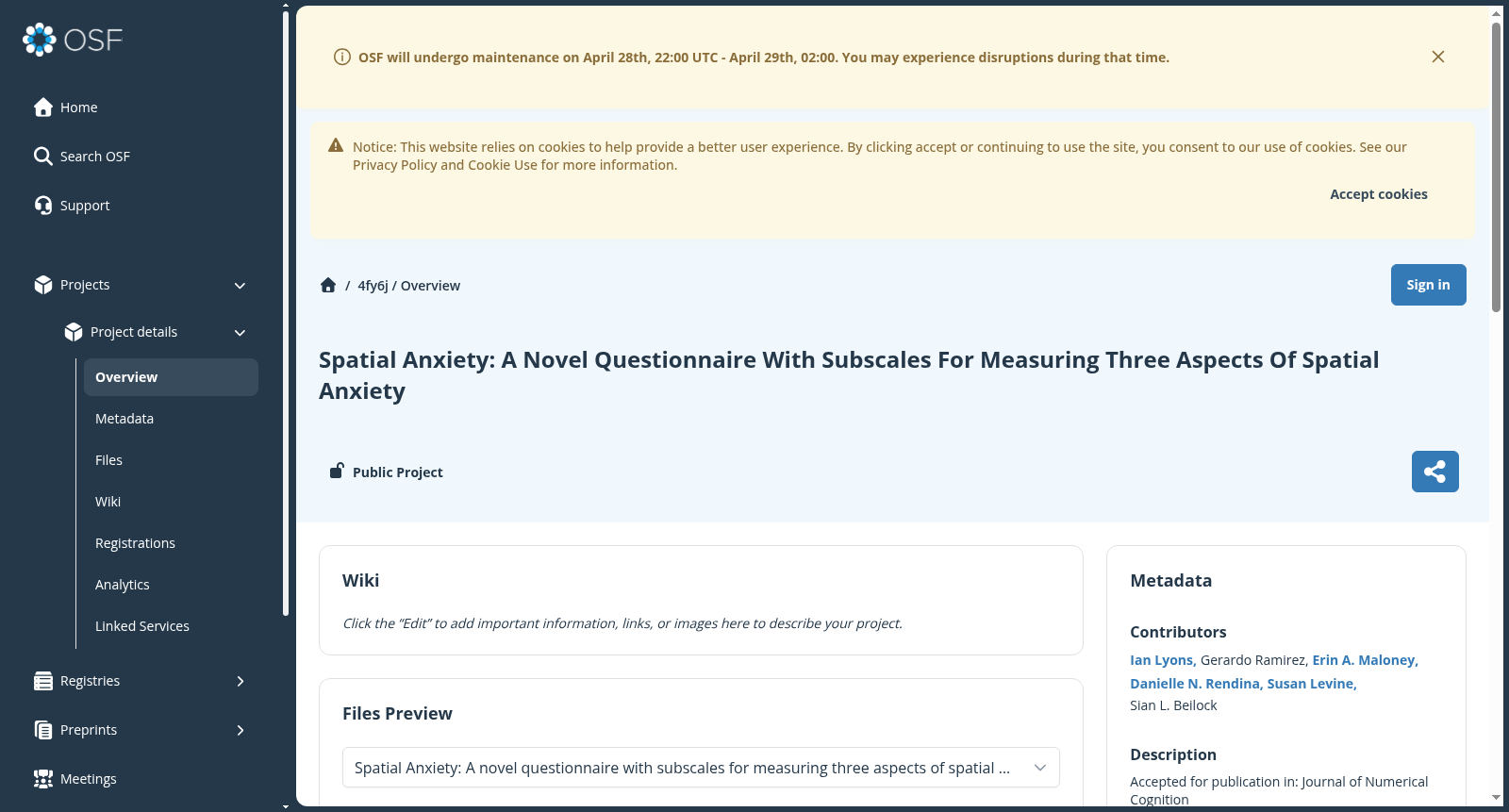
Spatial Anxiety: A novel questionnaire with subscales for measuring three aspects of spatial anxiety
收藏osf.io2018-11-28 更新2025-01-22 收录
下载链接:
https://osf.io/4fy6j
下载链接
链接失效反馈官方服务:
资源简介:
Accepted for publication in: Journal of Numerical Cognition
Abstract:
Spatial skills are a strong predictor of achievement and pursuit of employment in STEM fields. However, some individuals experience anxiety arising from situations that require performing spatial tasks in an evaluative context, and as a result, may avoid spatial related mental activities and exposure to spatially relevant experiences. We sought to generate and validate an instrument capable of reliably measuring individual differences in experiences of spatial anxiety. We developed a spatial anxiety data-driven approach, wherein an exploratory factor analysis was conducted within the framework for different types of spatial skills outlined by Uttal et al. (2013). In Study 1, factor analyses revealed that items loaded on three factors that corresponded well with some of the most common spatial abilities that have been discussed in the broader literature: navigation, mental-manipulation and imagery. The three subscales were high in internal reliability and between-scale selectivity. Study 2 then established that external validity was good for the navigation and manipulation subscales: higher anxiety ratings uniquely predicted lower objective performance and lower attitude/ability ratings on established measures within the respective subdomains. External validity was acceptable for the imagery subscale, uniquely predicting lower attitude/ability ratings on an established spatial imagery questionnaire. The overall result is an empirically validated Spatial Anxiety scale for use with adults that also respects the multifaceted nature of spatial processing. This questionnaire has the potential to provide a more comprehensive screening tool for spatial anxiety, and is a step toward identifying potential barriers to STEM education.
[Note: Lyons and Ramirez contributed equally to the paper and should be listed as co-first-authors.]
发表于:数值认知杂志
摘要:空间技能是预测STEM领域成就和就业追求的重要因素。然而,某些个体在面对需要评估性环境中执行空间任务的情境时,可能会产生焦虑,进而导致他们回避与空间相关的心理活动以及与空间相关的经验。本研究旨在生成并验证一种能够可靠地测量个体在空间焦虑体验中差异的工具。我们开发了一种空间焦虑数据驱动方法,在Uttal等人(2013年)提出的不同类型空间技能框架内进行探索性因素分析。在研究1中,因素分析揭示了三个因素,这些因素与文献中广泛讨论的一些最常见空间能力相吻合:导航、心理操作和意象。这三个子量表具有较高的内部可靠性和量表间的选择性。研究2进一步证实,导航和操作子量表具有良好的外部效度:更高的焦虑评分独特地预示了较低的目标性能和较低的态度/能力评分,这些评分是在各自子领域中已建立的测量中得出的。意象子量表的外部效度尚可接受,它能独特地预测在已建立的空间意象问卷上的较低的态度/能力评分。总体而言,我们得到了一个经过实证验证的空间焦虑量表,该量表适用于成人,并尊重空间处理的多维特性。该问卷有可能成为空间焦虑的更全面筛查工具,并有助于识别STEM教育中的潜在障碍。
[备注:Lyons和Ramirez对该论文的贡献相等,应列为共同第一作者。]
提供机构:
Center For Open Science
搜集汇总
数据集介绍
以上内容由遇见数据集搜集并总结生成


