
Benchmarking Suite for Generalization Error Confidence Intervals
收藏arXiv2024-09-27 更新2024-10-01 收录
下载链接:
https://www.openml.org/search?type=study&study_type=task&id=441
下载链接
链接失效反馈官方服务:
资源简介:
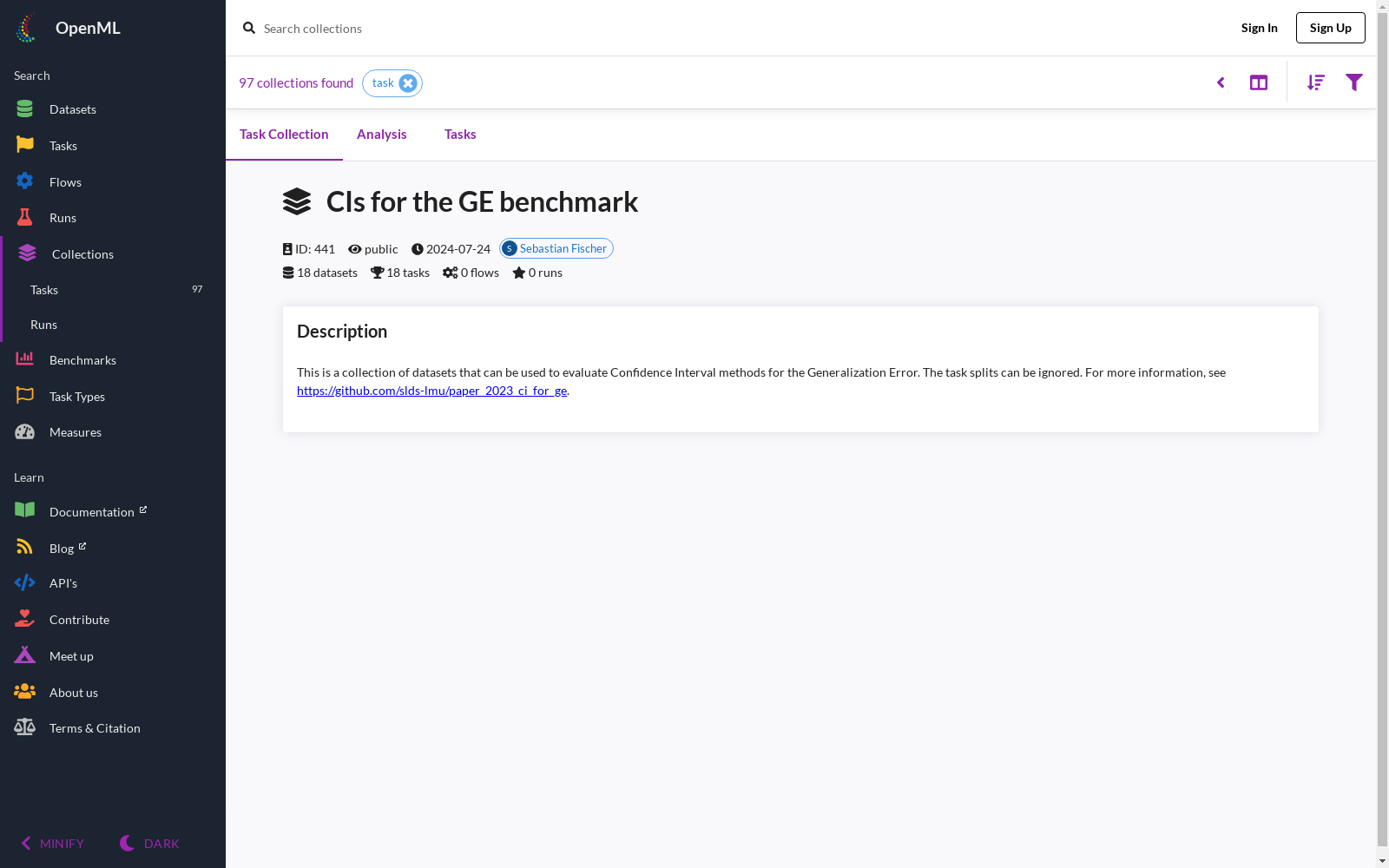
该数据集名为“Benchmarking Suite for Generalization Error Confidence Intervals”,由慕尼黑大学统计系创建,用于评估机器学习模型泛化误差的置信区间。数据集包含18个表格回归和分类问题,使用四种不同的模型和八种损失函数进行评估。数据集的创建过程涉及对现有方法的详细比较和新的数据生成过程。该数据集主要应用于机器学习模型的性能评估和不确定性量化,旨在解决模型预测精度的置信区间问题。
Benchmarking Suite for Generalization Error Confidence Intervals, developed by the Department of Statistics, Ludwig Maximilian University of Munich (LMU Munich), is designed to evaluate confidence intervals for the generalization errors of machine learning models. The dataset includes 18 tabular regression and classification tasks, and is evaluated using four distinct models and eight loss functions. The development of this dataset involves detailed comparisons of existing methodologies and a novel data generation process. It is primarily applied to performance evaluation and uncertainty quantification of machine learning models, aiming to address the problem of confidence intervals for model prediction accuracy.
提供机构:
慕尼黑大学统计系
创建时间:
2024-09-27
搜集汇总
数据集介绍
构建方式
该数据集通过综合评估13种不同的方法来构建泛化误差置信区间。研究团队在18个表格回归和分类问题上,使用四种不同的诱导器和八种损失函数,对这些方法进行了大规模的实证评估。数据集的构建包括对每种方法的覆盖频率、宽度以及运行时间的评估,并基于这些发现识别出推荐的方法。此外,研究团队还公开了数据集和代码,以便为未来的研究提供基础。
特点
该数据集的主要特点是其全面性和实证性。通过在多种数据生成过程(DGPs)和不同的模型设置下进行评估,数据集提供了对现有方法的深入比较。此外,数据集还包括了对每种方法的理论基础和构建置信区间时遇到的挑战的详细讨论。最后,数据集的公开性和可扩展性使得研究人员可以在此基础上进行进一步的研究和方法的扩展。
使用方法
使用该数据集的研究人员可以通过分析不同方法在各种条件下的表现,来选择最适合其特定应用的置信区间构建方法。数据集提供了详细的实验设置和结果,使得研究人员可以复现实验并进行进一步的分析。此外,数据集的代码和数据公开在GitHub和OpenML上,方便研究人员进行扩展和验证。研究人员还可以利用数据集中的理论讨论,来理解和改进现有的置信区间构建方法。
背景与挑战
背景概述
The Benchmarking Suite for Generalization Error Confidence Intervals is a comprehensive dataset designed to evaluate and compare various methods for constructing confidence intervals (CIs) for the generalization error in machine learning. This dataset was created by a team of researchers from the Department of Statistics at LMU Munich, the Munich Center for Machine Learning (MCML), and the Institute for Medical Information Processing, Biometry and Epidemiology, Faculty of Medicine, LMU Munich. The core research question addressed by this dataset is the empirical evaluation of 13 different methods for computing CIs for the generalization error, which is crucial for assessing the predictive performance of machine learning models. The dataset aims to provide a unified framework for comparing these methods, thereby contributing to the advancement of statistical inference in machine learning.
当前挑战
The construction of confidence intervals for the generalization error presents several challenges. Firstly, the vast array of resampling techniques and variance estimation methods available makes it difficult to determine which combination is most reliable. Theoretical guarantees for resampling-based variance estimators are sparse, and computational costs can be prohibitive, especially for large datasets. Additionally, the dependence structure created by resampling procedures introduces complexities in the inference data, making it challenging to accurately estimate the generalization error. The dataset addresses these challenges by providing a large-scale empirical study that evaluates the performance of different CI methods in terms of coverage frequency, width, and runtime, thereby helping to identify methods that are both reliable and computationally feasible.
常用场景
经典使用场景
该数据集最经典的使用场景在于评估机器学习模型在预测新数据时的泛化误差。通过构建泛化误差的置信区间(CIs),研究人员可以量化模型预测性能的不确定性。具体而言,数据集可用于比较13种不同的计算泛化误差CIs的方法,这些方法结合了各种重采样程序(如交叉验证和自助法)和不同的方差估计技术。
实际应用
在实际应用中,该数据集可用于指导数据科学家和机器学习从业者在选择和配置模型评估方法时做出更明智的决策。通过提供不同方法的性能比较,数据集帮助用户选择最适合其特定需求和数据特征的置信区间构建方法,从而提高模型评估的可靠性和准确性。
衍生相关工作
基于该数据集的研究,已经衍生出多项相关工作,包括对不同重采样技术和方差估计方法的深入分析,以及对泛化误差置信区间理论基础的探讨。此外,数据集的发布还促进了新的置信区间计算方法的提出和比较,推动了机器学习模型评估领域的进一步发展。
以上内容由遇见数据集搜集并总结生成



