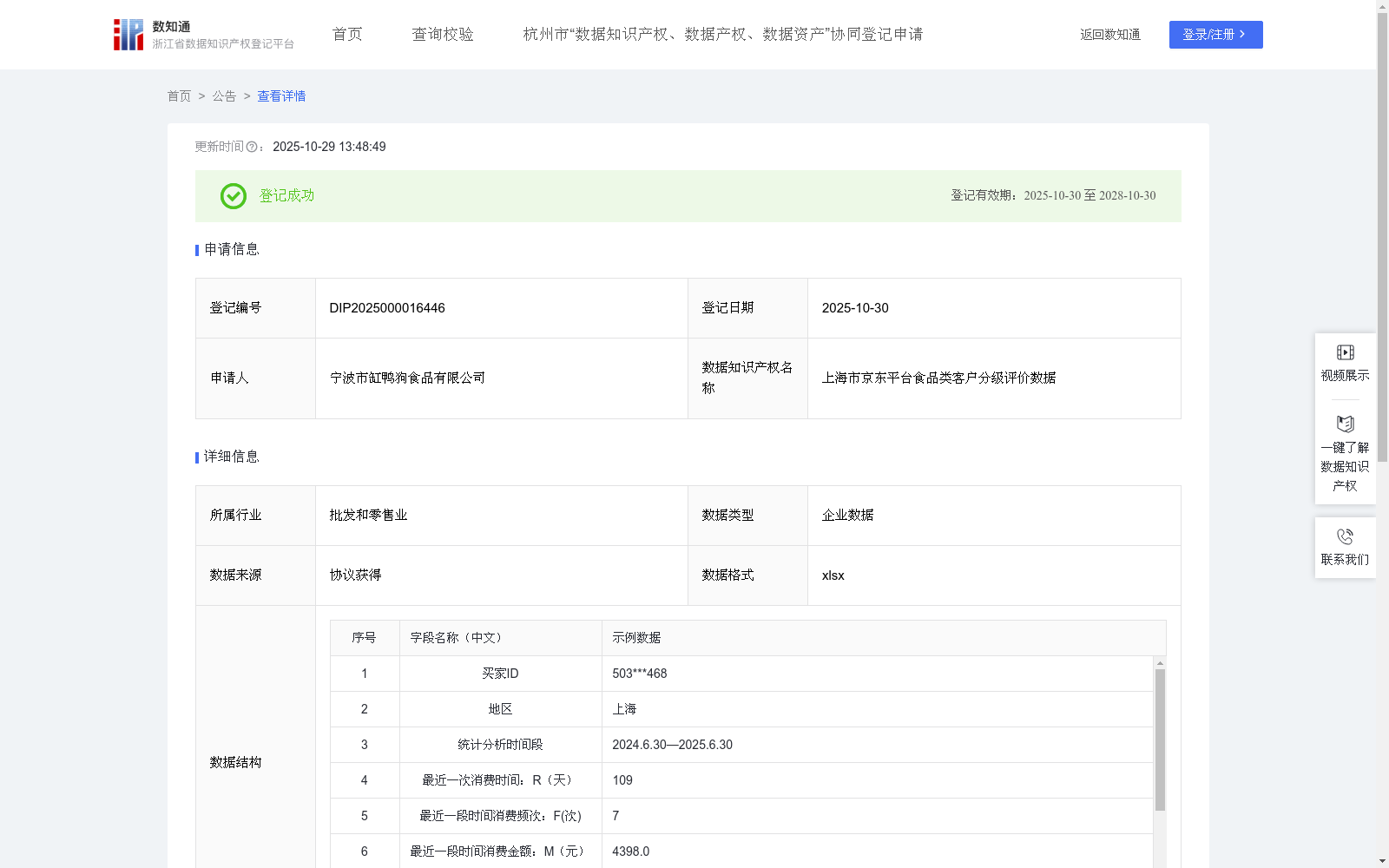
上海市京东平台食品类客户分级评价数据
收藏资源简介:
通过对京东平台的上海市用户消费行为数据进行深入分析,采用RFM模型来对用户进行细致的价值评级,通过用户的最近一次消费时间(R)、一定时期内的消费频次(F)以及同一时期内的消费金额(M)三个维度,来评估用户的价值和潜在贡献。通过精细化的用户价值管理,为平台的不同价值用户群体提供个性化的服务方案,不仅有助于优化积分和优惠券等激励措施的运营策略,还能为其他营销活动提供坚实的数据支持。具体而言,通过识别出最近消费、消费频次高、消费金额大的高价值用户,并为其提供更加定制化的服务和优惠,对于消费频次较低或消费金额较小的用户,可设计针对性的营销活动,以激发其消费潜力,提升用户活跃度和忠诚度。1、对从销售记录表中采集到对客户的销售单数和销售金额等信息进行脱敏、降噪、清洗、聚集、分析。2、数据加工:运用RFM模型结合客户在统计分析时间段间隔内距离截止日的最近一次消费时间天数(R)、客户在统计分析时间段之间的最近一段时间消费频次(F)和客户在统计分析时间段之间的最近一段时间消费金额(M)的得分排名对客户进行一个综合排名,最终得出一个RFM总评分。a.提取出最近一次消费时间的天数(R)、客户在统计分析时间段之间消费频次(F)和客户在统计分析时间段之间消费金额(M)进行分类,最近一次消费时间间隔最短的客户排在最上面。按照从1-5评分,前20%的客户获得5分,接下来的20%用户获得4分,再下来20%的客户为3分,再下来20% 的客户为2分,最后20% 的客户为1分。 b.根据客户在最近一段时间消费频次(F)从高到底依次对用户进行分类,前20%的客户在用户活动频率的分数为5,以此类推。 c, 根据客户在最近一段时间消费金额(M),前20%的客户在消费金额的分数为5,以此类推。消费金额最少的20%客户则分数为1。 RFM得分=0.3*(R得分)+0.3*(F得分)+0.4*(M得分) 评分大于等于4分的为A级客户,大于等于3小于4的为B级客户,大于等于2小于3的为C 级客户,低于2的为D 级客户。
By conducting an in-depth analysis of the consumer behavior data of Shanghai-based users on the JD.com platform, this study adopts the RFM model to perform detailed value grading of users. It evaluates user value and potential contribution based on three dimensions: Recency (R, the time since the user's last consumption), Purchase Frequency (F, the number of consumption occurrences within a specific period), and Monetary Value (M, the total consumption amount within the same period). Refined user value management to provide personalized service plans for user groups of different values on the platform not only helps optimize the operational strategies of incentive measures such as points and coupons, but also provides solid data support for other marketing activities. Specifically, by identifying high-value users who have consumed recently, have high purchase frequency and large transaction amounts, and providing them with more customized services and preferential treatments, targeted marketing activities can be designed for users with low purchase frequency or small transaction amounts to stimulate their consumption potential and enhance user engagement and loyalty. 1. Perform data desensitization, denoising, cleaning, aggregation and analysis on information such as the number of sales orders and transaction amounts of customers collected from sales record tables. 2. Data processing: Conduct a comprehensive ranking of customers using the RFM model, combined with the score rankings of three dimensions: the number of days since the customer's last purchase relative to the analysis deadline (R), the customer's purchase frequency (F) within the statistical analysis period, and the customer's transaction amount (M) within the statistical analysis period, and finally derive the overall RFM score. a. Classify the three dimensions of the number of days since last purchase (R), purchase frequency (F) and transaction amount (M) within the statistical analysis period. Customers with the shortest time since last purchase are ranked first. Scoring is conducted on a scale of 1 to 5: the top 20% of customers receive 5 points, the next 20% receive 4 points, the subsequent 20% receive 3 points, the next 20% receive 2 points, and the last 20% receive 1 point. b. Classify users in descending order based on their purchase frequency (F) within the recent period. The top 20% of customers get 5 points for their activity frequency score, and so on. c. Classify users based on their transaction amount (M) within the recent period. The top 20% of customers get 5 points for their transaction amount score, and so on; the 20% of customers with the lowest transaction amounts get 1 point. The overall RFM score is calculated as: RFM Score = 0.3*(R Score) + 0.3*(F Score) + 0.4*(M Score). Customers with a score ≥4 are classified as Class A customers, those with a score ≥3 and <4 as Class B customers, those with a score ≥2 and <3 as Class C customers, and those with a score <2 as Class D customers.