
mixture2_and_safe_pku
收藏arXiv2025-02-19 更新2025-02-20 收录
下载链接:
https://huggingface.co/datasets/weqweasdas/preference_dataset_mixture2_and_safe_pku
下载链接
链接失效反馈官方服务:
资源简介:
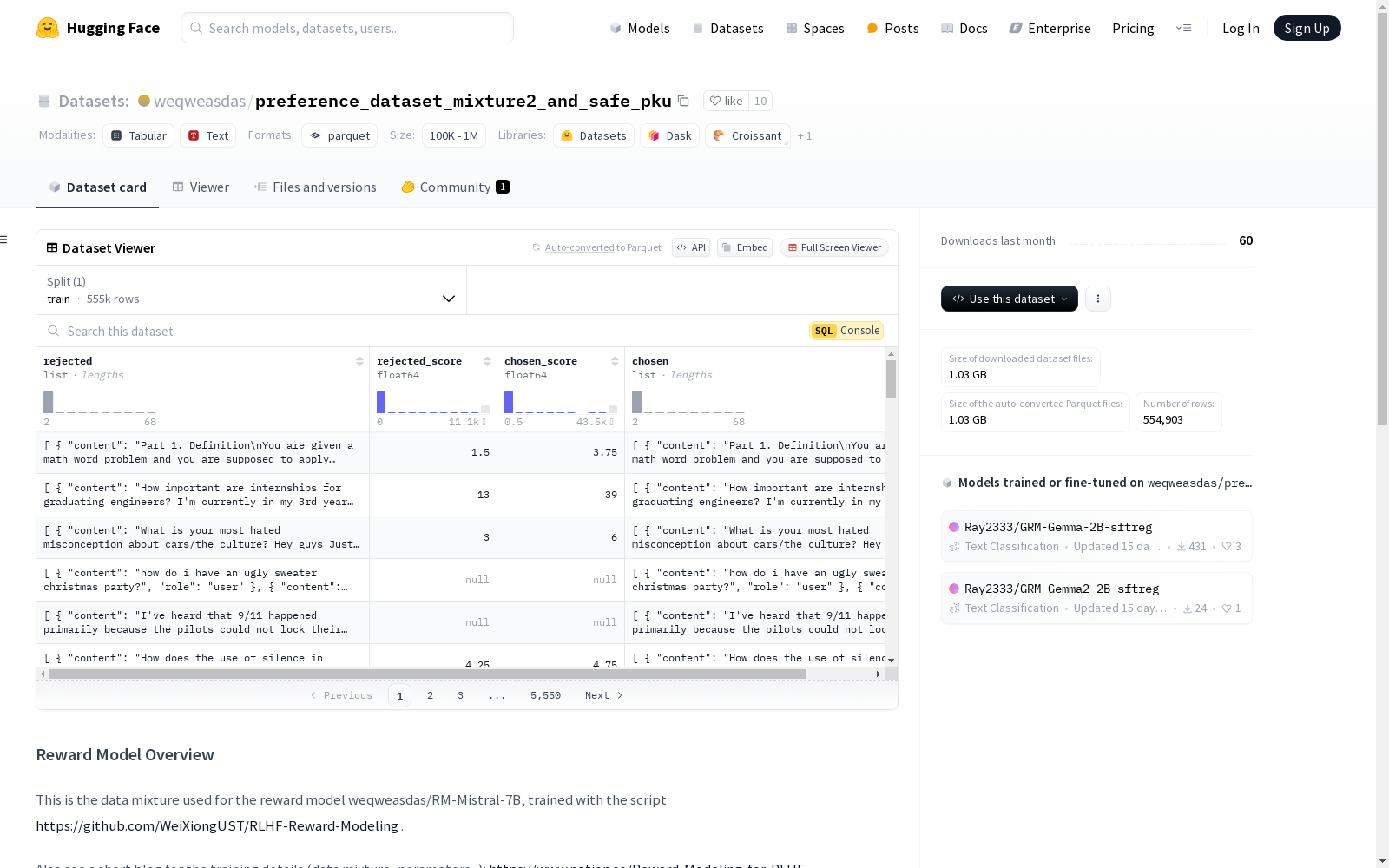
mixture2_and_safe_pku数据集是一个包含550k个配对偏好样本的集合,由莱斯大学等机构提供,该数据集整合了来自HH-RLHF和UltraFeedback的数据源,适用于研究多样化的偏好分解。数据集包含了丰富的样本,用于评估奖励模型在不同维度上的效果,如聊天质量、安全性和推理能力。
The Mixture2_and_Safe_PKU dataset is a collection of 550k paired preference samples, provided by Rice University and other institutions. This dataset integrates data sources from HH-RLHF and UltraFeedback, and is designed for research on diverse preference decomposition. It contains rich samples for evaluating the performance of reward models across multiple dimensions, including chat quality, safety, and reasoning capabilities.
提供机构:
莱斯大学, 伊利诺伊大学厄巴纳-香槟分校, 剑桥大学, 哥伦比亚大学
创建时间:
2025-02-19
搜集汇总
数据集介绍
构建方式
mixture2_and_safe_pku数据集是通过结合人类标注的偏好数据和GPT生成的标签构建而成的,旨在理解人类偏好的多样性和复杂性。该数据集包含了大量的二进制比较数据,即用户只需比较两个响应,无需进行细粒度的标注。通过将人类偏好表示为向量并使用主成分分析(PCA)进行分析,DRMs框架可以有效地提取出不同的偏好维度,如安全性、幽默感等。
特点
mixture2_and_safe_pku数据集的特点在于其多样性、复杂性和可解释性。通过PCA分析,该数据集可以提取出多个正交基向量,每个向量都捕捉到了人类偏好的不同方面。这些分解后的奖励可以灵活地组合起来,以适应不同的用户需求,提供了一种可解释且可扩展的替代传统奖励模型的方法。此外,DRMs框架还可以通过测试时对齐来适应新的用户,无需进行额外的训练。
使用方法
使用mixture2_and_safe_pku数据集,可以训练DRMs框架,并通过测试时对齐来适应新的用户。具体步骤如下:1. 使用嵌入提取器对偏好数据集进行推理,得到嵌入差异数据集。2. 对嵌入差异数据集进行PCA,得到一组基向量。3. 计算每个基向量对应的权重参数,并形成线性组合,以最好地与用户的偏好对齐。4. 使用HyRe等测试时对齐方法,根据小型的适应数据集动态调整奖励权重。
背景与挑战
背景概述
在深度学习和人工智能领域,理解人类偏好对于构建个性化AI系统至关重要。然而,传统的奖励模型在捕捉人类偏好的多样性和复杂性方面存在局限性。 Luo Feng等人提出了一种名为分解奖励模型(DRMs)的新方法,该方法通过二进制比较提取人类偏好,无需细粒度注释。该模型将人类偏好表示为向量,并使用主成分分析(PCA)进行分析。通过构建一组嵌入差异的数据集,DRMs识别出正交基向量,这些向量捕捉到偏好的不同方面。这些分解的奖励可以灵活地组合以适应不同的用户需求,为传统的奖励模型提供了一个可解释和可扩展的替代方案。该数据集的创建时间未在提供的论文中明确提及,但可以推测是在2025年或之后,因为论文的arXiv版本日期为2025年2月18日。
当前挑战
DRMs面临的主要挑战包括:1)构建过程中所遇到的挑战,例如如何有效地从大规模二进制比较数据中提取多维人类偏好;2)如何确保模型能够适应新用户,而无需额外的训练。此外,DRMs的分解奖励数量庞大(例如,Gemma-2B有2048个奖励头),需要手动分析每个奖励头以确定其对应的偏好属性,这在实际操作中可能是不切实际的。因此,开发自动化方法来分析这些奖励是一个未来的研究方向。
常用场景
经典使用场景
Decomposed Reward Models (DRMs) is a novel approach that extracts diverse human preferences from binary comparisons without requiring fine-grained annotations. This method is particularly useful for personalized preference learning, where it can capture the full range of human preferences without the need for expensive and hard-to-scale fine-grained preference data. DRMs can be applied in various scenarios where human preferences need to be understood and modeled, such as personalized AI systems, recommendation systems, and human-computer interaction.
解决学术问题
DRMs addresses the limitations of traditional reward models in capturing the full diversity of human preferences. Traditional models often reflect the preferences of the majority and struggle to represent the complex, multifaceted, and sometimes conflicting nature of human preferences with a single scalar reward. DRMs solve this problem by representing human preferences as vectors and analyzing them using Principal Component Analysis (PCA), allowing for a more comprehensive and interpretable understanding of human preferences.
衍生相关工作
DRMs has inspired several related works in the field of preference learning. For example, researchers have proposed multiobjective optimization methods to accommodate diverse user needs, and embedding-based reward models that integrate well with established statistical learning tools. Additionally, DRMs has also been applied in the field of dimensionality reduction and embedding analysis, where it has been shown to be effective in extracting latent dimensions that capture key human preferences for model alignment.
以上内容由遇见数据集搜集并总结生成



