
Unimelb Corridor Synthetic dataset
收藏DataCite Commons2020-09-22 更新2025-04-17 收录
下载链接:
https://melbourne.figshare.com/articles/UnimelbCorridorSynthetic_zip/10930457
下载链接
链接失效反馈官方服务:
资源简介:
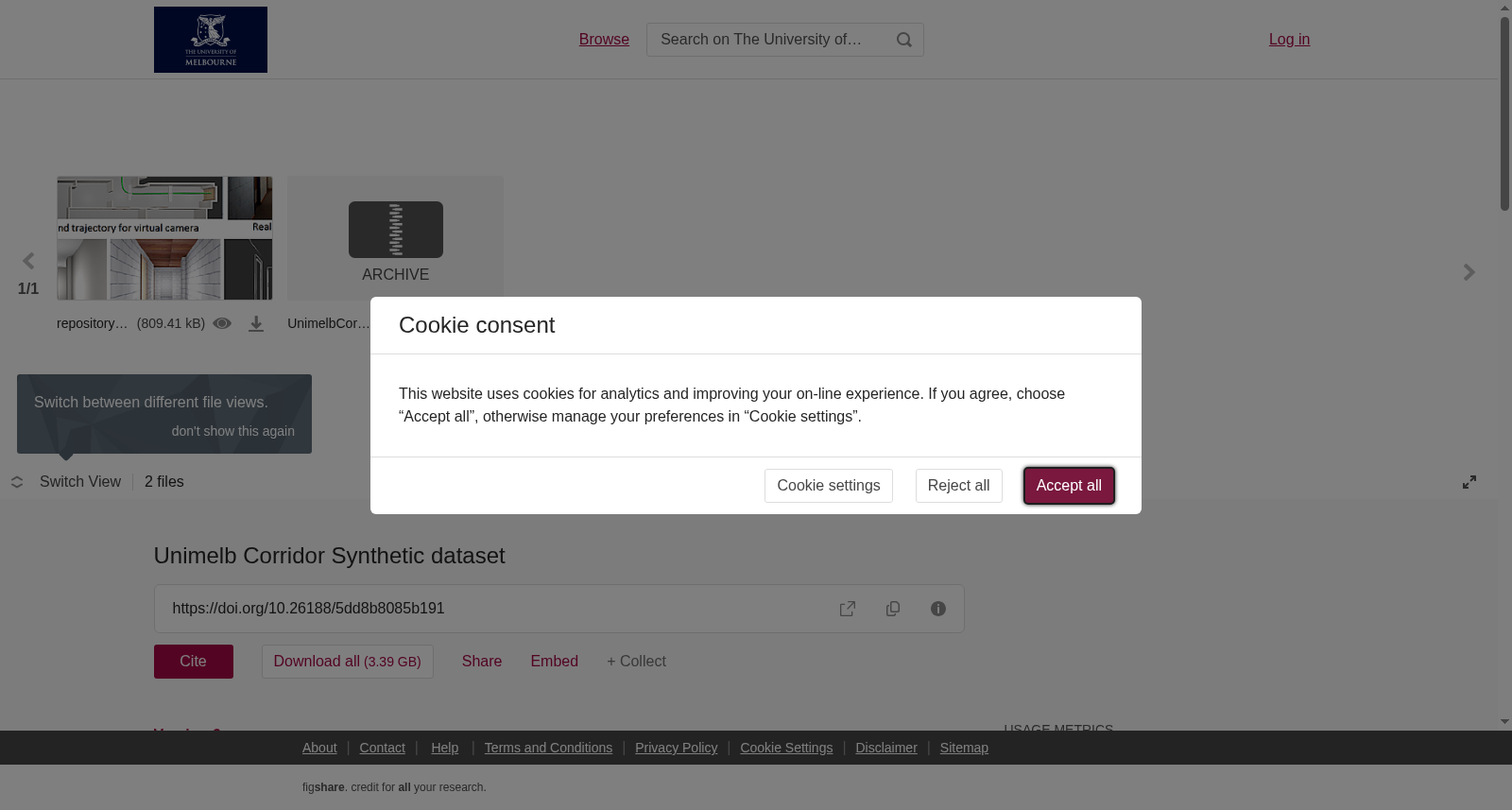
This data-set is a supplementary material related to the generation of synthetic images of a corridor in the University of Melbourne, Australia from a building information model (BIM). This data-set was generated to check the ability of deep learning algorithms to learn task of indoor localisation from synthetic images, when being tested on real images. <br>=============================================================================<br>The following is the name convention used for the data-sets. The brackets show the number of images in the data-set.<br>REAL DATA<br>Real ---------------------> Real images (949 images) Gradmag-Real -------> Gradmag of real data (949 images)<br>SYNTHETIC DATA<br>Syn-Car ----------------> Cartoonish images (2500 images) Syn-pho-real ----------> Synthetic photo-realistic images (2500 images) Syn-pho-real-tex -----> Synthetic photo-realistic textured (2500 images) Syn-Edge --------------> Edge render images (2500 images) Gradmag-Syn-Car ---> Gradmag of Cartoonish images (2500 images)<br>=============================================================================<br>Each folder contains the images and their respective groundtruth poses in the following format [ImageName X Y Z w p q r].<br>To generate the synthetic data-set, we define a trajectory in the 3D indoor model. The points in the trajectory serve as the ground truth poses of the synthetic images. The height of the trajectory was kept in the range of 1.5–1.8 m from the floor, which is the usual height of holding a camera in hand. Artificial point light sources were placed to illuminate the corridor (except for Edge render images). The length of the trajectory was approximately 30 m. A virtual camera was moved along the trajectory to render four different sets of synthetic images in Blender*. The intrinsic parameters of the virtual camera were kept identical to the real camera (VGA resolution, focal length of 3.5 mm, no distortion modeled). We have rendered images along the trajectory at 0.05 m interval and ± 10° tilt.<br>The main difference between the cartoonish (Syn-car) and photo-realistic images (Syn-pho-real) is the model of rendering. Photo-realistic rendering is a physics-based model that traces the path of light rays in the scene, which is similar to the real world, whereas the cartoonish rendering roughly traces the path of light rays. The photorealistic textured images (Syn-pho-real-tex) were rendered by adding repeating synthetic textures to the 3D indoor model, such as the textures of brick, carpet and wooden ceiling. The realism of the photo-realistic rendering comes at the cost of rendering times. However, the rendering times of the photo-realistic data-sets were considerably reduced with the help of a GPU. Note that the naming convention used for the data-sets (e.g. Cartoonish) is according to Blender terminology.<br>An additional data-set (Gradmag-Syn-car) was derived from the cartoonish images by taking the edge gradient magnitude of the images and suppressing weak edges below a threshold. The edge rendered images (Syn-edge) were generated by rendering only the edges of the 3D indoor model, without taking into account the lighting conditions. This data-set is similar to the Gradmag-Syn-car data-set, however, does not contain the effect of illumination of the scene, such as reflections and shadows.<br>*Blender is an open-source 3D computer graphics software and finds its applications in video games, animated films, simulation and visual art. For more information please visit: http://www.blender.org<br>Please cite the papers if you use the data-set:<br><i>1) Acharya, D., Khoshelham, K., and Winter, S., 2019. BIM-PoseNet: Indoor camera localisation using a 3D indoor model and deep learning from synthetic images. ISPRS Journal of Photogrammetry and Remote Sensing. 150: 245-258.</i><i><br></i><i>2) Acharya, D., Singha Roy, S., Khoshelham, K. and Winter, S. 2019. Modelling uncertainty of single image indoor localisation using a 3D model and deep learning. In ISPRS Annals of Photogrammetry, Remote Sensing & Spatial Information Sciences, IV-2/W5, pages 247-254.</i>
本数据集为澳大利亚墨尔本大学某走廊基于建筑信息模型(Building Information Modeling,BIM)生成合成图像的配套补充材料。本数据集旨在验证深度学习算法在基于真实图像测试时,从合成图像中学习室内定位任务的能力。
=============================================================================
本数据集采用如下命名规范,括号内标注数据集包含的图像数量:
### 真实数据(REAL DATA)
Real → 真实图像(共949张)
Gradmag-Real → 真实数据的梯度幅值(Gradient Magnitude)图像(共949张)
### 合成数据(SYNTHETIC DATA)
Syn-Car → 卡通风格图像(共2500张)
Syn-pho-real → 合成写实风格图像(共2500张)
Syn-pho-real-tex → 带纹理的合成写实风格图像(共2500张)
Syn-Edge → 边缘渲染图像(共2500张)
Gradmag-Syn-Car → 卡通风格图像的梯度幅值(Gradient Magnitude)图像(共2500张)
=============================================================================
每个文件夹均包含图像及其对应的真值位姿,格式为[ImageName X Y Z w p q r]。
合成数据集的生成流程如下:首先在3D室内模型中定义一条运动轨迹,轨迹上的采样点即为合成图像的真值位姿。轨迹高度设置为距地面1.5–1.8 m,符合手持相机拍摄的常规高度。除边缘渲染图像外,其余合成图像均通过人工点光源照亮走廊场景。轨迹总长度约30 m,我们通过虚拟相机沿该轨迹在Blender*中渲染得到四组不同的合成图像数据集。虚拟相机的内参与真实相机保持一致:VGA分辨率、焦距3.5 mm、无畸变建模。我们以0.05 m为步长沿轨迹采集图像,并设置±10°的俯仰倾斜角度。
卡通风格(Syn-Car)与写实风格图像(Syn-pho-real)的核心差异在于渲染模型。写实风格渲染为基于物理的光线追踪模型,精准模拟真实世界中的光线路径;而卡通风格渲染仅对光线路径进行近似追踪。带纹理的写实风格图像(Syn-pho-real-tex)通过为3D室内模型添加重复的合成纹理(如砖块、地毯与木质天花板纹理)生成。写实风格渲染的真实感以更长的渲染时长为代价,但借助图形处理器(Graphics Processing Unit,GPU)可大幅缩短写实数据集的渲染耗时。需注意,本数据集采用的命名规范(如"Cartoonish")均源自Blender的官方术语体系。
额外的Gradmag-Syn-Car数据集由卡通风格图像衍生得到:通过提取图像的边缘梯度幅值并抑制阈值以下的弱边缘生成。边缘渲染图像(Syn-Edge)仅渲染3D室内模型的边缘轮廓,不考虑光照条件,与Gradmag-Syn-Car数据集类似,但不含场景光照(如反射与阴影)的影响。
*Blender是一款开源3D计算机图形软件,广泛应用于电子游戏、动画电影、仿真与视觉艺术领域。更多信息请访问:http://www.blender.org
若使用本数据集,请引用以下论文:
1) Acharya, D., Khoshelham, K., and Winter, S., 2019. BIM-PoseNet: Indoor camera localisation using a 3D indoor model and deep learning from synthetic images. ISPRS Journal of Photogrammetry and Remote Sensing. 150: 245-258.
2) Acharya, D., Singha Roy, S., Khoshelham, K. and Winter, S. 2019. Modelling uncertainty of single image indoor localisation using a 3D model and deep learning. In ISPRS Annals of Photogrammetry, Remote Sensing & Spatial Information Sciences, IV-2/W5, pages 247-254.
创建时间:
2019-11-23
搜集汇总
数据集介绍
以上内容由遇见数据集搜集并总结生成

暂无相关数据集


