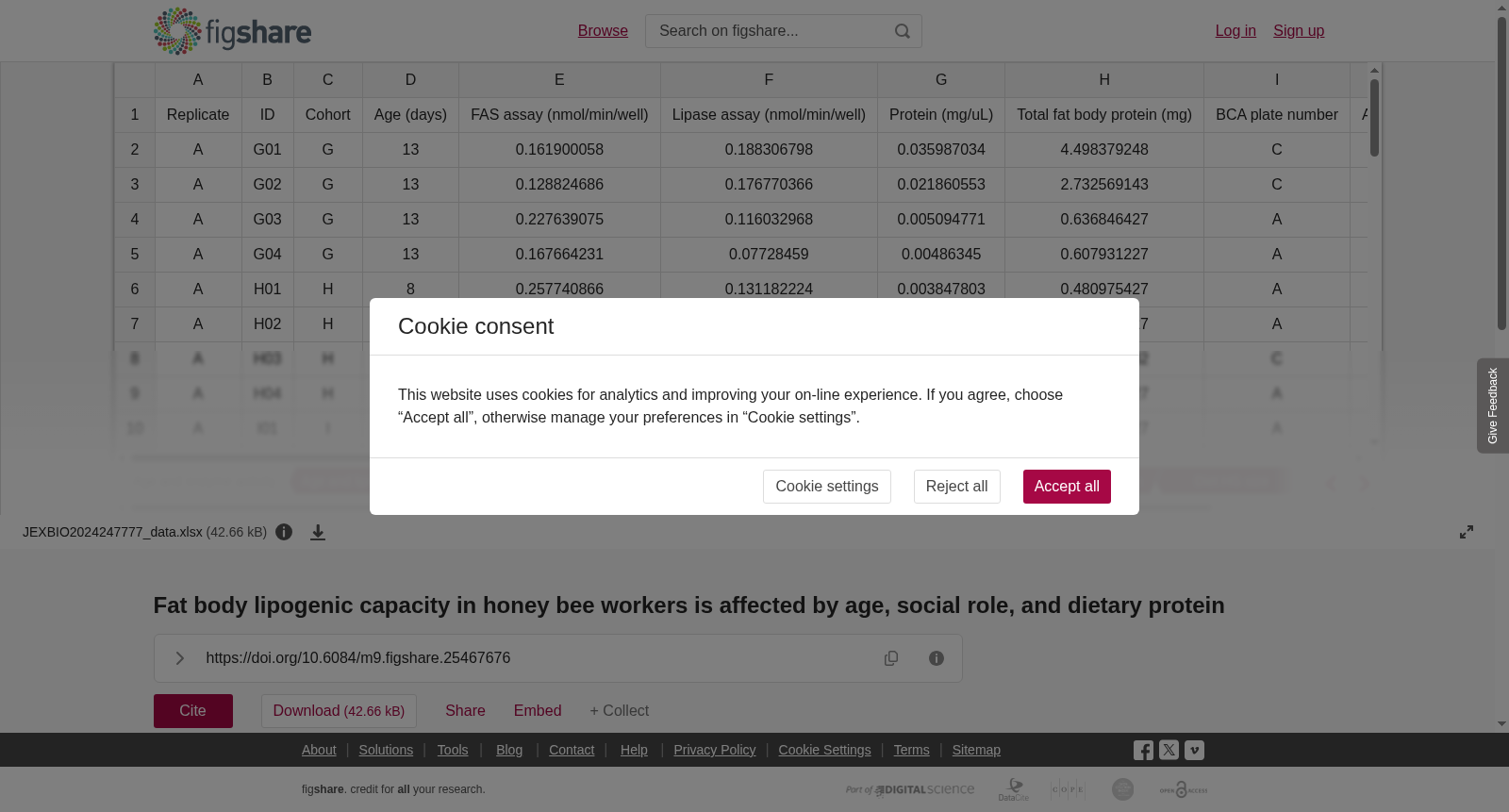
<b>Fat body lipogenic capacity in honey bee workers is affected by age, social role, and dietary protein</b>
收藏资源简介:
<b>Abstract</b>All organisms need to balance processes that consume energy against those that produce energy. With an increase in biological complexity over evolutionary time, regulation of this balance has become much more complex, resulting in specialization of metabolic tasks between organelles, cells, organs, and in the case of eusocial organisms, between the individuals who comprise the ‘superorganism.’ Exemplifying this, nurse honey bees maintain high abdominal lipids, while foragers have very low lipid stores, likely contributing to efficient performance of their social role, and thus to colony fitness. The proximate mechanisms responsible for these metabolic differences remain poorly understood. Here, we investigated the effects of age, worker class, and dietary macronutrients on the abdominal activity of fatty acid synthase (FAS), the enzyme responsible for <i>de novo</i> synthesis of fatty acids as well as age on lipase activity, enzymes responsible for breakdown of stored lipids. We found that FAS but not lipase activity declines as bees age past peak nursing age. Feeding both nurses and foragers carbohydrates increased FAS activity compared with starved bee, but, whether fed or starved, nurses had much higher FAS activity than similarly treated foragers, implicating reduced lipid synthesis as one component of foragers’ low lipid stores. Finally, we used artificial diets with different amounts of protein and fat to precociously induce low, forager-like FAS activity levels in nurse-age bees deprived of protein. We speculate that reduced protein appetite and consumption during the nurse-forager transition is responsible for suppressed lipid synthesis in foragers.
<b>摘要</b>所有生物都需要在能量消耗与能量产生的过程之间维持动态平衡。随着进化历程中生物复杂度的不断提升,该平衡的调控机制也愈发复杂,使得代谢任务在细胞器、细胞、器官之间出现特化;对于真社会性(eusocial)生物而言,这种特化甚至延伸至构成“超个体”的不同个体之间。典型例证便是西方蜜蜂:保育蜂腹部脂质含量维持在较高水平,而采集蜂的脂质储备则极低,这或许有助于二者高效履行各自的社会职能,进而提升蜂群适合度。目前学界对这类代谢差异的近因机制仍知之甚少。本研究探讨了日龄、工蜂品级以及膳食宏量营养素对腹部脂肪酸合酶(Fatty Acid Synthase, FAS)活性的影响——该酶负责脂肪酸的从头(de novo)合成;同时还分析了日龄对脂肪酶(Lipase)活性的影响,脂肪酶是负责分解储存脂质的酶类。研究发现,当工蜂日龄超过保育高峰期后,其体内的FAS活性会显著下降,但脂肪酶活性并无此类变化。与饥饿处理的工蜂相比,给保育蜂和采集蜂投喂碳水化合物均可提升其FAS活性;但无论投喂与否,保育蜂的FAS活性均显著高于经相同处理的采集蜂,这表明脂质合成能力下降是采集蜂脂质储备偏低的原因之一。最后,本研究通过配制不同蛋白质与脂肪含量的人工饲料,在缺乏蛋白质的保育日龄工蜂中早熟性诱导出类似采集蜂的低FAS活性水平。我们推测,在保育蜂向采集蜂转变的过程中,工蜂对蛋白质的食欲与摄入量下降,是导致采集蜂脂质合成受抑制的关键原因。