
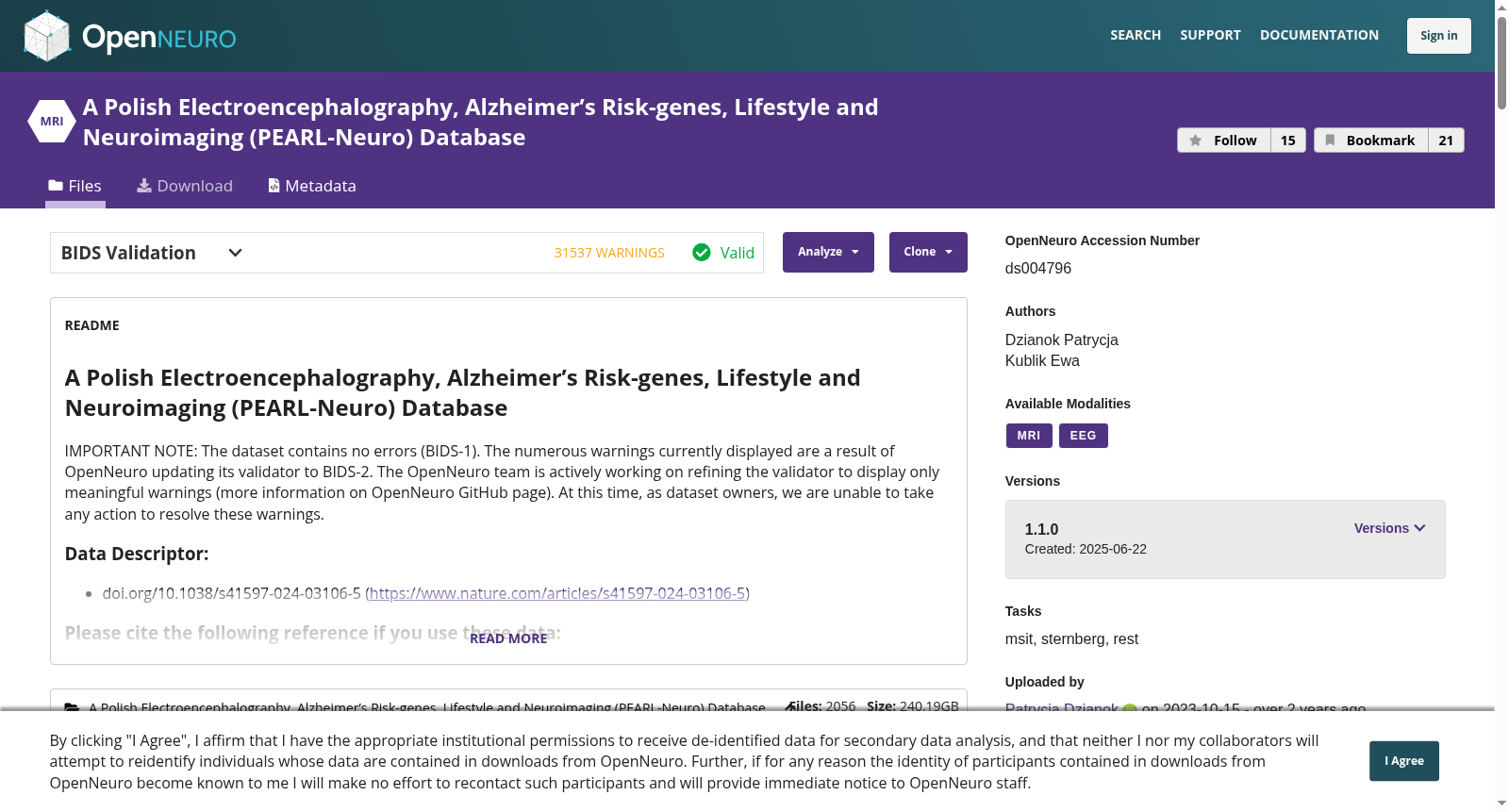
A Polish Electroencephalography, Alzheimer’s Risk-genes, Lifestyle and Neuroimaging (PEARL-Neuro) Database
收藏OpenNeuro2023-10-15 更新2026-03-14 收录
下载链接:
https://openneuro.org/datasets/ds004796
下载链接
链接失效反馈官方服务:
资源简介:
## A Polish Electroencephalography, Alzheimer’s Risk-genes, Lifestyle and Neuroimaging (PEARL-Neuro) Database
IMPORTANT NOTE: The dataset contains no errors (BIDS-1). The numerous warnings currently displayed are a result of OpenNeuro updating its validator to BIDS-2. The OpenNeuro team is actively working on refining the validator to display only meaningful warnings (more information on OpenNeuro GitHub page). At this time, as dataset owners, we are unable to take any action to resolve these warnings.
### Data Descriptor:
* doi.org/10.1038/s41597-024-03106-5 (https://www.nature.com/articles/s41597-024-03106-5)
### Please cite the following reference if you use these data:
* Dzianok P, Kublik E. PEARL-Neuro Database: EEG, fMRI, health and lifestyle data of middle-aged people at risk of dementia. Sci Data 11, 276 (2024). DOI: https://doi.org/10.1038/s41597-024-03106-5
### Publications related to this dataset, reporting & additional data
* https://github.com/PTDZ/PEARL-Neuro — updates, additional study details, and list of research outputs related to this dataset.
IMPORTANT: Please inform us of any research outputs related to the shared data, including publications, preprints, posters, abstracts, talks, and any commercial usage. This is crucial for ensuring transparency and informing users about the analyses already performed on this dataset. Additionally, such information can foster collaboration.
### Description of the database:
Full cohort: 192 healthy middle-aged (50-63) individuals, balanced female and male ratio.
* Genetic data (N = 192):
* Apolipoprotein E (APOE)
* Phosphatidylinositol binding clathrin assembly protein (PICALM)
* Basic demographic and health data
* Psychometric data (memory, intelligence, mood, personality, stress coping strategies)
Cohort subgroup: 79 healthy middle-aged (50-63) individuals, balanced female and male ratio.
* Neuroimaging data:
* Functional data — electroencefalography (EEG) and functional magnetic resonance imaging (fMRI):
* Resting-state protocol (with two conditions: eyes open and eyes closed)
* Cognitive tasks: multi-source interference task (MSIT) and Sternberg’s memory task
* Blood tests data (blood count, lipid profile, HSV virus)
### Release history:
* 10/2023: Initial release
* 02/2024: Public release
* 06/2025, version: 1.1.0 — marker corrections in .tsv and .vmrk EEG resting-state files
During EEG data acquisition, technical issues led to missing starting markers for the eyes-open and/or eyes-closed conditions in the resting-state protocol for some participants. As described in the Data Note, the S1 marker indicates the end of the instruction phase—when the participant presses "Enter" to begin a condition (either eyes-open or eyes-closed). Consequently, the first S1 marker coincides with the S2 marker (start of the eyes-open condition), and the second S1 marker aligns with the S4 marker (start of the eyes-closed condition).
To ensure consistency with Table 5 in the released Data Note, the missing markers were added to the relevant files (.tsv and .vmrk) for the following participants: 08, 09, 11, 12, 14, 15, 21, 22, 25, 35, 42, 54, 62, 64, 65, 67, 70, 71, 73, 75, and 79.
For participants 19 and 30, the S11 marker (indicating the end of the task and accompanying sound effect) was not saved, resulting in a slightly shorter eyes-closed recording duration (by approximately 30–60 seconds).
For participant 34, the S11 marker was also not recorded because he/she forgot to press "Enter" to mark the start of the eyes-closed condition, pressing it only after the condition had ended. However, he/she followed the instructions and kept his/her eyes closed during the condition. Therefore, the relevant markers (S1/S4) were manually adjusted to reflect the correct start time.
# 波兰语脑电图、阿尔茨海默病风险基因、生活方式与神经影像(PEARL-Neuro)数据库
## 重要说明
本数据集本身无BIDS-1格式错误。当前显示的大量警告源于OpenNeuro将验证器更新至BIDS-2标准。OpenNeuro团队正积极优化验证器,仅展示有实际意义的警告(更多信息可查阅OpenNeuro GitHub页面)。目前作为数据集所有者,我们暂无可行措施解决此类警告。
### 数据说明文档
doi.org/10.1038/s41597-024-03106-5(https://www.nature.com/articles/s41597-024-03106-5)
### 若使用本数据集,请引用以下文献
Dzianok P, Kublik E. PEARL-Neuro数据库:痴呆风险中年人群的脑电图、功能磁共振成像、健康与生活方式数据. 科学数据, 11, 276 (2024). DOI: https://doi.org/10.1038/s41597-024-03106-5
### 与本数据集相关的出版物、报告及补充数据
https://github.com/PTDZ/PEARL-Neuro —— 本页面提供本数据集的更新信息、额外研究细节及相关研究成果列表。
## 重要提示
请告知我们所有基于本共享数据集产生的研究成果,包括已发表论文、预印本、海报、摘要、学术报告及任何商业应用场景。这对确保研究透明度、告知用户本数据集已开展的分析工作至关重要,同时此类信息也有助于促进学术合作。
### 数据库描述
完整队列:192名健康中年(50-63岁)受试者,男女比例均衡。
* 遗传数据(N=192):
* 载脂蛋白E(Apolipoprotein E, APOE)
* 磷脂酰肌醇结合网格蛋白组装蛋白(Phosphatidylinositol binding clathrin assembly protein, PICALM)
* 基础人口统计学与健康数据
* 心理测量数据(记忆、智力、情绪、人格、压力应对策略)
队列亚组:79名健康中年(50-63岁)受试者,男女比例均衡。
* 神经影像数据:
* 功能数据——脑电图(electroencefalography, EEG)与功能磁共振成像(functional magnetic resonance imaging, fMRI):
* 静息态扫描方案(包含睁眼与闭眼两种实验条件)
* 认知任务:多源干扰任务(multi-source interference task, MSIT)与斯特恩伯格记忆任务(Sternberg’s memory task)
* 血液检测数据(血常规、血脂谱、单纯疱疹病毒(HSV)检测)
### 发布历史
* 2023年10月:首次发布
* 2024年2月:公开发布
* 2025年6月,版本1.1.0:修正.tsv与.vmrk格式的脑电图静息态文件中的标记信息
在脑电图数据采集过程中,部分受试者的静息态扫描方案中存在睁眼和/或闭眼状态的起始标记缺失的技术故障。如数据说明文档所述,S1标记代表指令阶段结束——即受试者按下“Enter”键以启动某一实验状态(睁眼或闭眼)。因此,第一个S1标记与S2标记(睁眼状态启动标记)重合,第二个S1标记与S4标记(闭眼状态启动标记)重合。
为确保与已发布的数据说明文档中的表5保持一致,我们已为以下受试者的相关文件(.tsv与.vmrk)补充了缺失的标记:08、09、11、12、14、15、21、22、25、35、42、54、62、64、65、67、70、71、73、75及79。
对于受试者19与30,标记S11(代表任务结束及伴随音效)未被保存,导致闭眼状态的扫描时长略短(约30-60秒)。
对于受试者34,由于其忘记在闭眼状态启动前按下“Enter”键标记起始,仅在状态结束后才按下该按键,因此同样未记录S11标记。但该受试者全程遵循指令保持闭眼状态,因此我们已手动调整相关标记(S1/S4)以匹配正确的起始时间。
创建时间:
2023-10-15
搜集汇总
数据集介绍
背景与挑战
背景概述
PEARL-Neuro数据库是一个综合神经科学数据集,专注于中年人群的痴呆风险研究。它包含192名健康参与者(50-63岁,性别平衡)的遗传、人口统计、健康和心理测量数据,其中79人的子集还提供了多模态神经影像数据,包括静息态和认知任务下的EEG和fMRI,以及血液检测信息。数据集遵循BIDS标准,公开可用,并附有详细的技术注释和伦理批准,支持阿尔茨海默病及相关疾病的跨学科研究。
以上内容由遇见数据集搜集并总结生成


