Pollen detection dataset
收藏资源简介:
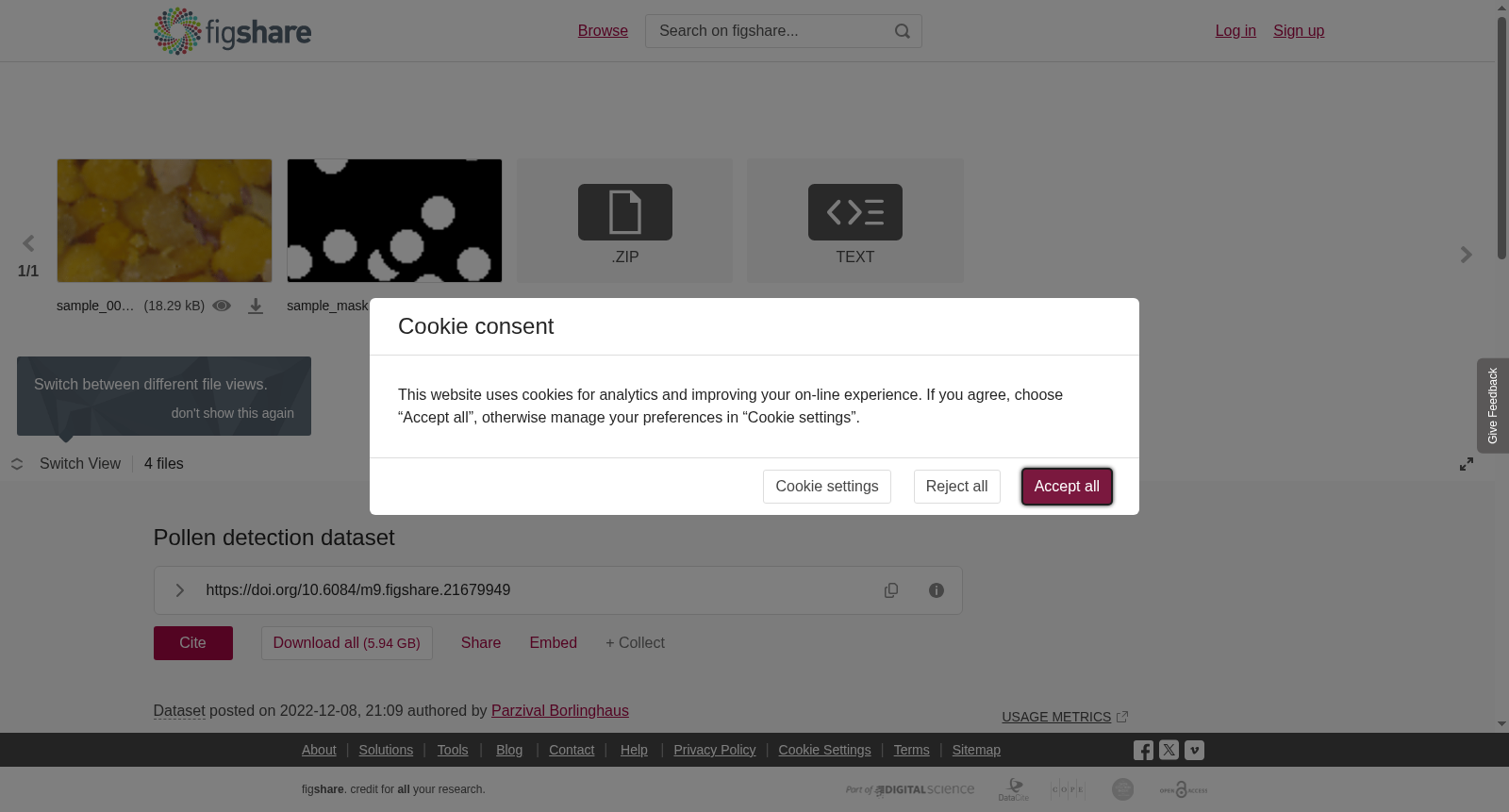
Overview This dataset is about corbicular pollen loads as foraged by honey bees (apis mellifera). Pollen were obtained by using pollen traps and show a wide range of colors. A total of 12568 (training) and 1629 (validation) pollen were annotated on 64 (training) and 5 images (validation), respectively. The images were partly from photographs and partly from scanned pollen. From these images, 96x96 pixel images were randomly cropped and augmented. Suitable masks were also created and saved together with the corresponding images and csv files. These cropped images form the given data set. File structure train/ train/imgs/ 495k images contain a total of 1410991 pollen. Images have shape (96px * 96px * 3 channels). Details on augmentation can be found in README.md. ~20% of the images show no pollen. Mathematically, each labeled pollen appears on 112 images in the data set. train/imgs/masks For each image exists a binary mask suitable for U-net training. The mask is not a real segmentation, but a white circle marking the center of the pollen. Each white circle has a black border that guarantees that no white circles overlap. This helps the U-net to learn the separation of the pollen segmentations, which simplifies the detection of blobs or local maxima on the output map of the U-net. train/imgs/coords For each image exists a .csv file with the annotated pollen centers. val/ val/imgs/ 50k images contain a total of 284125 pollen. Images have shape (96px * 96px * 3 channels). Details on augmentation can be found in README.md.. ~20% of the images show no pollen. Mathematically, each labeled pollen appears on 108 images in the data set. val/imgs/masks For each image exists a binary mask suitable for U-net training. The mask is not a real segmentation, but a white circle marking the center of the pollen. Each white circle has a black border that guarantees that no white circles overlap. This helps the U-net to learn the separation of the pollen segmentations, which simplifies the detection of blobs or local maxima on the output map of the U-net. val/imgs/coords For each image exists a .csv file with the annotated pollen centers.
数据集概述 本数据集聚焦于西方蜜蜂(Apis mellifera)花粉篮承载的花粉团(corbicular pollen loads)。花粉样本通过花粉陷阱采集获得,颜色分布范围广泛。分别在64张训练集图像与5张验证集图像上,完成了12568个训练样本花粉与1629个验证样本花粉的标注工作。图像来源分为实拍照片与扫描花粉样本两类。从上述原始图像中随机裁剪出分辨率为96×96像素的图像并进行数据增强。同时生成配套的掩码文件,与对应图像及CSV文件一同存储。上述裁剪后的图像即构成本数据集的主体内容。 文件结构 训练集目录(train/): 1. train/imgs/:包含495000张图像,总计涵盖1410991个花粉样本。图像分辨率为96像素×96像素×3通道。数据增强的详细说明可参考README.md文件。约20%的图像未包含任何花粉样本。从数学分布角度而言,数据集中每个标注花粉样本会在112张图像中出现。 2. train/imgs/masks:为每张图像生成适配U-net训练的二进制掩码。该掩码并非真实的实例分割掩码,而是以白色圆圈标记花粉的中心位置,且每个白色圆圈均带有黑色边框,以确保圆圈之间无重叠。该设计可帮助U-net学习花粉实例的分割分离,简化U-net输出特征图上的团块或局部极大值检测流程。 3. train/imgs/coords:为每张图像配套提供一个CSV文件,存储标注的花粉中心坐标。 验证集目录(val/): 1. val/imgs/:包含50000张图像,总计涵盖284125个花粉样本。图像分辨率为96像素×96像素×3通道。数据增强的详细说明可参考README.md文件。约20%的图像未包含任何花粉样本。从数学分布角度而言,数据集中每个标注花粉样本会在108张图像中出现。 2. val/imgs/masks:为每张图像生成适配U-net训练的二进制掩码。该掩码并非真实的实例分割掩码,而是以白色圆圈标记花粉的中心位置,且每个白色圆圈均带有黑色边框,以确保圆圈之间无重叠。该设计可帮助U-net学习花粉实例的分割分离,简化U-net输出特征图上的团块或局部极大值检测流程。 3. val/imgs/coords:为每张图像配套提供一个CSV文件,存储标注的花粉中心坐标。