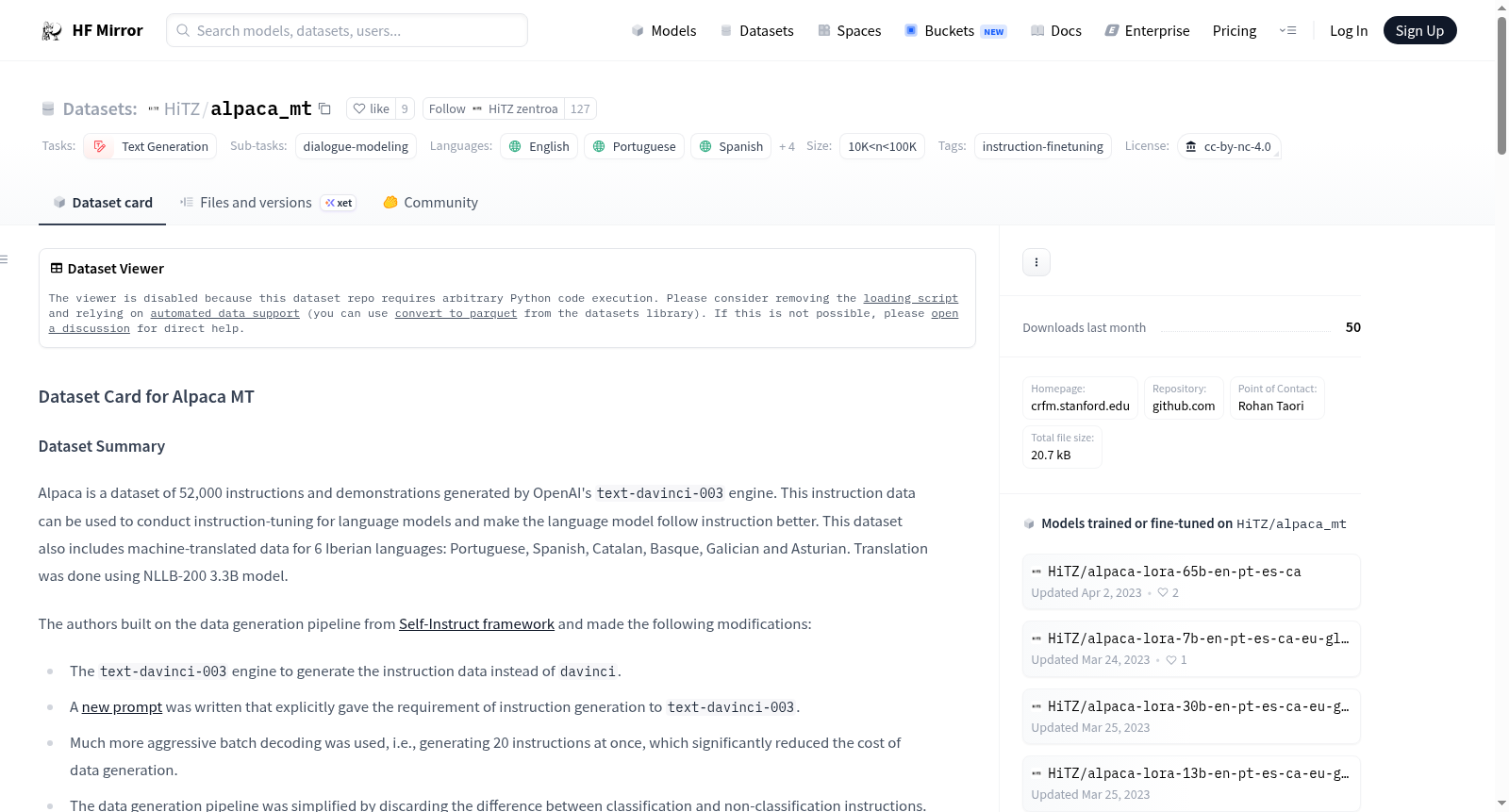
HiTZ/alpaca_mt
收藏资源简介:
--- annotations_creators: - no-annotation language: - en - pt - es - ca - eu - gl - at language_creators: - machine-generated license: cc-by-nc-4.0 multilinguality: - multilingual - translation pretty_name: Alpaca MT size_categories: - 10K<n<100K source_datasets: - tatsu-lab/alpaca tags: - instruction-finetuning task_categories: - text-generation task_ids: - dialogue-modeling dataset_info: - config_name: en features: - name: instruction dtype: string - name: input dtype: string - name: output dtype: string - name: prompt dtype: string splits: - name: train num_bytes: 32088854 num_examples: 51942 download_size: 22764890 dataset_size: 32088854 - config_name: pt features: - name: instruction dtype: string - name: input dtype: string - name: output dtype: string - name: prompt dtype: string splits: - name: train num_bytes: 33600380 num_examples: 51942 download_size: 23513483 dataset_size: 33600380 - config_name: es features: - name: instruction dtype: string - name: input dtype: string - name: output dtype: string - name: prompt dtype: string splits: - name: train num_bytes: 35893136 num_examples: 51942 download_size: 24483751 dataset_size: 35893136 - config_name: ca features: - name: instruction dtype: string - name: input dtype: string - name: output dtype: string - name: prompt dtype: string splits: - name: train num_bytes: 33938638 num_examples: 51942 download_size: 23096222 dataset_size: 33938638 - config_name: eu features: - name: instruction dtype: string - name: input dtype: string - name: output dtype: string - name: prompt dtype: string splits: - name: train num_bytes: 29977672 num_examples: 51942 download_size: 20469814 dataset_size: 29977672 - config_name: gl features: - name: instruction dtype: string - name: input dtype: string - name: output dtype: string - name: prompt dtype: string splits: - name: train num_bytes: 32736710 num_examples: 51942 download_size: 22356802 dataset_size: 32736710 - config_name: at features: - name: instruction dtype: string - name: input dtype: string - name: output dtype: string - name: prompt dtype: string splits: - name: train num_bytes: 31487842 num_examples: 51942 download_size: 20688305 dataset_size: 31487842 --- # Dataset Card for Alpaca MT ## Dataset Description - **Homepage:** https://crfm.stanford.edu/2023/03/13/alpaca.html - **Repository:** https://github.com/juletx/alpaca-lora-mt - **Paper:** - **Leaderboard:** - **Point of Contact:** Rohan Taori ### Dataset Summary Alpaca is a dataset of 52,000 instructions and demonstrations generated by OpenAI's `text-davinci-003` engine. This instruction data can be used to conduct instruction-tuning for language models and make the language model follow instruction better. This dataset also includes machine-translated data for 6 Iberian languages: Portuguese, Spanish, Catalan, Basque, Galician and Asturian. Translation was done using NLLB-200 3.3B model. The authors built on the data generation pipeline from [Self-Instruct framework](https://github.com/yizhongw/self-instruct) and made the following modifications: - The `text-davinci-003` engine to generate the instruction data instead of `davinci`. - A [new prompt](https://github.com/tatsu-lab/stanford_alpaca/blob/main/prompt.txt) was written that explicitly gave the requirement of instruction generation to `text-davinci-003`. - Much more aggressive batch decoding was used, i.e., generating 20 instructions at once, which significantly reduced the cost of data generation. - The data generation pipeline was simplified by discarding the difference between classification and non-classification instructions. - Only a single instance was generated for each instruction, instead of 2 to 3 instances as in Self-Instruct. This produced an instruction-following dataset with 52K examples obtained at a much lower cost (less than $500). In a preliminary study, the authors also found that the 52K generated data to be much more diverse than the data released by [Self-Instruct](https://github.com/yizhongw/self-instruct/blob/main/data/seed_tasks.jsonl). ### Supported Tasks and Leaderboards The Alpaca dataset designed for instruction training pretrained language models. ### Languages The original data in Alpaca is in English (BCP-47 en). We also provide machine-translated data for 6 Iberian languages: Portuguese (BCP-47 pt), Spanish (BCP-47 es), Catalan (BCP-47 ca), Basque (BCP-47 eu), Galician (BCP-47 gl) and Asturian (BCP-47 at). ## Dataset Structure ### Data Instances An example of "train" looks as follows: ```json { "instruction": "Create a classification task by clustering the given list of items.", "input": "Apples, oranges, bananas, strawberries, pineapples", "output": "Class 1: Apples, Oranges\nClass 2: Bananas, Strawberries\nClass 3: Pineapples", "text": "Below is an instruction that describes a task, paired with an input that provides further context. Write a response that appropriately completes the request.\n\n### Instruction:\nCreate a classification task by clustering the given list of items.\n\n### Input:\nApples, oranges, bananas, strawberries, pineapples\n\n### Response:\nClass 1: Apples, Oranges\nClass 2: Bananas, Strawberries\nClass 3: Pineapples", } ``` ### Data Fields The data fields are as follows: * `instruction`: describes the task the model should perform. Each of the 52K instructions is unique. * `input`: optional context or input for the task. For example, when the instruction is "Summarize the following article", the input is the article. Around 40% of the examples have an input. * `output`: the answer to the instruction as generated by `text-davinci-003`. * `text`: the `instruction`, `input` and `output` formatted with the [prompt template](https://github.com/tatsu-lab/stanford_alpaca#data-release) used by the authors for fine-tuning their models. ### Data Splits | | train | |---------------|------:| | en | 52002 | | pt | 52002 | | es | 52002 | | ca | 52002 | | eu | 52002 | | gl | 52002 | | at | 52002 | ## Dataset Creation ### Curation Rationale [More Information Needed] ### Source Data #### Initial Data Collection and Normalization [More Information Needed] #### Who are the source language producers? [More Information Needed] ### Annotations #### Annotation process [More Information Needed] #### Who are the annotators? [More Information Needed] ### Personal and Sensitive Information [More Information Needed] ## Considerations for Using the Data ### Social Impact of Dataset Excerpt the [blog post](https://crfm.stanford.edu/2023/03/13/alpaca.html) accompanying the release of this dataset: > We believe that releasing the above assets will enable the academic community to perform controlled scientific studies on instruction-following language models, resulting in better science and ultimately new techniques to address the existing deficiencies with these models. At the same time, any release carries some risk. First, we recognize that releasing our training recipe reveals the feasibility of certain capabilities. On one hand, this enables more people (including bad actors) to create models that could cause harm (either intentionally or not). On the other hand, this awareness might incentivize swift defensive action, especially from the academic community, now empowered by the means to perform deeper safety research on such models. Overall, we believe that the benefits for the research community outweigh the risks of this particular release. Given that we are releasing the training recipe, we believe that releasing the data, model weights, and training code incur minimal further risk, given the simplicity of the recipe. At the same time, releasing these assets has enormous benefits for reproducible science, so that the academic community can use standard datasets, models, and code to perform controlled comparisons and to explore extensions. Deploying an interactive demo for Alpaca also poses potential risks, such as more widely disseminating harmful content and lowering the barrier for spam, fraud, or disinformation. We have put into place two risk mitigation strategies. First, we have implemented a content filter using OpenAI’s content moderation API, which filters out harmful content as defined by OpenAI’s usage policies. Second, we watermark all the model outputs using the method described in Kirchenbauer et al. 2023, so that others can detect (with some probability) whether an output comes from Alpaca 7B. Finally, we have strict terms and conditions for using the demo; it is restricted to non-commercial uses and to uses that follow LLaMA’s license agreement. We understand that these mitigation measures can be circumvented once we release the model weights or if users train their own instruction-following models. However, by installing these mitigations, we hope to advance the best practices and ultimately develop community norms for the responsible deployment of foundation models. ### Discussion of Biases [More Information Needed] ### Other Known Limitations The `alpaca` data is generated by a language model (`text-davinci-003`) and inevitably contains some errors or biases. We encourage users to use this data with caution and propose new methods to filter or improve the imperfections. ## Additional Information ### Dataset Curators [More Information Needed] ### Licensing Information The dataset is available under the [Creative Commons NonCommercial (CC BY-NC 4.0)](https://creativecommons.org/licenses/by-nc/4.0/legalcode). ### Citation Information ``` @misc{alpaca, author = {Rohan Taori and Ishaan Gulrajani and Tianyi Zhang and Yann Dubois and Xuechen Li and Carlos Guestrin and Percy Liang and Tatsunori B. Hashimoto }, title = {Stanford Alpaca: An Instruction-following LLaMA model}, year = {2023}, publisher = {GitHub}, journal = {GitHub repository}, howpublished = {\url{https://github.com/tatsu-lab/stanford_alpaca}}, } ``` ### Contributions [More Information Needed]
数据集概述
名称: Alpaca MT
语言: 英语 (en), 葡萄牙语 (pt), 西班牙语 (es), 加泰罗尼亚语 (ca), 巴斯克语 (eu), 加利西亚语 (gl), 阿斯图里亚语 (at)
语言创建方式: 机器生成
许可证: Creative Commons NonCommercial (CC BY-NC 4.0)
多语言性: 多语言, 翻译
大小: 10K<n<100K
源数据集: tatsu-lab/alpaca
标签: 指令微调
任务类别: 文本生成
任务ID: 对话建模
数据集结构
数据实例
- 字段:
instruction: 描述模型应执行的任务。input: 任务的上下文或输入。output:text-davinci-003生成的任务答案。text: 使用作者用于微调模型的提示模板格式化的instruction,input和output。
数据分割
| 语言 | 训练 |
|---|---|
| en | 52002 |
| pt | 52002 |
| es | 52002 |
| ca | 52002 |
| eu | 52002 |
| gl | 52002 |
| at | 52002 |
数据集创建
- 数据生成: 使用
text-davinci-003引擎生成指令数据。 - 翻译: 使用NLLB-200 3.3B模型进行6种伊比利亚语言的机器翻译。
使用考虑
- 社会影响: 数据集的发布旨在促进学术界对指令遵循语言模型的科学研究,同时认识到存在风险,已实施内容过滤和输出水印等风险缓解策略。
- 偏见与限制: 数据由语言模型生成,可能包含错误或偏见,建议用户谨慎使用并提出改进方法。