protein-secondary-structure-nppe2
收藏资源简介:
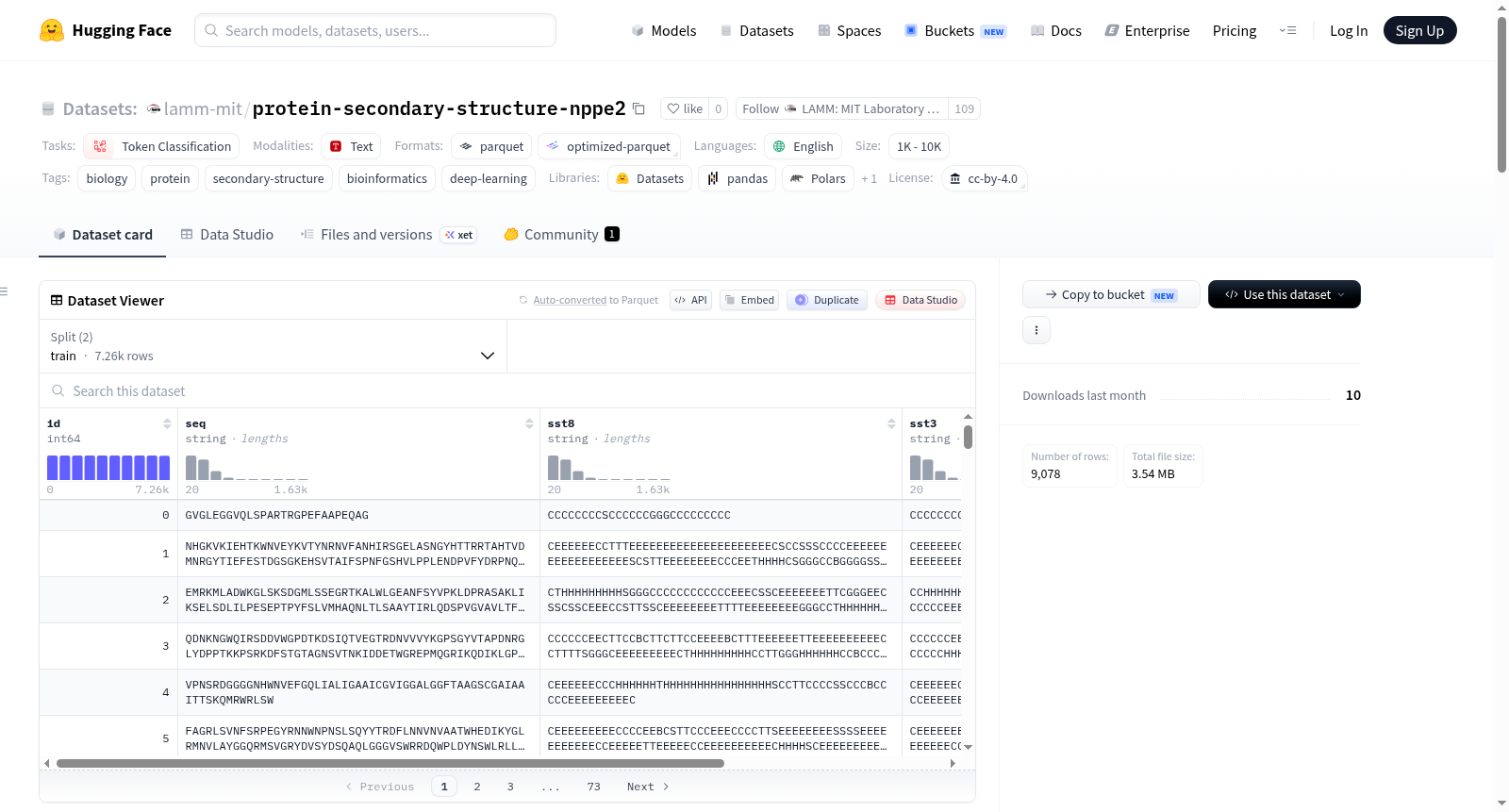
该数据集名为蛋白质二级结构预测数据集(NPPE-2),用于印度理工学院马德拉斯分校深度学习与生成AI课程中的蛋白质二级结构预测竞赛。其主要任务是在残基水平预测蛋白质的二级结构,采用两种分类体系:八态分类(Q8/sst8,基于DSSP符号,包括H(α螺旋)、C(卷曲/环)、E(β链)、T(转角)、S(弯曲)、G(3-10螺旋)、B(β桥)和I(π螺旋))和三态分类(Q3/sst3,将八态归类为C(卷曲,包含C、T、S)、H(螺旋,包含H、G、I)和E(链,包含E、B))。评估指标为Q8和Q3宏F1分数的调和平均数。数据集包含训练集(7,262个蛋白质序列,共1,763,921个残基)和测试集(1,816个序列,标签未提供)。序列长度范围为20至1,632个残基,平均长度为242.9个残基。标签分布显示,在Q8分类中,H(α螺旋)占比最高(31.6%),其次是C(24.2%)和E(21.0%);在Q3分类中,C(卷曲)占比最高(42.6%),其次是H(螺旋,35.4%)和E(链,22.1%)。数据以CSV文件形式组织,训练集文件包含id(唯一序列标识符)、seq(由20种标准氨基酸组成的序列)、sst8(Q8标签)和sst3(Q3标签)四列;测试集文件包含id和seq两列。该数据集适用于标记分类任务,特别是在生物信息学和深度学习领域用于蛋白质结构预测研究。
This dataset is named the Protein Secondary Structure Prediction Dataset (NPPE-2), used for a protein secondary structure prediction competition in the Deep Learning and Generative AI course at the Indian Institute of Technology Madras. Its main task is to predict protein secondary structure at the residue level, employing two classification systems: an eight-state classification (Q8/sst8, based on DSSP symbols, including H (α-helix), C (coil/loop), E (β-strand), T (turn), S (bend), G (3-10 helix), B (β-bridge), and I (π-helix)) and a three-state classification (Q3/sst3, which groups the eight states into C (coil, including C, T, S), H (helix, including H, G, I), and E (strand, including E, B)). The evaluation metric is the harmonic mean of the macro F1 scores for Q8 and Q3. The dataset includes a training set (7,262 protein sequences, totaling 1,763,921 residues) and a test set (1,816 sequences, labels not provided). The sequence length ranges from 20 to 1,632 residues, with an average length of 242.9 residues. Label distribution shows that in the Q8 classification, H (α-helix) has the highest proportion (31.6%), followed by C (24.2%) and E (21.0%); in the Q3 classification, C (coil) has the highest proportion (42.6%), followed by H (helix, 35.4%) and E (strand, 22.1%). The data is organized in CSV files: the training set file contains four columns—id (unique sequence identifier), seq (sequence composed of 20 standard amino acids), sst8 (Q8 label), and sst3 (Q3 label); the test set file contains two columns—id and seq. This dataset is suitable for token classification tasks, particularly for protein structure prediction research in bioinformatics and deep learning.