
Sternberg Working Memory
收藏OpenNeuro2022-05-01 更新2026-03-14 收录
下载链接:
https://openneuro.org/datasets/ds004117
下载链接
链接失效反馈官方服务:
资源简介:
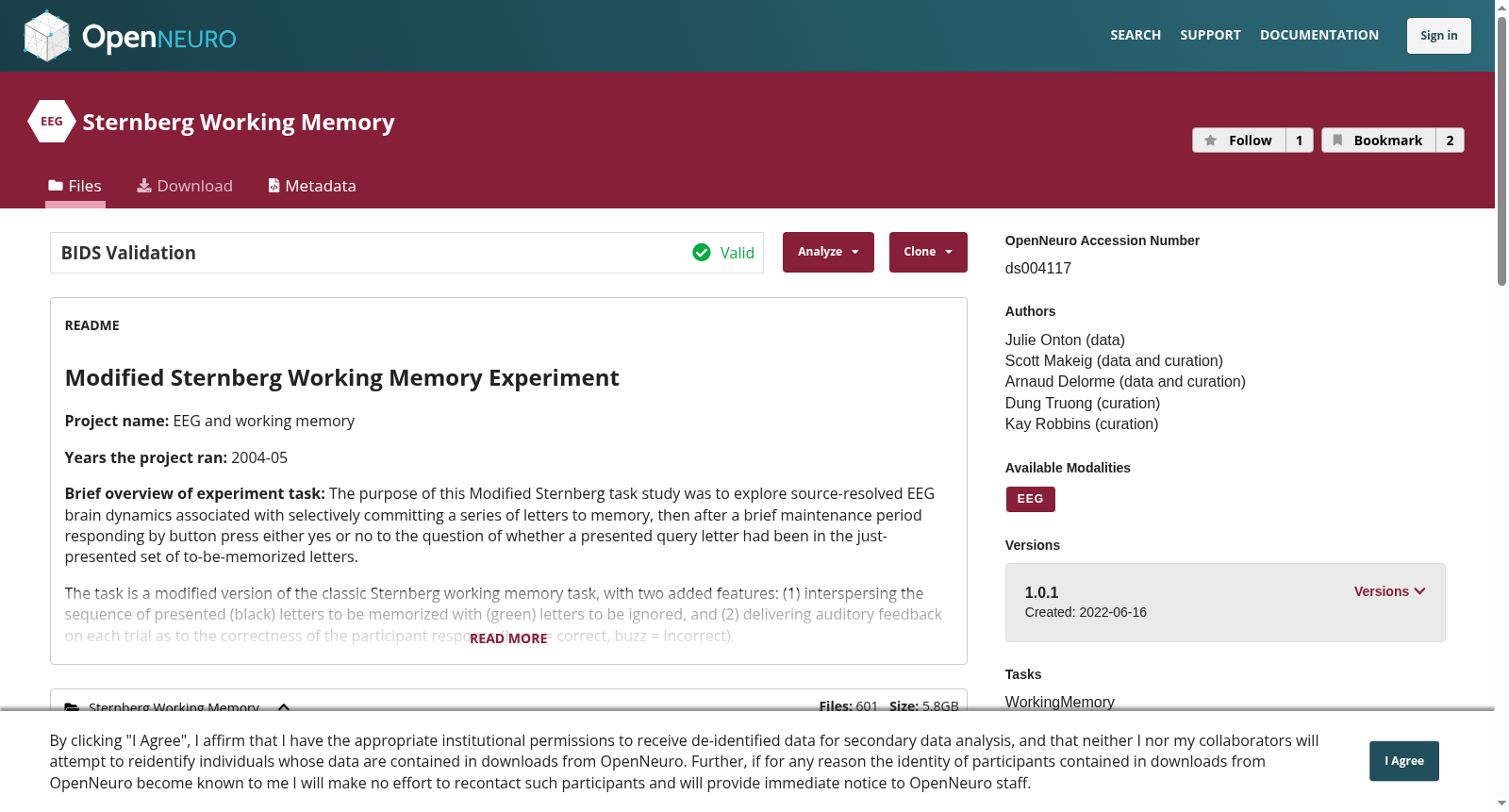
## Modified Sternberg Working Memory Experiment
**Project name:** EEG and working memory
**Years the project ran:** 2004-05
**Brief overview of experiment task:** The purpose of this Modified Sternberg task study was to
explore source-resolved EEG brain dynamics associated with selectively committing a series of letters to memory,
then after a brief maintenance period responding by button press either yes or no to the question of whether
a presented query letter had been in the just-presented set of to-be-memorized letters.
The task is a modified version of the classic Sternberg working memory task, with two added features:
(1) interspersing the sequence of presented (black) letters to be memorized with (green) letters to be ignored,
and (2) delivering auditory feedback on each trial as to the correctness of the participant response
(beep = correct, buzz = incorrect).
**Data collection:** Scalp EEG data were collected from 71 scalp electrode channels,
each referred to a right mastoid electrode, at a sampling rate of 250 Hz/channel within an
analog passband of 0.1 to 100 Hz.
**Contact person: Julie Onton <julieonton@gmail.com>, ORCID#:0000-0002-5602-3557.
**Access information:** Contributed to OpenNeuro.org and NEMAR.org in BIDS format
following annotation using HED 8.0.0 in April, 2022.
**Independent variables:** Letter category (to_memorize, to_ignore);
numbers of presented letters to_memorize/to_ignore (3/5, 5/3, 7/1);
probe letter category (in/not in the presented set). Note, only letters to be memorized appear as in set probe letters.
**Dependent variables:** EEG; button press response latency; participant response (correct/incorrect).
**Participant pool:** The dataset includes data collected from 23 healthy young adult subjects
(7 male, 6 female, 11 unidentified) between the ages of 19 and 40 years of age.
**Apparatus:** A Neurobehavioral Systems, Inc. EEG system running under Window98 acquired the data.
The experiment control program was Presentation (Neurobehavioral Systems, Inc.).
**Initial setup:** EEG data were collected from 71 channels (69 scalp and two periocular electrodes,
all referred to right mastoid) with an analog pass band of 0.01 to 100 Hz (SA Instrumentation, San Diego).
Input impedances were brought under 5 kOhms by careful scalp preparation.
Data for subjects 1-12 was acquired at a sampling rate of 250Hz. The data for subject 14 was acquired at
1000 Hz and the data for subjects 15-24 was a acquired using a 500 Hz sampling rate.
**Task organization:** Data was organized into runs of 25 trials each followed by a rest.
Each block was a separate run in the BIDS dataset.
**Task details:** Each trial consisted of the following sequence of events:
**[Trial initiation]**. After a self-selected, variable delay,
the subject initiated the next trial by pressing either response button,
triggering the reappearance of the fixation cross.
**[Letter sequence presentation]**. In these experiments, following a 5s presentation of a central
fixation cross cue, a series of 8 visual letters (~2 deg of visual angle) were presented at
screen center for 1.2s followed by a 0.2s ISI:
- Either 3, 5, or 7 of these were colored black.
- The participant was to memorize as letters in this set.
- The other 5, 3, or 1 letters in the sequence were colored green and participants were to ignore these.
- The letters were drawn without substitution from the English alphabet (omitting only A, E, I, O, and U).
- The presentation order of black and green letters was pseudo-random.
**[Memory maintenance]**. In place of a ninth letter, a dash appeared on the screen to signal the
beginning of a Memory Maintenance period lasting between 2 to 4 s.
During this period subjects were to silently rehearse the identities of the memorized letters.
**[Memory probe]**. A (red) probe letter then appeared, prompting the subject to respond by
pressing one of two buttons (with the thumb or index finger of their dominant hand)
to indicate whether or not the probe letter had been in the trial?s to-be-memorized letter set.
**[Response feedback]**. An auditory feedback signal (a confirmatory beep or cautionary buzz),
then presented beginning at 400 ms after the button press, informed the subject whether their
response was correct or incorrect. Note: responses in the task were largely correct.
**[Session time structure]**. Each task session comprised of 3 or 4 task blocks of 25 trials each
separated into individual run files.
**Experiment location**: Swartz Center for Neural Computation (SCCN), University of California San Diego, La Jolla CA (USA).
**Note 1**: Results presented in Onton, J., Delorme, A. and Makeig, S., 2005.
Frontal midline EEG dynamics during working memory. Neuroimage, 27(2), pp.341-356.
**Note 2**: This paradigm is one of 20 event-related EEG task paradigms selected for replication by the EEGManyLabs project.
For details, see https://psyarxiv.com/528nr/. Contact: Yuri Pavlov <pavlovug@gmail.com>.
**Note 3**: Participant 5 did not have feedback events in the trials.
**Note 4**: The code subdirectory has several auxilliary files that were produced during
the curation process. The curation was done using a series of Jupyter notebooks
that are available as run in the code/curation_notebooks subdirectory.
During the running of these curation notebooks information about the status was logged
using the HEDLogger. The output of the logging process is in code/curation_logs.
Updated versions of the curation notebooks can be found at:
https://github.com/hed-standard/hed-examples/tree/main/hedcode/jupyter_notebooks/dataset_specific_processing/sternberg
# 改良版斯特恩伯格工作记忆实验(Modified Sternberg Working Memory Experiment)
## 项目名称:脑电图(electroencephalogram, EEG)与工作记忆
## 项目执行年限:2004年至2005年
## 实验任务概述:
本研究针对改良版斯特恩伯格任务,旨在探究与选择性识记一系列字母相关的源解析脑电图脑活动动态;实验流程为先经短暂记忆维持阶段,随后向被试呈现查询字母,要求其通过按键(是/否)判断该查询字母是否属于本次实验刚呈现的待记忆字母集合。
本任务为经典斯特恩伯格工作记忆任务的改良版本,新增两项特征:
1. 在待识记的黑色字母序列中插入需忽略的绿色字母;
2. 为每一试次提供听觉反馈,正确反应对应蜂鸣音,错误反应对应嗡嗡声。
## 数据收集:
本研究采集了71个头皮电极通道的脑电图数据,所有通道均以右侧乳突电极作为参考电极,采样率为250Hz/通道,模拟通带范围为0.1至100Hz。
## 联系人:Julie Onton <julieonton@gmail.com>,ORCID编号:0000-0002-5602-3557。
## 数据访问信息:
本数据集于2022年4月使用层次事件描述符(Hierarchical Event Descriptor, HED)8.0.0进行标注后,以脑成像数据结构(Brain Imaging Data Structure, BIDS)格式上传至OpenNeuro.org与NEMAR.org平台。
## 自变量:
1. 字母类别(待识记、待忽略);
2. 待识记/待忽略字母的数量(3/5、5/3、7/1);
3. 探测字母类别(属于/不属于本次呈现的记忆集合)。
注:仅待识记字母会作为“属于集合”的探测字母。
## 因变量:
脑电图(EEG)、按键反应潜伏期、被试反应结果(正确/错误)。
## 被试群体:
本数据集包含23名健康年轻成人被试的数据,年龄介于19至40岁之间,其中男性7名、女性6名,剩余11名被试未标注性别。
## 实验设备:
采用Neurobehavioral Systems, Inc.公司的EEG系统,运行于Windows 98操作系统,实验控制程序为Presentation(Neurobehavioral Systems, Inc.)。
## 初始设置:
本实验采用69个头皮电极与2个眼周电极,共71通道,所有电极均以右侧乳突为参考电极,模拟通带范围为0.01至100Hz(采用SA Instrumentation公司(美国圣地亚哥)的设备)。经严格的头皮准备后,将输入阻抗控制在5kΩ以下。
不同被试的采样率存在差异:被试1至12的采样率为250Hz,被试14的采样率为1000Hz,被试15至24的采样率为500Hz。
## 任务组织:
数据以每25个试次为一个运行单元(run),每个运行单元结束后安排休息;在BIDS数据集中,每个任务区块对应一个独立的运行文件。
## 任务详细流程:
每个试次包含以下事件序列:
1. **试次启动**:被试经自主选择的可变延迟后,按下任一反应按键启动下一试次,触发屏幕中央的注视十字重现。
2. **字母序列呈现**:先在屏幕中央呈现5秒的注视十字提示,随后在屏幕中央呈现共8个视觉字母(视角约2°),每个字母呈现1.2秒,字母间刺激间隔为0.2秒:
- 其中3、5或7个字母为黑色,要求被试进行识记;
- 剩余5、3或1个字母为绿色,要求被试忽略;
- 字母从英文字母表中无替换选取,仅排除A、E、I、O、U五个元音字母;
- 黑色与绿色字母的呈现顺序为伪随机。
3. **记忆维持阶段**:序列第9个位置呈现短横线,标志记忆维持阶段开始,该阶段持续2至4秒,期间被试需默默复述识记字母的身份。
4. **记忆探测阶段**:呈现红色探测字母,提示被试通过按下两个按键中的一个(利手的拇指或食指),判断探测字母是否属于本次试次的待记忆字母集合。
5. **反应反馈阶段**:按键后400毫秒开始呈现听觉反馈信号(确认性蜂鸣音或警示性嗡嗡声),告知被试其反应正确与否。注:本任务中被试的反应正确率普遍较高。
6. **实验时段结构**:每个任务会话包含3或4个任务区块,每个区块含25个试次,拆分为独立的运行文件。
## 实验地点:
美国加利福尼亚州拉霍亚市加利福尼亚大学圣地亚哥分校斯沃茨神经计算中心(Swartz Center for Neural Computation, SCCN)。
## 注释:
1. 相关研究结果发表于Onton, J., Delorme, A. 与 Makeig, S. 2005年发表于《神经图像》(Neuroimage)的论文《工作记忆期间的额中线脑电图动态》,该期刊第27卷第2期,第341至356页。
2. 该范式是EEGManyLabs项目选定的20个事件相关脑电图任务范式之一,用于重复验证。详细信息请参见https://psyarxiv.com/528nr/,联系人:Yuri Pavlov <pavlovug@gmail.com>。
3. 被试5的所有试次中均未包含反馈事件。
4. 代码子目录包含若干在数据整理过程中生成的辅助文件。本次数据整理采用一系列Jupyter笔记本完成,相关文件存放于`code/curation_notebooks`子目录中。运行这些整理笔记本时,状态信息通过HEDLogger记录,日志文件输出至`code/curation_logs`目录。整理笔记本的更新版本可于以下网址获取:https://github.com/hed-standard/hed-examples/tree/main/hedcode/jupyter_notebooks/dataset_specific_processing/sternberg
创建时间:
2022-05-01
搜集汇总
数据集介绍
背景与挑战
背景概述
该数据集包含23名健康成年人的EEG数据,采用改进的Sternberg工作记忆任务,研究记忆和忽略不同字母时的脑电活动。数据集提供了详细的实验设计和行为数据,适用于工作记忆和认知神经科学研究。
以上内容由遇见数据集搜集并总结生成



