BanglaCEH
收藏资源简介:
BanglaCEH 是一个用于孟加拉语文化纠缠同形词消歧(Culturally Entangled Homograph, CEH)的基准数据集。该数据集来源于论文《When a Name Is Not a Name: A Benchmark Dataset and Distilled Reasoning for Culturally Entangled Bangla Homographs in Low-Resource LLMs》。数据集关注孟加拉语中一个词既是人名又是具有文化内涵的普通名词的现象(例如“মায়া”既是女孩名也表示深情的慈悲)。数据集包含1,516个孟加拉语句子,每个句子中同一个词出现两次,分别具有不同的语义角色(如人名 vs. 概念)。每个出现位置被标注为六种文化类别之一:Name(人名)、Concept(概念)、Emotion(情感)、Emotional State(情感状态)、Collective State(集体状态)、Spiritual(精神)。总标注数为3,032个。数据集中还包含每处出现的文化解释和文化纠缠说明。数据构建过程包括:由母语者人工选词、三个大语言模型生成句子和解释、交叉模型验证、最后由两位母语专家人工审核(Cohens κ = 0.95)。数据集可用于评估孟加拉语和多语言大语言模型的文化理解能力、训练命名实体识别和共指消解、以及低资源语言的知识蒸馏研究。基准测试结果显示,模型在零样本下存在系统性的主导意义偏差(偏向普通名词),而通过文化链式推理(C-CoT)或知识蒸馏微调(QLoRA-KD)可显著降低偏差。该数据集采用CC-BY-4.0许可,大小在1K到10K样本之间。
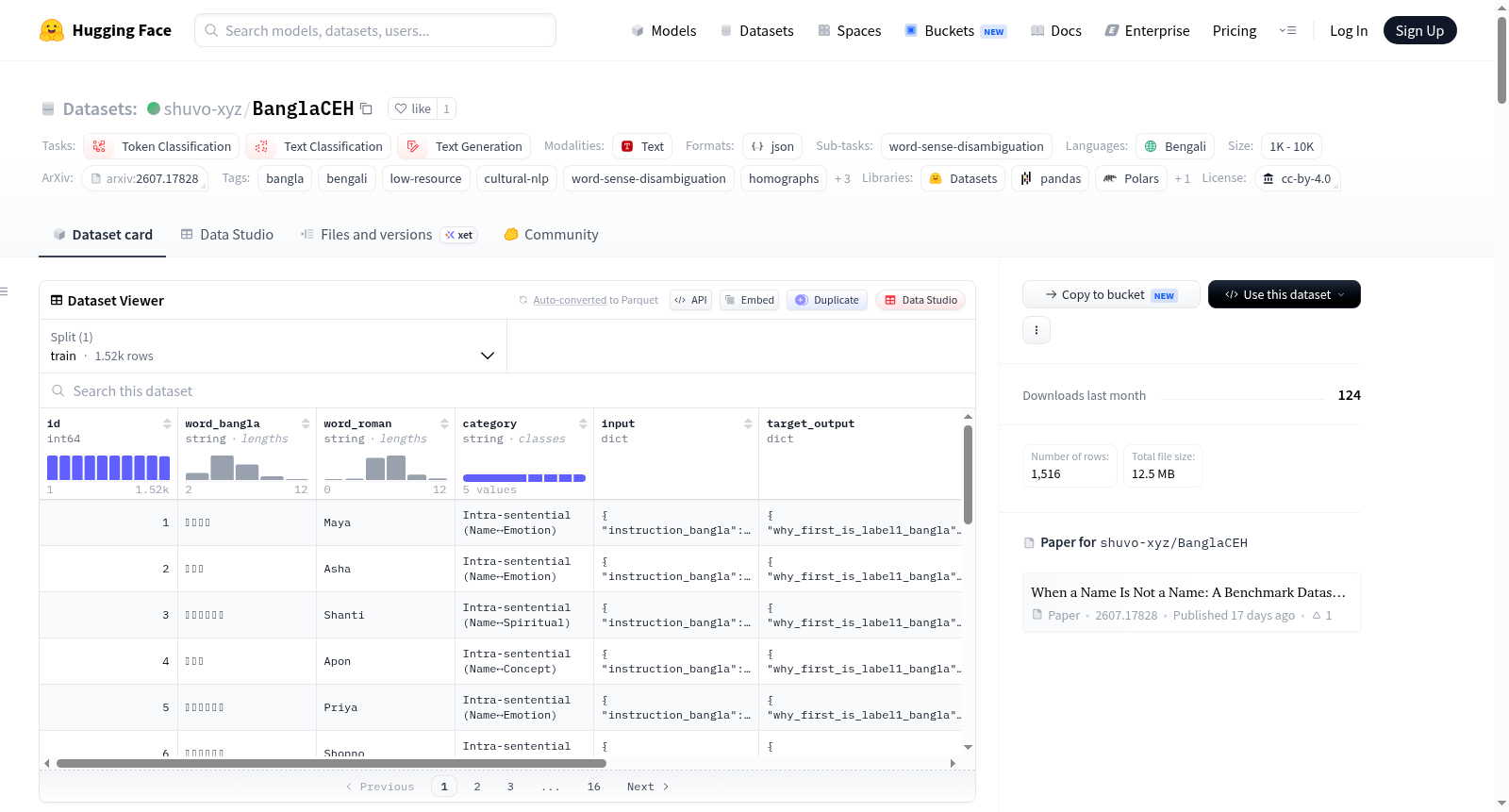
BanglaCEH is a benchmark dataset for culturally entangled homograph disambiguation (CEH) in Bengali. It originates from the paper When a Name Is Not a Name: A Benchmark Dataset and Distilled Reasoning for Culturally Entangled Bangla Homographs in Low-Resource LLMs. The dataset focuses on words in Bengali that are both personal names and culturally meaningful common nouns (e.g., মায়া is both a girls name and means compassionate affection). It contains 1,516 Bengali sentences, each featuring the same word appearing twice with different semantic roles (e.g., name vs. concept). Each occurrence is annotated into one of six cultural categories: Name, Concept, Emotion, Emotional State, Collective State, and Spiritual. The total number of annotations is 3,032. The dataset also includes cultural explanations and cultural entanglement descriptions for each occurrence. The data construction process includes: manual word selection by native speakers, sentence and explanation generation by three large language models, cross-model validation, and final manual review by two native experts (Cohens κ = 0.95). The dataset can be used to evaluate the cultural understanding ability of Bengali and multilingual large language models, train named entity recognition and coreference resolution, and study knowledge distillation in low-resource languages. Baseline results show that models exhibit systematic dominant sense bias (favoring common nouns) in zero-shot settings, while cultural chain-of-thought (C-CoT) or knowledge distillation fine-tuning (QLoRA-KD) can significantly reduce the bias. The dataset is licensed under CC-BY-4.0 and has a size between 1K and 10K samples.
BanglaCEH:文化纠缠孟加拉语同形异义词基准数据集
数据集概述
BanglaCEH(Culturally Entangled Bangla Homographs)是一个专门用于孟加拉语中“文化纠缠同形异义词”(CEH)消歧的基准数据集。该数据集解决的核心问题是:许多孟加拉语词汇同时是人名和具有文化内涵的普通名词(如 মায়া 既是常见女孩名,又表示“深情 Compassion”;গগন 既是人名,又指“天空”),仅凭频率或分布线索无法正确区分其含义。
基本信息
| 属性 | 详情 |
|---|---|
| 语言 | 孟加拉语(bn,孟加拉文) |
| 许可证 | CC-BY-4.0 |
| 数据规模 | 1,516 个句子实例(1K < n < 10K) |
| 标注数量 | 3,032 个词例(每句 2 个) |
| 任务类型 | 词义消歧(token-classification、text-classification、text-generation) |
| 发布形式 | 单文件 ceh_knowledge_distillation_final.json,含 train 分割 |
数据集结构
每个记录为一个 JSON 对象,包含:
- id:实例编号
- word_bangla / word_roman:目标词的孟加拉文和罗马化形式
- category:纠缠类别(如“句内 Name↔Concept”)
- input:孟加拉语叙事文本及两个标签(label_1、label_2)
- token_labels:两个词例的标签
- cultural_entanglement_note:文化纠缠注释
- 完整 schema 还包括双语论证、文化纠缠段落和逐词例解释
标签体系
数据集包含 6 种文化标签: Name(人名)、Concept(概念)、Emotion(情感)、Emotional State(情绪状态)、Collective State(集体状态)、Spiritual(精神)
纠缠类别分布
| 类别 | 数量 |
|---|---|
| 人名 ↔ 概念 | 795 |
| 概念 ↔ 情感 | 193 |
| 人名 ↔ 精神 | 179 |
| 人名 ↔ 情感 | 178 |
| 情感 ↔ 状态 | 171 |
| 总计 | 1,516 |
词例级标签分布
| 标签 | 数量 |
|---|---|
| Name | 1,153 |
| Concept | 985 |
| Emotional State | 345 |
| Collective State | 202 |
| Spiritual | 187 |
| Emotion | 160 |
| 总计 | 3,032 |
数据集构建流程
- 词汇筛选:由一位母语人士手工挑选同时具有人名和文化名词双重含义的词汇
- 多模型生成:三种模型(Claude Fable 5、Kimi K3、Gemini 3.5 Flash)分别生成 690、480、344 个实例
- 交叉验证:不同模型间互相审核(Claude→Kimi、Kimi→Gemini、Gemini→Claude)
- 人工验证:两位母语孟加拉语专家校对,标注者间一致性 Cohens κ = 0.95
数据划分
完整数据集以单文件发布(1,516 条)。论文实验中采用 78% 训练 / 10% 验证 / 12% 测试 的固定随机种子划分。
基准实验结果
实验涵盖零样本、少样本、文化思维链(C-CoT)和 QLoRA 知识蒸馏微调四种模式,核心诊断指标为 Dominant-Bias(模型漏判人名标签、默认采用文化含义读法的频率):
| 模型 | 模式 | EM ↑ | Macro-F1 ↑ | Hall. ↓ | Bias ↓ |
|---|---|---|---|---|---|
| Qwen2.5-1.5B | 零样本 | 0.65 | 0.115 | 52.90 | 63.46 |
| Qwen2.5-1.5B | C-CoT | 30.97 | 0.300 | 0.00 | 2.88 |
| Qwen2.5-1.5B | QLoRA-KD | 85.16 | 0.737 | 1.65 | 0.00 |
| Llama-3.2-3B | 零样本 | 10.97 | 0.144 | 40.00 | 65.38 |
| Llama-3.2-3B | QLoRA-KD | 82.42 | 0.722 | 1.10 | 2.80 |
| gemma-3-1b-it | 零样本 | 0.91 | 0.079 | 16.13 | 100.0 |
| TituLLM-1B | 零样本 | 0.11 | 0.005 | 100.0 | 100.0 |
| TituLLM-1B | QLoRA-KD | 87.91 | 0.758 | 1.65 | 4.20 |
| GPT-4o-mini | 零样本 | 43.87 | 0.467 | 0.65 | 16.35 |
| GPT-4o-mini | 少样本 | 49.68 | 0.623 | 0.00 | 2.88 |
关键发现
- 系统性主导含义偏见:零样本下所有开源模型默认采用普通名词含义,漏判人名词例,偏见率 62.5%~100%
- 语言特定预训练不等于文化基础:孟加拉语专用模型 TituLLM 在零样本输入中 100% 产生幻觉
- 对比推理有效但非普适:C-CoT 将 Qwen 偏见从 63.46% 降至 2.88% 且零幻觉,但对 Llama 反有负面效果
- 蒸馏推理优于蒸馏标签:仅蒸馏标签的 EM 为 41.33%、偏见 34.56%;同时蒸馏标签与文化解释可达 EM 85.16%、零偏见
- 长尾瓶颈:Micro 与 Macro-F1 的差距几乎完全集中在稀有的 Emotion 和 Spiritual 标签上
预期用途
- 评估孟加拉语和多语言 LLM 的文化基础能力(与表面词汇能力区分)
- 孟加拉语 NLP 流水线中的人名 vs 概念消歧任务(NER、共指消解、机器翻译)
- 低资源语言推理蒸馏研究
- 为其他存在名字-概念纠缠的语言构建类似基准提供模板
局限性
- 单一策展人筛选词汇:覆盖范围受一人命名知识限制,可能遗漏地域性或小众名字
- 模型生成文本:句子和解释由 LLM 初始生成,虽经人工验证但仍可能保留机器文本的微妙文体规律
- 标注者池较小:虽然一致性高(κ=0.95),更多区域和语言背景的标注者会更稳健
- 计算资源受限的微调:实验基于 1–3B 参数模型的参数高效微调,结果可能不完全适用于更大模型或全参数微调
伦理考量
数据集中的孟加拉语常用人名仅作为合成句子中的通用词项使用,不涉及真实个体。文化注释反映主流孟加拉命名惯例,不应视为对所有孟加拉语社区的穷尽性或权威性描述。
相关资源
- 论文:https://arxiv.org/abs/2607.17828
- 代码:https://github.com/ashuvo25/BanglaCEH