lightblue/mitsu_tophalf_borda
收藏资源简介:
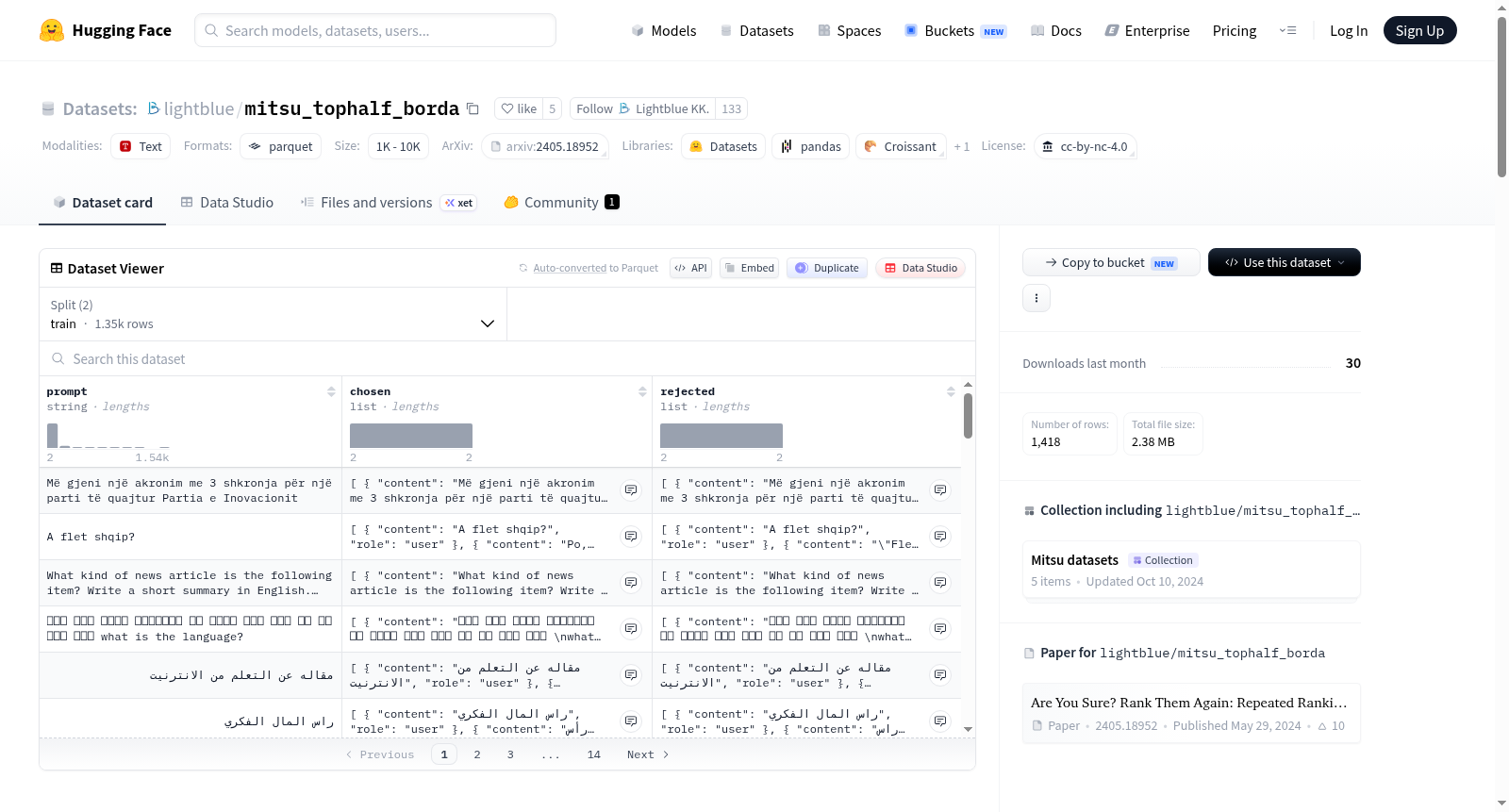
--- dataset_info: features: - name: prompt dtype: string - name: chosen list: - name: content dtype: string - name: role dtype: string - name: rejected list: - name: content dtype: string - name: role dtype: string splits: - name: test num_bytes: 216048.79407407407 num_examples: 68 - name: train num_bytes: 4289220 num_examples: 1350 download_size: 4766811 dataset_size: 4505268.794074073 configs: - config_name: default data_files: - split: train path: data/train-* - split: test path: data/test-* license: cc-by-nc-4.0 --- # Mitsu <p align="center"> <img width=400 src="https://cdn-uploads.huggingface.co/production/uploads/64b63f8ad57e02621dc93c8b/Ypd0x0ZyVCJs7rkd5xA_O.png" alt="Mitsu - a honey bee in its comb"/> </p> [[Paper]](https://arxiv.org/abs/2405.18952) [[Model]](https://huggingface.co/lightblue/suzume-llama-3-8B-multilingual-orpo-borda-half) This is a multilingual preference dataset generated using human written prompts and responses from 7 LLMs. We evaluate each set of responses 5 times using GPT4. Note that this model has a non-commerical license as we used the Command R and Command R+ models to create this data. We are currently working on a developing a commerically usable model, so stay tuned for that! # Dataset details This is the ORPO training dataset derived from the [lightblue/mitsu](https://huggingface.co/datasets/lightblue/mitsu). This dataset contains the prompts corresponding to the 50\% most consistely ranked responses by GPT, with the highest/lowest ranked responses used as the positive and negative responses for each prompt. # How we made this: We made this dataset using our Repeated Ranking method, which entails the following steps: 1. Sample responses from [lightblue/tagengo-gpt4](https://huggingface.co/datasets/lightblue/tagengo-gpt4), stratifying by language by sampling 100 per language 2. Generate responses for each prompt using each of the following models: * gpt-35-turbo-instruct (0914) * gpt-4 (0125-Preview) * Nexusflow/Starling-LM-7B-beta * Qwen/Qwen1.5-32B-Chat * Qwen/Qwen1.5-72B-Chat * CohereForAI/c4ai-command-r-v01 * CohereForAI/c4ai-command-r-plus 3. Evaluate the responses using gpt-4 (0125-Preview) 5 times, randomly shuffling the order that the responses are given in each time 4. Calculate the agreement between the rankings using Kendall's W The full code for creating this dataset can be [found on our repo](https://github.com/lightblue-tech/suzume/tree/main/mitsu/data_creation). # How to use it: We process this dataset into datasets usable for DPO/PPO/ORPO training using the [code available on our repo](https://github.com/lightblue-tech/suzume/blob/main/mitsu/data_creation/response_rank_process.ipynb). Processed versions of this dataset can be found at: * [All prompt dataset](https://huggingface.co/datasets/lightblue/mitsu_full_borda) * [Prompts with top 75% most repeated consistent evaluations](https://huggingface.co/datasets/lightblue/mitsu_top75_borda) * [Prompts with top 50% most repeated consistent evaluations (recommended for training)](https://huggingface.co/datasets/lightblue/mitsu_tophalf_borda) * [Prompts with top 25% most repeated consistent evaluations](https://huggingface.co/datasets/lightblue/mitsu_top25_borda) # Dataset results We conducted experiments by training our [lightblue/suzume-llama-3-8B-multilingual](https://huggingface.co/lightblue/suzume-llama-3-8B-multilingual) using this dataset with ORPO training. We also conduct experiments where we sample varying fractions of the dataset, ordered by the consistency of the 5 rankings that the evaluator model gave (as described in the diagram below). <p align="center"> <img width=800 src="https://cdn-uploads.huggingface.co/production/uploads/64b63f8ad57e02621dc93c8b/Ccz6V2G7zCmfZWXuHK0x3.png" alt="Diagram describing our repeated ranking methodology"/> </p> We train using the top 75%, 50%, and 25% most consistently ranked responses, and compare that to training on all responses. We find that training on less data can actually result in greater down stream accuracy for down-stream tasks, such as the MT-Bench scores in 6 languages that we test on: <p align="center"> <img width=700 src="https://cdn-uploads.huggingface.co/production/uploads/64b63f8ad57e02621dc93c8b/JahHDC6xcgbz3Ej2ZrWjQ.png" alt="MT-Bench results for our ORPO experiments"/> </p> # How to cite ```tex @article{devine2024sure, title={Are You Sure? Rank Them Again: Repeated Ranking For Better Preference Datasets}, author={Devine, Peter}, journal={arXiv preprint arXiv:2405.18952}, year={2024} } ``` # Developer Peter Devine - ([ptrdvn](https://huggingface.co/ptrdvn))
dataset_info: 数据集信息: 特征: - 名称:prompt(提示词),数据类型:字符串 - 名称:chosen(选中回复),为列表类型,包含两个子字段: - 名称:content(内容),数据类型:字符串 - 名称:role(角色),数据类型:字符串 - 名称:rejected(拒选回复),为列表类型,包含两个子字段: - 名称:content(内容),数据类型:字符串 - 名称:role(角色),数据类型:字符串 划分集: - 名称:test(测试集),字节数:216048.79407407407,样本数:68 - 名称:train(训练集),字节数:4289220,样本数:1350 下载大小:4766811,数据集总大小:4505268.794074073 配置: - 配置名称:default(默认配置),数据文件: - 划分集:train,路径:data/train-* - 划分集:test,路径:data/test-* 许可证:cc-by-nc-4.0 # Mitsu <p align="center"><img width=400 src="https://cdn-uploads.huggingface.co/production/uploads/64b63f8ad57e02621dc93c8b/Ypd0x0ZyVCJs7rkd5xA_O.png" alt="Mitsu——蜂巢中的蜜蜂"/></p> [[论文]](https://arxiv.org/abs/2405.18952) [[模型]](https://huggingface.co/lightblue/suzume-llama-3-8B-multilingual-orpo-borda-half) 本数据集为多语言偏好数据集,由人工撰写的提示词与7个大语言模型(Large Language Model, LLM)生成的回复构建而成。我们使用GPT-4对每组回复进行5次评估。 注意:本数据集采用非商业许可证,因为我们在构建该数据时使用了Command R与Command R+模型。我们目前正在开发可商用的模型,敬请期待! # 数据集详情 本数据集为源自[lightblue/mitsu](https://huggingface.co/datasets/lightblue/mitsu)的ORPO训练数据集。 本数据集包含的提示词对应经GPT评分一致性排名前50%的回复,其中评分最高/最低的回复分别作为每条提示词的正样本与负样本。 # 数据集构建方法 我们采用**重复排序法**构建本数据集,具体步骤如下: 1. 从[lightblue/tagengo-gpt4](https://huggingface.co/datasets/lightblue/tagengo-gpt4)中按语言分层采样,每种语言采样100条样本 2. 使用以下7个模型为每条提示词生成回复: * gpt-35-turbo-instruct (0914) * gpt-4 (0125-Preview) * Nexusflow/Starling-LM-7B-beta * Qwen/Qwen1.5-32B-Chat * Qwen/Qwen1.5-72B-Chat * CohereForAI/c4ai-command-r-v01 * CohereForAI/c4ai-command-r-plus 3. 使用gpt-4 (0125-Preview)对所有回复进行5次评估,每次评估时均随机打乱回复的展示顺序 4. 使用肯德尔和谐系数(Kendall's W)计算排序结果的一致性 本数据集的完整构建代码可在我们的代码仓库中获取:[https://github.com/lightblue-tech/suzume/tree/main/mitsu/data_creation](https://github.com/lightblue-tech/suzume/tree/main/mitsu/data_creation) # 使用方法 我们通过代码仓库中的脚本将本数据集处理为可用于DPO/PPO/ORPO训练的格式,代码地址为:[https://github.com/lightblue-tech/suzume/blob/main/mitsu/data_creation/response_rank_process.ipynb](https://github.com/lightblue-tech/suzume/blob/main/mitsu/data_creation/response_rank_process.ipynb) 本数据集的不同处理版本可在以下链接获取: * [全提示词数据集](https://huggingface.co/datasets/lightblue/mitsu_full_borda) * [评分一致性排名前75%的提示词回复数据集](https://huggingface.co/datasets/lightblue/mitsu_top75_borda) * [评分一致性排名前50%的提示词回复数据集(推荐用于训练)](https://huggingface.co/datasets/lightblue/mitsu_tophalf_borda) * [评分一致性排名前25%的提示词回复数据集](https://huggingface.co/datasets/lightblue/mitsu_top25_borda) # 数据集实验结果 我们使用本数据集通过ORPO训练方式训练了[lightblue/suzume-llama-3-8B-multilingual](https://huggingface.co/lightblue/suzume-llama-3-8B-multilingual)模型,并开展了相关实验。实验中我们按评估模型给出的5次评分的一致性对数据集进行排序,并按不同比例采样进行训练(具体流程如下图所示)。 <p align="center"><img width=800 src="https://cdn-uploads.huggingface.co/production/uploads/64b63f8ad57e02621dc93c8b/Ccz6V2G7zCmfZWXuHK0x3.png" alt="重复排序方法流程示意图"/></p> 我们分别使用评分一致性排名前75%、50%、25%的回复进行训练,并与使用全部回复进行训练的结果进行对比。实验结果表明,使用更少的数据进行训练反而能在下游任务中获得更高的性能,例如我们在6种语言上测试的MT-Bench评分: <p align="center"><img width=700 src="https://cdn-uploads.huggingface.co/production/uploads/64b63f8ad57e02621dc93c8b/JahHDC6xcgbz3Ej2ZrWjQ.png" alt="ORPO训练实验的MT-Bench结果"/></p> # 引用方式 tex @article{devine2024sure, title={Are You Sure? Rank Them Again: Repeated Ranking For Better Preference Datasets}, author={Devine, Peter}, journal={arXiv preprint arXiv:2405.18952}, year={2024} } # 开发者 Peter Devine - ([ptrdvn](https://huggingface.co/ptrdvn))
数据集概述
数据集信息
-
特征(Features):
- prompt:字符串类型
- chosen:列表类型,包含
- content:字符串类型
- role:字符串类型
- rejected:列表类型,包含
- content:字符串类型
- role:字符串类型
-
分割(Splits):
- test:包含68个示例,总字节数为216048.79407407407
- train:包含1350个示例,总字节数为4289220
-
下载大小(Download Size):4766811字节
-
数据集大小(Dataset Size):4505268.794074073字节
配置(Configs)
- 默认配置(config_name: default):
- 训练数据文件(split: train):路径为
data/train-* - 测试数据文件(split: test):路径为
data/test-*
- 训练数据文件(split: train):路径为
许可证(License)
- cc-by-nc-4.0
数据集创建方法
- 使用Repeated Ranking方法:
- 从
lightblue/tagengo-gpt4数据集中按语言抽样100个响应 - 使用多种模型生成响应
- 使用
gpt-4 (0125-Preview)评估响应,每次随机排序 - 使用Kendalls W计算排名一致性
- 从
数据集使用
- 用于DPO/PPO/ORPO训练:
- 处理代码可在GitHub仓库找到
- 处理后的数据集版本:
实验结果
- 使用
lightblue/suzume-llama-3-8B-multilingual进行ORPO训练:- 比较了不同比例的响应训练效果
- 发现使用较少但更一致的数据可以提高下游任务的准确性
引用信息
tex @article{devine2024sure, title={Are You Sure? Rank Them Again: Repeated Ranking For Better Preference Datasets}, author={Devine, Peter}, journal={arXiv preprint arXiv:2405.18952}, year={2024} }