
Global Spatially-Disaggregated Crop Production Statistics Data for 2020 Version 2.0 Release 2
收藏DataCite Commons2026-05-05 更新2025-04-15 收录
下载链接:
https://dataverse.harvard.edu/citation?persistentId=doi:10.7910/DVN/SWPENT
下载链接
链接失效反馈官方服务:
资源简介:
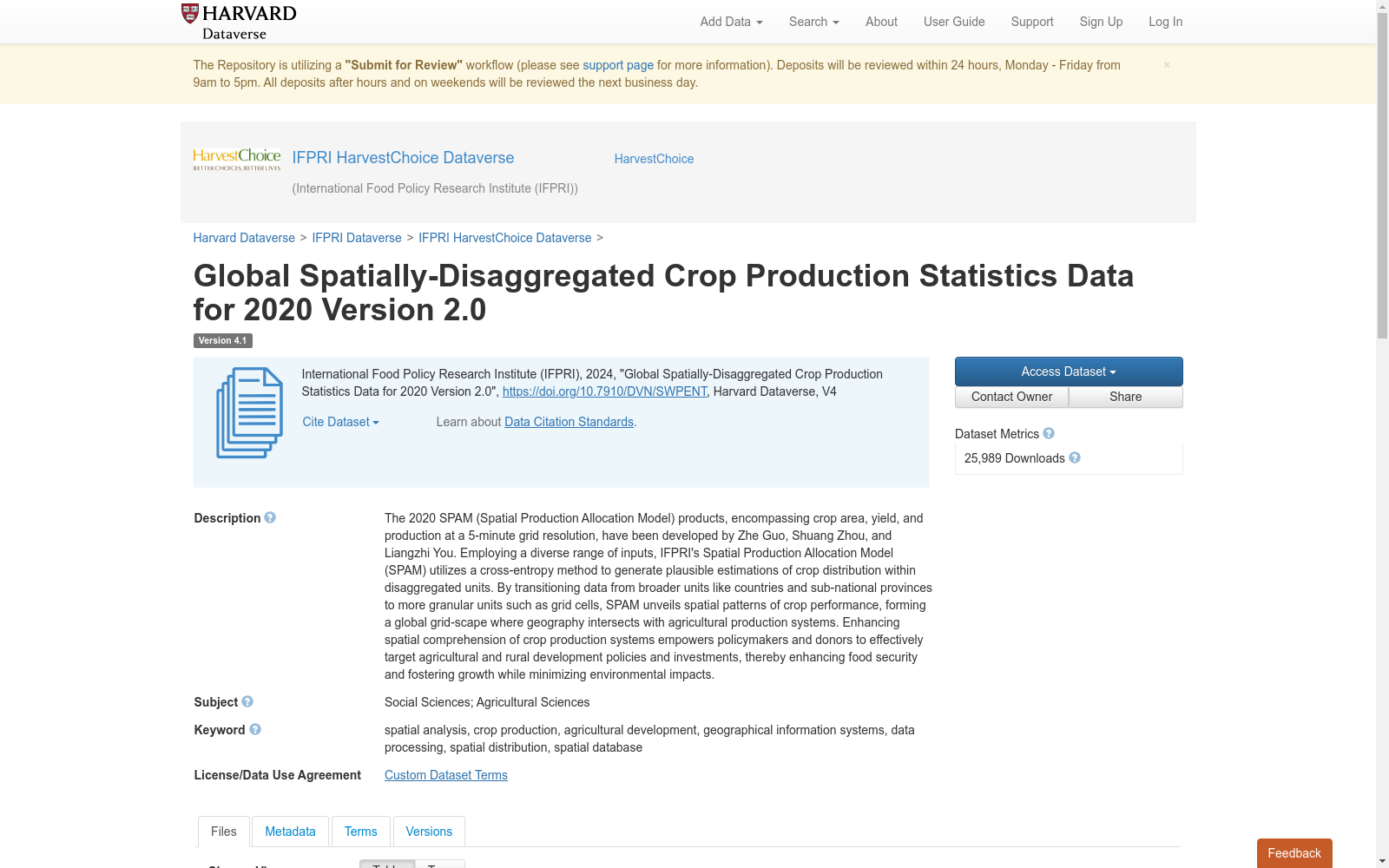
The 2020 SPAM (Spatial Production Allocation Model) products, encompassing crop area, yield, and production at a 5-minute grid resolution, have been developed by Zhe Guo, Shuang Zhou, and Liangzhi You. Employing a diverse range of inputs, IFPRI's Spatial Production Allocation Model (SPAM) utilizes a cross-entropy method to generate plausible estimations of crop distribution within disaggregated units. By transitioning data from broader units like countries and sub-national provinces to more granular units such as grid cells, SPAM unveils spatial patterns of crop performance, forming a global grid-scape where geography intersects with agricultural production systems. Enhancing spatial comprehension of crop production systems empowers policymakers and donors to effectively target agricultural and rural development policies and investments, thereby enhancing food security and fostering growth while minimizing environmental impacts.
2020年空间生产分配模型(Spatial Production Allocation Model,简称SPAM)数据集由郭哲、周爽和尤良植开发,该数据集包含5分钟网格分辨率下的作物种植面积、单产及总产量数据。国际食物政策研究所(International Food Policy Research Institute,IFPRI)的空间生产分配模型(SPAM)依托多源输入数据,采用交叉熵方法对细分单元内的作物分布开展合理估算,通过将数据从国家、省级行政区等粗粒度单元转换至网格单元这类精细尺度单元,揭示了作物生产表现的空间格局,构建起地理与农业生产系统相互交织的全球网格图景。提升对农业生产系统的空间认知,能够帮助政策制定者与援助方更精准地制定农业与农村发展政策、配置投资资金,从而在降低环境影响的同时,提升粮食安全水平并促进经济增长。
提供机构:
Harvard Dataverse
创建时间:
2024-04-09
搜集汇总
数据集介绍
背景与挑战
背景概述
该数据集提供2020年全球农作物生产的空间分布统计信息,包括作物面积、产量和生产量等指标,采用5分钟网格分辨率。数据基于国际粮食政策研究所开发的空间生产分配模型(SPAM),通过交叉熵方法生成,旨在帮助政策制定者和研究人员更好地理解农作物生产系统的空间格局。
以上内容由遇见数据集搜集并总结生成



