KRLabsOrg/lettucedetect-prose-hallucination
收藏资源简介:
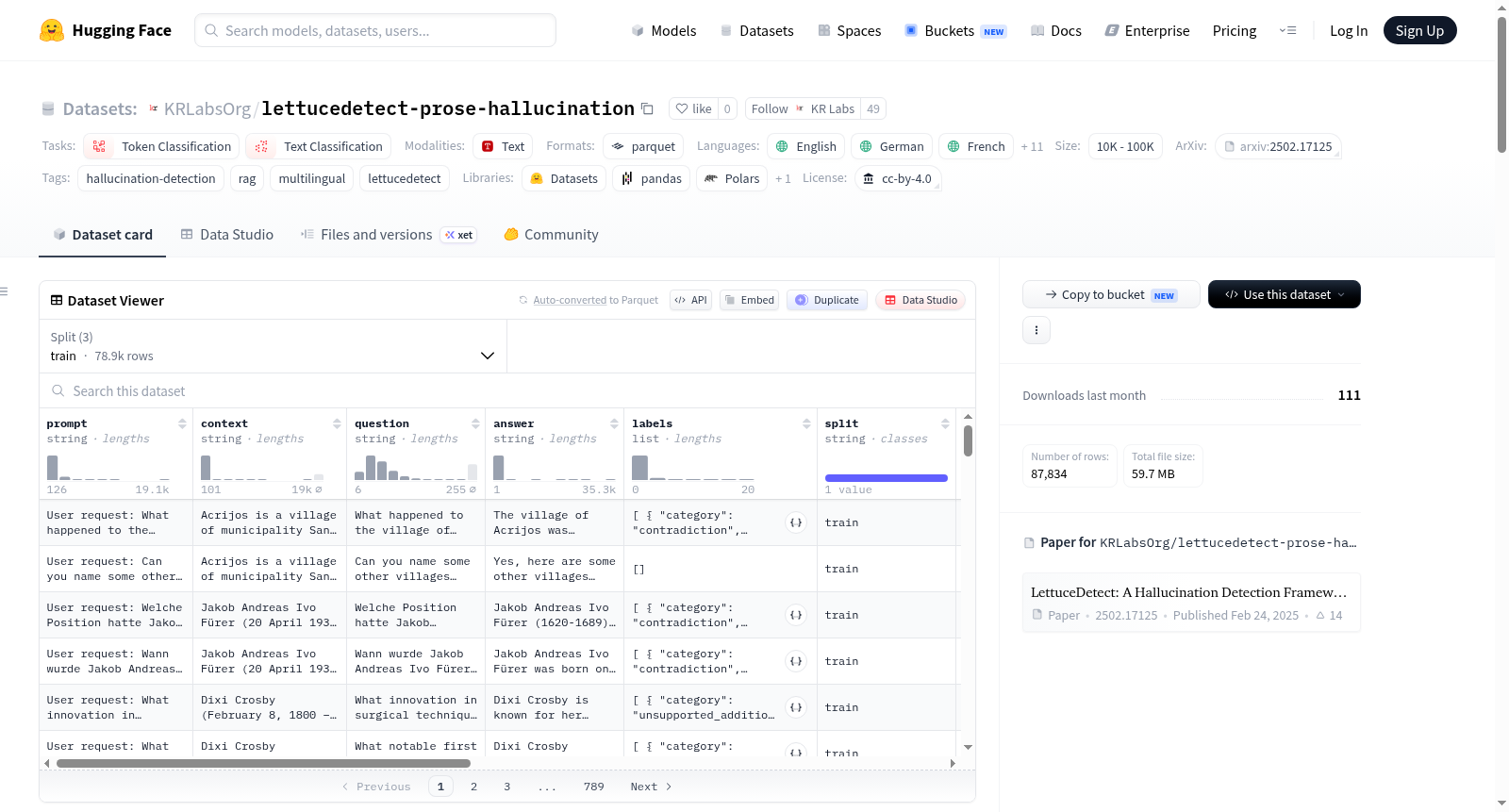
LettuceDetect Prose Hallucination Dataset是一个针对散文上下文的令牌级幻觉标注数据集,基于两个公开的RAG幻觉资源(PsiloQA和RAGTruth)构建,并映射到一个统一的分类体系。该数据集是结构化上下文(代码、工具输出、文档)数据集的对应散文版本,共同支持跨模态训练单一检测器。PsiloQA来源包含自然产生的幻觉(由真实LLM在基于维基百科的问答中生成),涵盖14种语言;RAGTruth来源包含在LLM RAG答案(问答、摘要、数据到文本)上的标注,仅限英语。数据集总样本量为87,834,分为训练集(78,882样本,其中63,349个幻觉样本和15,533个干净样本)、验证集(3,355样本)和测试集(5,597样本)。幻觉分类包括三个顶级类别:矛盾(与上下文冲突)、无支持添加(添加上下文未陈述或暗示的声称)和伪造引用(引用上下文中不存在的命名元素),每个类别有子类型。数据格式为JSONL,包含提示、上下文、问题、答案、标签、分类、来源、语言等字段。
Token-level hallucination annotations on LLM answers grounded in prose context, drawn from two public RAG hallucination resources and mapped into one unified taxonomy. This is the prose counterpart to the structured-context (code, tool output, documents) collection — together they let a single detector be trained across modalities. Two sources sit side by side: PsiloQA (natural hallucinations from real LLMs answering Wikipedia-grounded questions, spanning 14 languages) and RAGTruth (annotations on LLM RAG answers for QA, summarization, data-to-text, in English). The dataset totals 87,834 samples, split into train (78,882 samples, with 63,349 hallucinated and 15,533 clean), validation (3,355 samples), and test (5,597 samples). Hallucination taxonomy includes three top-level categories: contradiction, unsupported_addition, and fabricated_reference, each with subtypes. Data is in JSONL format with fields like prompt, context, question, answer, labels, category, dataset, language, etc.