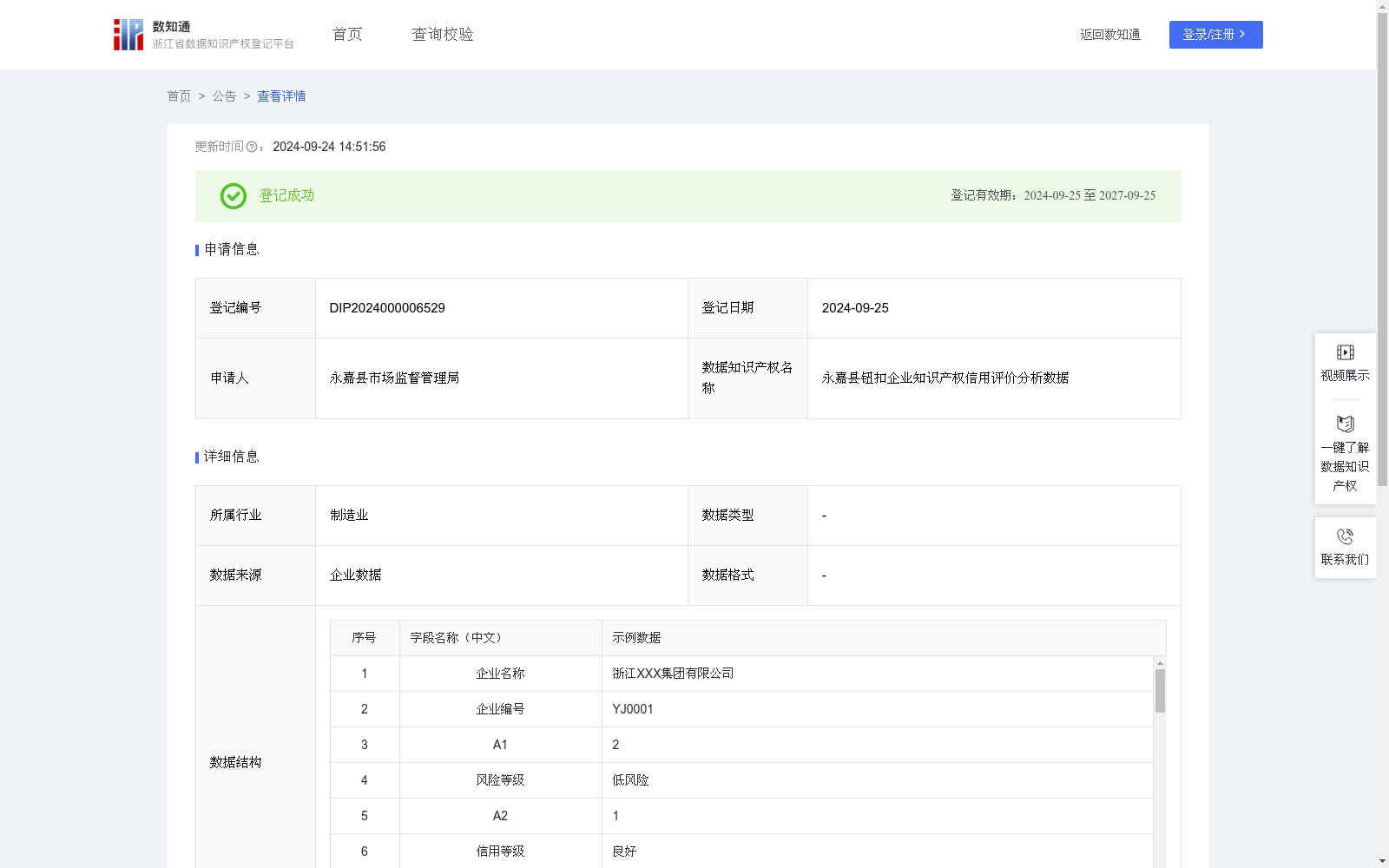
永嘉县钮扣企业知识产权信用评价分析数据
收藏资源简介:
由于钮扣产品申请专利往往以外观设计为主,导致企业间产品复制、侵权现象时有发生。为了加强行业自律,促进钮扣产业持续健康发展。因此,构建钮扣行业知识产权信用等级评价指标体系,根据知识产权领域信用监管等级评价结果(A、B、C、D),对钮扣企业等实施分类监管。对诚信行为,在资源配置、项目立项、成果奖励、创新创业等知识产权领域中给予重点支持和优先便利;对失信行为,采取重点审查、重点监督,限制或禁止其参与市监部门组织的各类认定、奖励、表彰等活动及享受市监部门财政补助和优惠;另外对于本行业外的所有企业,企业信用情况在经济管理领域中起着非常重要的作用,可以帮助所有企业识别和评估钮扣企业的信用风险情况,从而避免因客户违约而造成的损失,例如对于评优秀、良好信用的企业,可以放心合作或者降低定金比例促进双方交易量,而对于评严重失信的企业,所有企业一定需要与该企业在50%以上的定金比例上才能合作,从而避免因客户违约而造成的损失。 1.数据采集:采集企业的经营情况、风险等级、信用等级、非正常专利申请、新增专利、贯标、知识产权运营、专利示范企业、品牌情况、机构建设、参加相关培训活动、激励制度的建立及落实、相关经费投入、开展维权活动、履行公约、是否有专利代理师及建立数据库、安装区块链情况等17个维度的数据。2.数据处理:对上述17个维度分别对企业知识产权信用进行打分,打分值依次为A1、A2、A3.........A17。3.计算信用评分值M=(A1+A2+A3+......A17)。4.数据分析:根据信用评分值M对企业进行分级,M>80,评良好信用,A级;70<M≤80分,评一般信用,B级;在60<M≤70分,评一般失信,C级;M≤60,评严重失信,D级。
Since most patent applications for button products focus on design patents, product replication and infringement among enterprises occur frequently. To strengthen industry self-discipline and promote the sustainable and healthy development of the button industry, this study constructs an intellectual property credit rating evaluation index system for the button industry, and implements classified supervision on button enterprises and other relevant entities based on the credit supervision rating results (A, B, C, D) in the intellectual property field. For enterprises with honest credit records, key support and preferential conveniences will be granted in intellectual property-related domains such as resource allocation, project approval, achievement rewards, and innovation and entrepreneurship; for dishonest enterprises, key review and supervision will be implemented, and their participation in various recognition, reward and commendation activities organized by the market supervision departments, as well as their access to financial subsidies and preferential policies issued by these departments, will be restricted or prohibited. Furthermore, for all enterprises outside the button industry, enterprise credit status plays a vital role in economic management, enabling them to identify and evaluate the credit risks of button enterprises and thus avoid losses caused by customer defaults. For example, enterprises with excellent or good credit ratings can be safely cooperated with, or the deposit ratio can be reduced to increase bilateral transaction volume; whereas for enterprises with severe dishonest ratings, all enterprises must cooperate with them with a deposit ratio of no less than 50% to prevent losses from customer defaults. 1. Data Collection: Collect data across 17 dimensions, including enterprise operation status, risk level, credit rating, abnormal patent applications, newly granted patents, implementation of intellectual property management standards, intellectual property operation, patent demonstration enterprises, brand status, institutional construction, participation in relevant training activities, establishment and implementation of incentive systems, relevant fund investment, rights protection activities, compliance with industry conventions, possession of patent agents, database establishment and blockchain application status. 2. Data Processing: Score the intellectual property credit of each enterprise for each of the 17 dimensions mentioned above, with the scores denoted as A1, A2, A3, ..., A17 respectively. 3. Credit Score Calculation: Calculate the total credit score M = (A1 + A2 + A3 + ... + A17). 4. Data Analysis and Classification: Classify enterprises based on the total credit score M: Grade A (Good Credit) for M > 80; Grade B (General Credit) for 70 < M ≤ 80; Grade C (General Dishonesty) for 60 < M ≤ 70; Grade D (Severe Dishonesty) for M ≤ 60.