
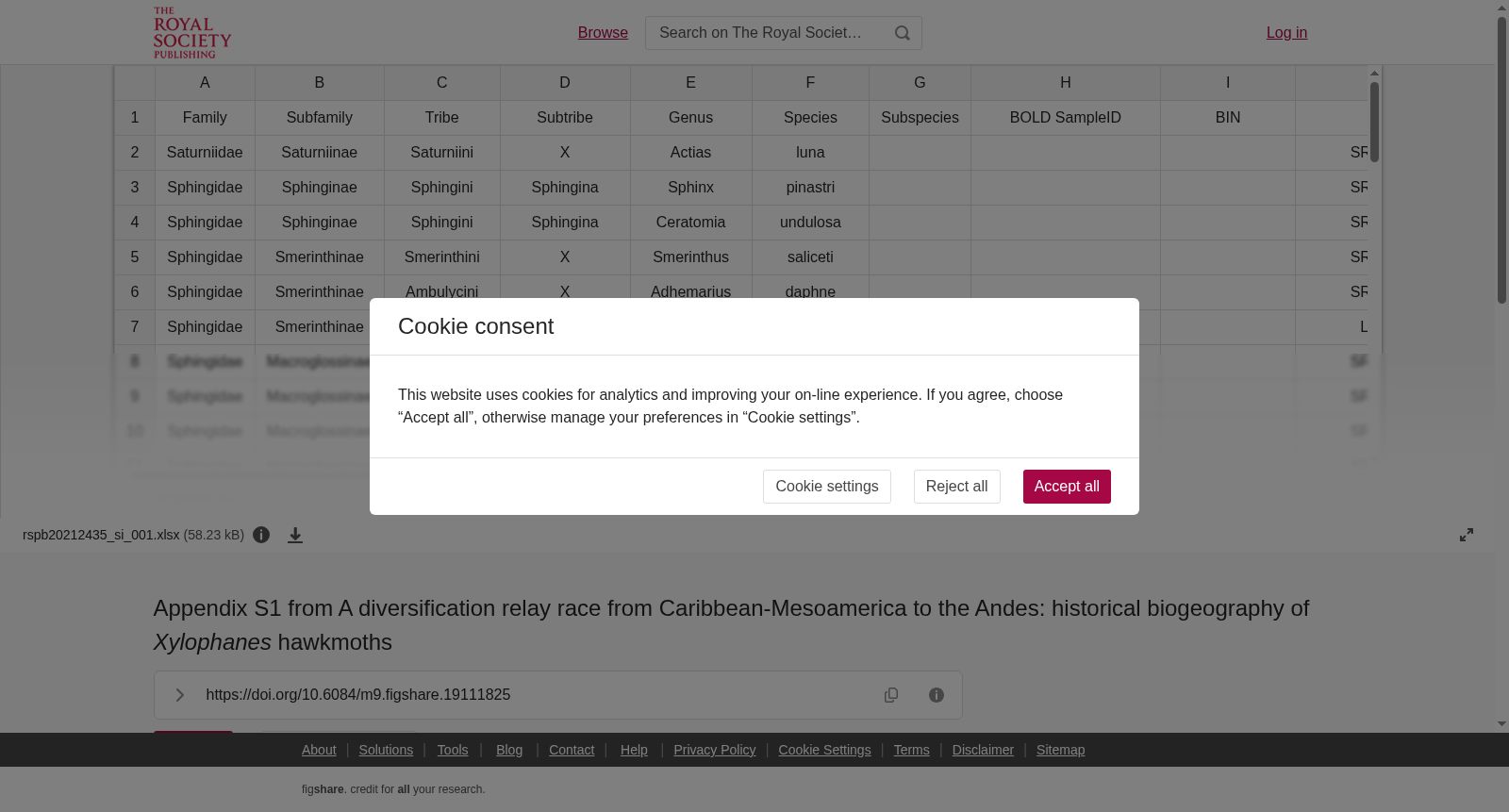
Appendix S1 from A diversification relay race from Caribbean-Mesoamerica to the Andes: historical biogeography of <i>Xylophanes</i> hawkmoths
收藏DataCite Commons2022-02-03 更新2024-07-29 收录
下载链接:
https://rs.figshare.com/articles/dataset/Appendix_S1_from_A_diversification_relay_race_from_Caribbean-Mesoamerica_to_the_Andes_historical_biogeography_of_i_Xylophanes_i_hawkmoths/19111825
下载链接
链接失效反馈官方服务:
资源简介:
The regions of the Andes and Caribbean-Mesoamerica are both hypothesized to be the cradle for many Neotropical lineages, but few studies have fully investigated the dynamics and interactions between Neotropical bioregions. The New World hawkmoth genus <i>Xylophanes</i> is the most taxonomically diverse genus in the Sphingidae, and the highest endemism and richness in the Andes and Caribbean-Mesoamerica. We integrated phylogenomic and DNA barcode data and generated the first time-calibrated tree for this genus, covering 93.8% of the species diversity. We used event-based likelihood ancestral area estimation and biogeographic stochastic mapping to examine the speciation and dispersal dynamics of <i>Xylophanes</i> across bioregions. We also used trait-dependent diversification models to compare speciation and extinction rates of lineages associated with different bioregions. Our results indicate that <i>Xylophanes</i> originated in Caribbean-Mesoamerica in the Late Miocene, and immediately diverged into five major clades. The current species diversity and distribution of <i>Xylophanes</i> can be explained by two consecutive phases. In the first phase, the highest <i>Xylophanes</i> speciation and emigration rates occurred in the Caribbean-Mesoamerica, and the highest immigration rates occurred in the Andes, whereas in the second phase the highest immigration rates were found in Amazonia, and the Andes had the highest speciation and emigration rates.
安第斯(Andes)与加勒比-中美洲(Caribbean-Mesoamerica)地区均被假说为众多新热带(Neotropical)支系的起源摇篮,但鲜有研究全面探究新热带生物地理区域间的动态变化与相互作用。新大陆天蛾科(Sphingidae)的白肩天蛾属(Xylophanes)是该科中分类多样性最高的属,其在安第斯与加勒比-中美洲地区展现出最高的特有性与物种丰富度。我们整合了系统基因组学与DNA条形码(DNA barcode)数据,构建了该属首个时间校准系统发育树,覆盖了93.8%的已知物种多样性。我们采用基于事件的似然法祖先区域估计(event-based likelihood ancestral area estimation)与生物地理随机映射(biogeographic stochastic mapping)方法,解析了白肩天蛾属在各生物地理区域间的物种形成与扩散动态。我们还运用依赖性状的多样化模型(trait-dependent diversification models),对比了关联不同生物地理区域的支系的物种形成与灭绝速率。研究结果表明,白肩天蛾属起源于晚中新世(Late Miocene)的加勒比-中美洲地区,并随即分化为五大主要演化支。该属现存的物种多样性与分布格局可通过两个连续阶段加以解释:第一阶段中,加勒比-中美洲地区的白肩天蛾物种形成与迁出速率最高,而安第斯地区的迁入速率最高;第二阶段则以亚马逊(Amazonia)地区的迁入速率最高,且安第斯地区的物种形成与迁出速率达到峰值。
提供机构:
The Royal Society创建时间:
2022-02-03
搜集汇总
数据集介绍
背景与挑战
背景概述
该数据集是研究新世界天蛾属Xylophanes历史生物地理学的补充材料,通过整合系统基因组学和DNA条形码数据,构建了首个覆盖93.8%物种多样性的时间校准系统发育树。研究揭示了Xylophanes起源于晚中新世的加勒比-中美洲,并经历两个连续阶段:第一阶段加勒比-中美洲物种形成和迁出率最高,安第斯地区迁入率最高;第二阶段亚马逊地区迁入率最高,安第斯地区物种形成和迁出率最高,解释了当前物种多样性和分布模式。
以上内容由遇见数据集搜集并总结生成


